
A day in the life of Miami hockey Head Coach Anthony Noreen
From early in the morning until late at night, follow a behind-the-scenes look at building the Miami hockey program.
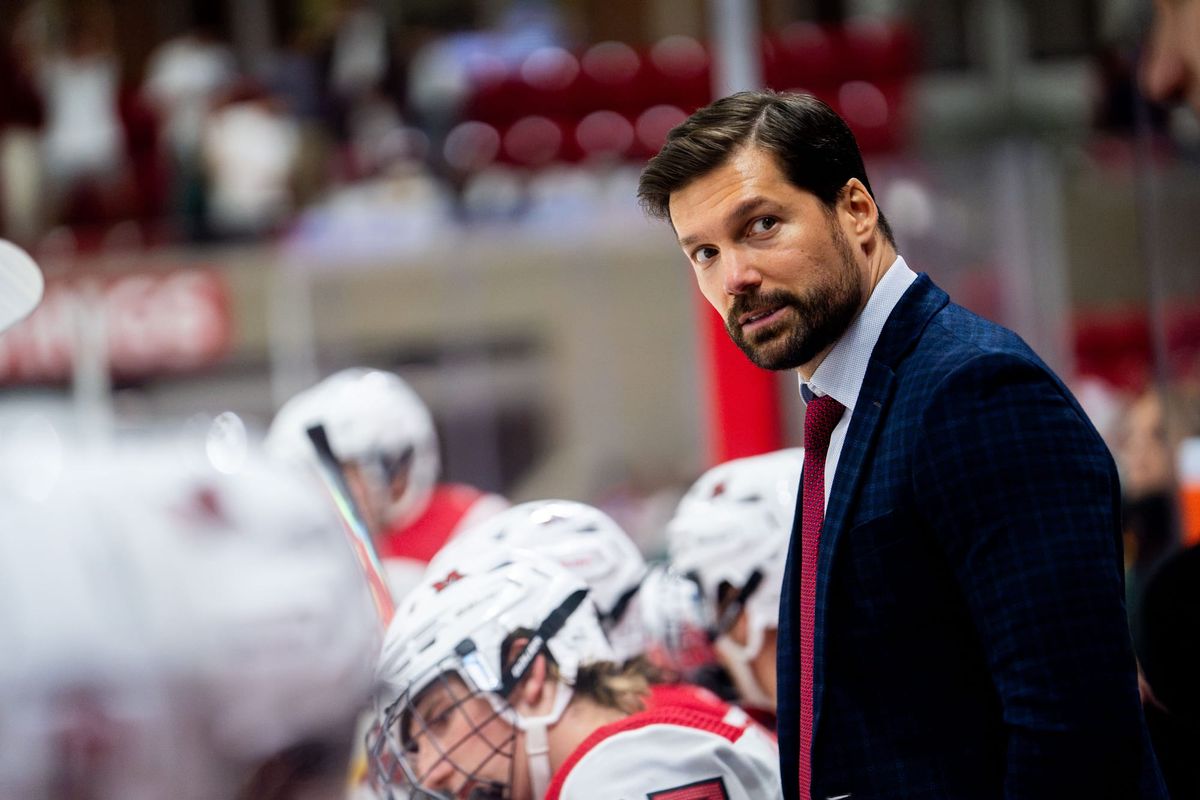
The time is 5:25 a.m. The date is Oct. 27.
The air is crisp. The sky is dark. Oxford is quiet.
Anthony Noreen rises out of bed and walks into the bathroom, where he brushes his teeth, washes his face and flips on a bright light panel, emitting waves that help with his circadian rhythm.
Then, he returns to his room and begins his red light therapy by powering on another panel. A method known for cellular regeneration, he stands in front of the light and takes in the low-level waves.
Noreen breathes deeply. He does so 29 more times. One set of deep breaths down, still standing in front of his red light panel.
The routine is not complete until 60 more deep inhales and exhales are finished. He does not waver from the panel until they are done. Then, it’s time to get ready and walk to work.
Donning an all-black – his favorite color – quarter-zip, sweatpants and shoes, Noreen strolls his way down the Miami University sidewalks and through the south part of the campus to his office. The big brick building looms large on South Oak Street across from Porter and Anderson halls on one end and a parking garage and the recreation center on the other.
Goggin Ice Center welcomes its Division I hockey head coach at 6:40 a.m.
Noreen enters through the side door of the rink, scanning his phone and walking past the big silver locker room doors with a Miami “M” inscribed on it on his left. He passes the weight room, with large silver letters above every red and black weight rack on the far wall reading “Leahy Performance Center” on his right.
On the southernmost wall of the weight room is a red and black “M” with the words “Hockey Strong” under it, and a little corner is carved out of the wall for a shooting room.
Then, on his right, he passes the Champions Room, which holds the Friendship Four trophy his team earned in 2025-26 in Belfast, Northern Ireland, along with numerous other trophies earned in tenures before his. More importantly, it holds the saying in big, bold letters, “I will leave this place better than I found it” – a motto established before his time, but one he and his players still hold close to their hearts.
Finally, he arrives at the coaches’ room, an unmarked, seemingly innocuous door in the depths of Goggin’s underbelly.
Inside the room sits Associate Coach Troy Thibodeau, who greets him with a, “What’s up, Ant?”
Around the table within the gray walls sit six black, cushioned chairs. Thibodeau sits on the far side, closest to the wall and a whiteboard with drills listed on it for the day’s practice. Noreen places his stuff in his locker in the next part of the coach’s room and makes himself a coffee in the new espresso machine.
After constructing a triple espresso Americano, Noreen sits next to Thibodeau, pulls out his laptop and begins to watch film on the RedHawks for the upcoming player meetings.
Above the table against the wall is a television that’s playing the National Hockey League (NHL) Network channel and showcasing highlights from NHL action the previous night.
The two coaches will occasionally look up to see highlights or a final score, but the focus is their own videos – Noreen with his team, Thibodeau with NHL footage to show during film sessions.
The next man through the door is Assistant Coach Lionel “Leo” Mauron at 6:55 a.m., who Thibodeau asks if he can take some hits for a drill they’re thinking of running.
“Got the shoulder pads on you?” Thibodeau asks.
Noreen gives a chuckle, but as Mauron sits down across from him, his focus is on the video of Miami’s last series against the University of Alaska Anchorage Seawolves. His eyes hardly move from the screen.
Play, pause, play, rewind, play, clip and save.
Then, he fast-forwards through the game until he finds another sequence and repeats the process.
A noise suddenly blasts in from the weight room, but it’s one the coaches have come to expect at 7 a.m. The song “One Moment In Time” by Whitney Houston floods the hallways. It has become a staple of their morning routine, and all three coaches smile and laugh as it plays.
The Miami synchronized skating team uses the song every day during morning stretches, and for the hockey coaches, it’s a nice break-up to the quiet that fills the coaches’ room.
Strength and conditioning coach Gord Farnell arrives at 7:10 a.m. and begins to prepare the weight room and other facilities for the day. Then, 20 and 25 minutes later, general manager/assistant coach David Nies and goaltending director Jimmy Spratt walk in, respectively.
Through the arrival process, Noreen continues to watch his own players’ film, but now it’s time to watch video on the group’s upcoming opponent: the St. Thomas University Tommies led by former Miami head coach Enrico Blasi.
From 7:40 to 8:00 a.m., Noreen is scanning the purple and white jerseys on the computer screen to spot a weakness or a trend they can rely on to show up when the two teams hit the ice on Friday and Saturday.
Around him, Noreen’s assistant coaches are working through the same process that he was prior to watching St. Thomas’ film. Their fingers grace across their laptop touchpads and dance around the keyboard finding clips to show players what to do and what not to when they meet with them through the day for individual film sessions.
“I wouldn’t be able to do it without those guys,” Noreen said.
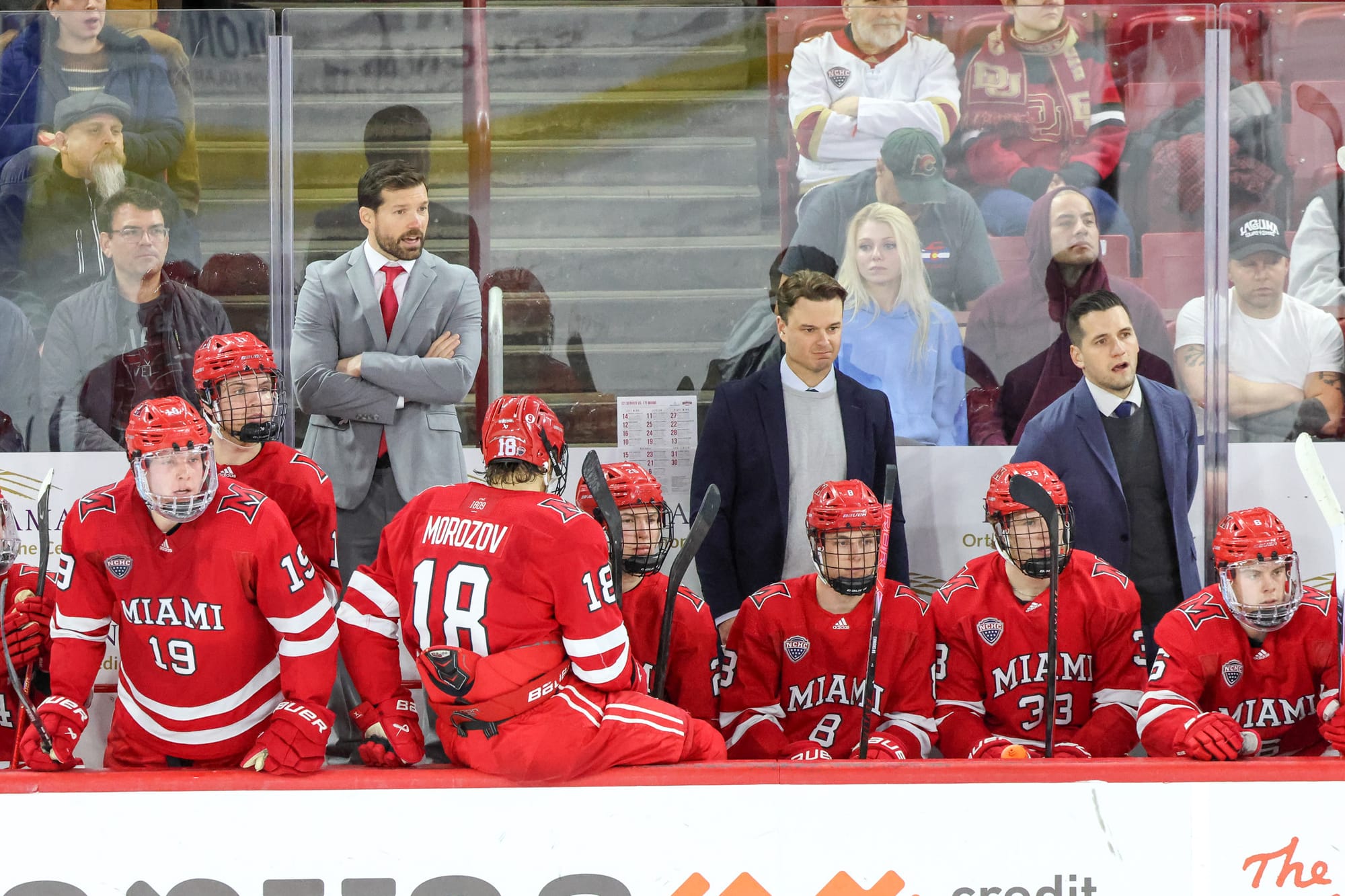
After taking down mental and physical notes, Noreen checks injury reports and begins discussing the practice drills with Thibodeau.
The day’s practice is a little different.
Instead of one big group on the ice at the same time, the forwards will be divided into two skill groups working with Thibodeau, and the defensemen will be on the other side of the ice with Mauron.
Thibodeau runs through the drills, focusing on a myriad of different small details that a fan may not even notice during a game. Hesitations, net drives, rebound shots and positioning are just some of the things emphasized in these drills that are drawn for approval and then written down by their code word on the whiteboard.
As the practice discussion winds down, the coaches walk through the connecting door, through the locker room and into the team lounge to grab breakfast. Some are more extravagant than others, but not Noreen.
The head coach doesn’t grab breakfast. Instead, he goes to mingle with the players, including a chat with freshman forward Chuck Blanchard at his locker stall before re-entering the coaches’ room and lacing up his skates for practice.
While Noreen, who is a pescatarian, has a fondness for eggs, he sticks to the same eating routine every day. He does not eat breakfast. Instead, he sits down at lunch with overnight oats combined with nuts and other protein. At dinner, he eats a mix of broccoli, sweet potatoes, rice and occasionally salmon.
At 9:15 a.m., practice begins. Noreen steps on the ice and works as a makeshift defenseman in the first drill with the forwards, and in the second drill he got to watch more and offers plenty of encouragement.
“Atta way, Blanch!” Noreen yelled.
“Oh yeah, Delly, there we go!” Noreen said later in the drill.
The first practice session ends for forwards, and Noreen leads the charge for fist bumps and talks to individual players on the ice. He skates over to watch the defenseman and gives an audible, “Oh my God,” as freshman defenseman Cal Huston rips a strong side one-timer off the crossbar and into the net.
On that note, he exits the ice to attend business calls and NCAA hockey head coaching meetings.
Following his meetings with school and league administrators in his light-yellow colored office, with a Team USA jersey signed by all of his players he coached from the 2018-19 championship World Junior A Challenge, it's lunchtime.
After finishing his overnight oats and apple, along with broccoli that was provided for the players, it was time for the third coffee of the day.
This time, Noreen doesn’t grab one from the new espresso machine or the coffee pot in the equipment room. Instead, he walks to one of two places: the Starbucks in Shriver Center or Kofenya uptown.
Usually, he prefers the local vibe of Kofenya. Growing up and living in northwest Chicago near Hiawatha Park, he felt the same way. He would try to find new local and quaint coffee shops to go to every time he wanted a java.
Plugging his wired earbuds into his phone and placing them in his ears, Noreen strolls toward the center of Miami’s campus. He listens to podcasts or takes phone calls on his walk.
“Glue Guys,” a show hosted by former National Football League quarterback and three-time Pro Bowler Alex Smith, former National Basketball Association (NBA) player and two-time champion, Shane Battier and former Chief Operating Officer and Chief Financial Officer of Instacart, Ravi Gupta, is the go-to listening experience.
Noreen grabs his latte from the to-go rack and walks back to the rink and heads up to his office, where he takes calls from multiple agents to talk about potential recruits. He gives his pitch on the program he’s building as he paces back and forth high above Steve “Coach” Cady Arena.
The end of the phone call brings a downed latte and the first video session of the day with sophomore forward and Michigan State transfer Austin Baker at 1:05 p.m.
“OK can’t be good enough for you guys,” Noreen said about Baker’s line with senior captain Doug Grimes and junior forward Ryan Smith. “You guys have to find a way to impact the hockey game. And like I’ve said, it’s going to be through your skating and your puck pressure. Then, when you get the chance, use your skill and execute. Make sense?”
The meeting only lasts 20 minutes, but it’s intense.
Baker studies with ready eyes as Noreen walks him through pieces of the game in every area – one-on-one battles, five-on-five play, breakouts, positioning and more.
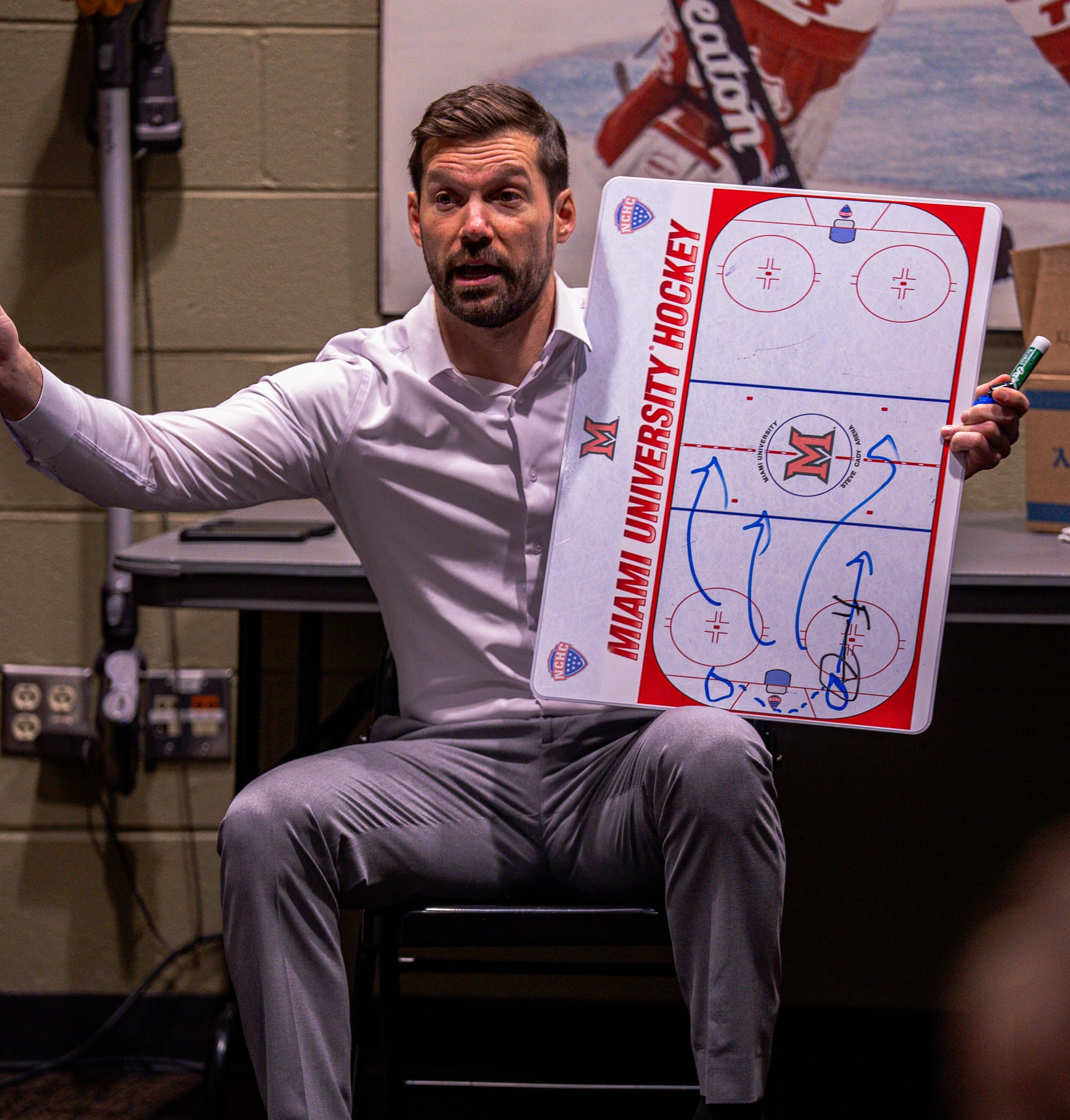
Following the departure of his third-line center, Noreen walks back to the coaches' room and sits in the same spot he did in the morning after grabbing another cup of black coffee. This time, the Pat McAfee show is on the television.
At 2 p.m., the all-staff meeting begins.
Equipment manager Andy Geshan, associate athletic trainer Michael LeRoy and Farnell join the coaching staff on the couch in the coaches’ room to discuss every facet of a hockey program, including workout schedules in conjunction with player class registration early in the morning, injuries and timelines, team gear and clothing from Adidas, travel the following week before the team’s series against the University of Minnesota-Duluth and team meals.
All of that was talked about before the coaches began informing each other about film sessions with players, recruit meetings and phone calls, agent phone calls, school and business meetings and, most importantly, the next day’s practice schedule and what to look for in the upcoming weekend.
In these all-staff meetings, Noreen sits and asks everyone their opinion. He wants his coaches to feel valued and heard.
“You’re here to coach, you’re not here to push pucks,” was a saying Noreen heard in his first coaching job at his alma mater, the University of Wisconsin-Stevens Point, under Wil Nichol, now Director of Player Development for the NHL’s Vegas Golden Knights and former Miami graduate assistant coach from 1999 to 2001. He applies that same principle to those on his staff.
But he also wants to hear about how his players are doing. He asks for the scoop on how guys are and what they might need from him. He offers his opinion, and so do the others, but the goal is to gauge how his guys are doing on and off the ice.
With all of the discussion done after 55 minutes, Noreen heads back up to his office for another video session, this time with senior forward Matteo Giampa, emphasizing physicality, leg drive and playing a strong two-way game to help him at the next level.
After the second 20-minute video session is complete, Noreen goes to the gym and works out for 50 minutes before three more phone calls, two with agents and the other with Grimes to talk about pre-game meals for the players before the weekend.
Depending on the day, Noreen may go home to make his dinner, or he may find a restaurant to go to. Afterward, he embarks on another walk to work off the food and be in nature.
As the sun sets and leaves start to fall around campus, he strolls around Central and South quads and takes it all in.
When he returns to his office in Goggin Ice Center, his phone calls begin again. From 6:30 to 7 p.m., he is on the phone nonstop with more agents for potential recruits and even players that he’s checking on who have already committed.
“Recruiting is an everyday process,” Noreen said. “There’s no other way to do it.”
Then, it’s time for his final video session of the day at 7:05 p.m. with Grimes, who leaves the meeting impressed that his head coach is still around at this hour.
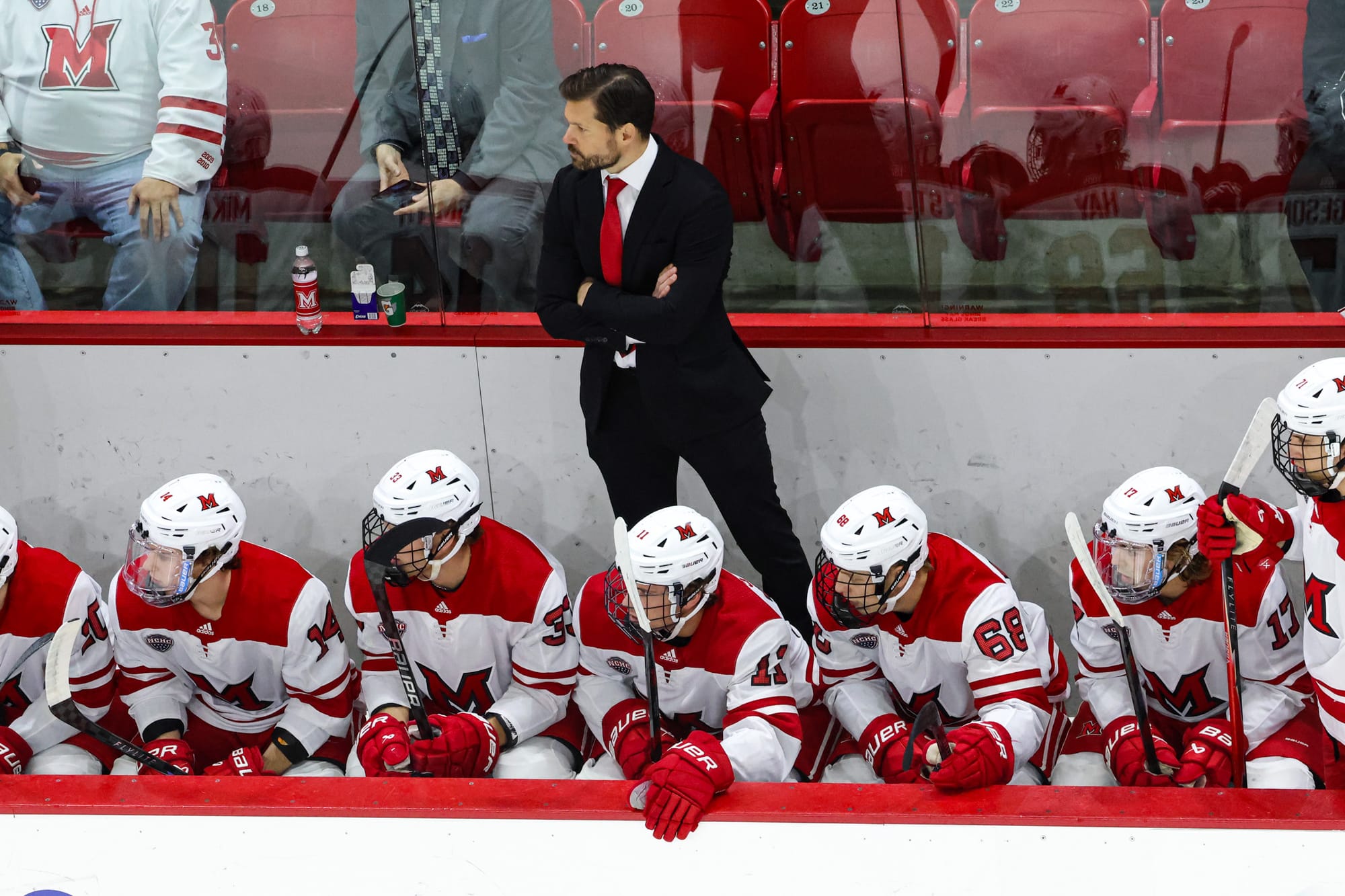
At 7:45 p.m., the day ends. Just as it was dark when he entered the rink, it’s dark as he leaves it.
Noreen walks home and begins his nightly routine. He puts his phone away and makes ginger tea. Then, he picks up and reads whatever book he is diving into at the moment.
Currently, he’s reading “The Winner Within” by Pat Riley, Miami Heat President and five-time NBA champion Head Coach, but his other recommendations include “Breath” by James Nestor on the science of breathing and anything by Ryan Holiday.
When his reading is finished, he journals about three things he’s grateful for, three things he’s striving for and three things that are important to do the following day. The clock hits 9:30 p.m., and he’s off to sleep to prepare for another day as the head coach of the Miami hockey team.
Noreen’s goal since arriving at Miami was not to build a team; it was to build a program. Travel, meals, managing coaches, managing players, meeting with administrators, preparing for the next day and the upcoming weekend, calling agents and recruiting are all important aspects of that.
However, managing himself and being disciplined is the most important of all.