

An armadillo in Oxford offers clues on climate change
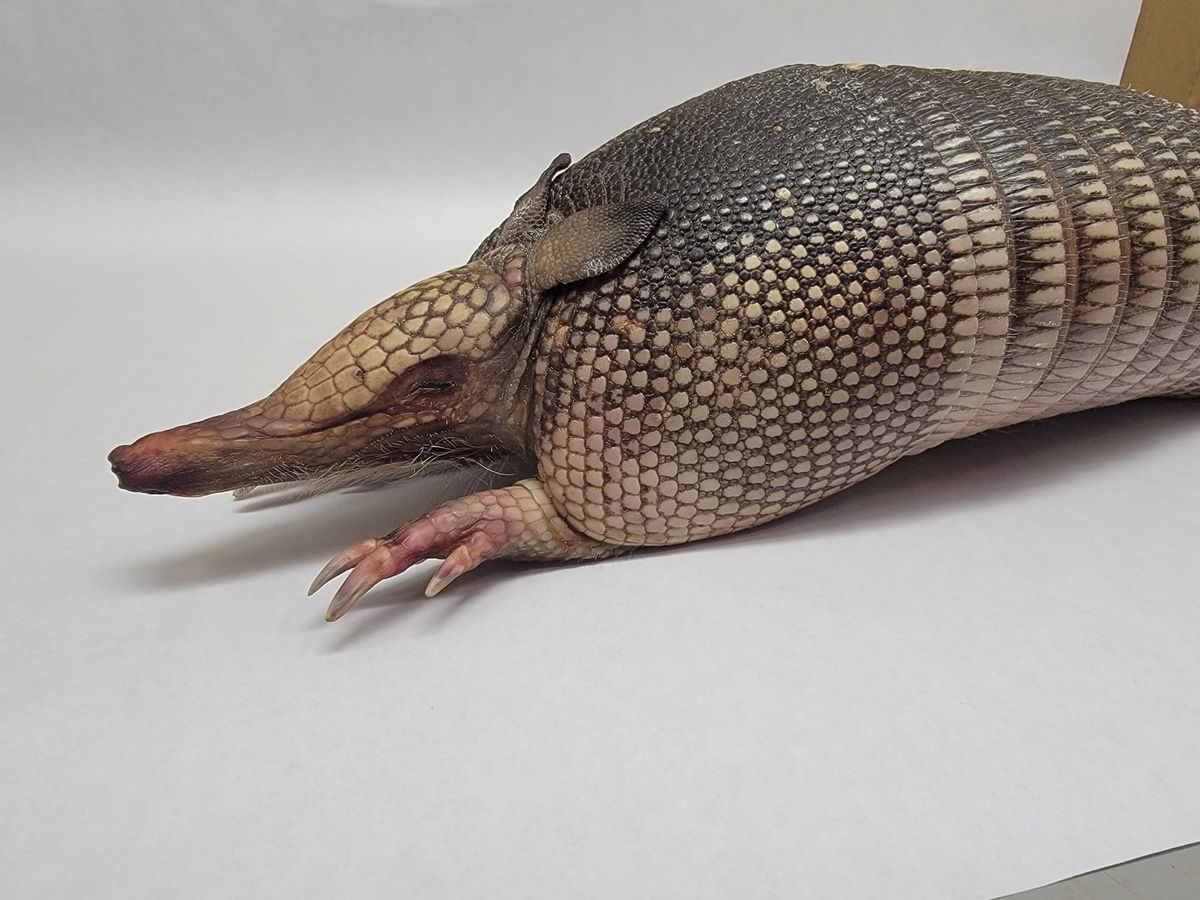
The discovery could help researchers understand how the species is expanding into northern areas
An armadillo found dead in an Oxford driveway has given Miami University researchers a rare opportunity to study how the species is adapting to colder climates and expanding farther north.
Tereza Jezkova, associate professor in the Department of Biology at Miami, first heard about the armadillo from a post in a local Facebook group.
“A lady that lives about four miles east of Oxford … posted that there (was) a dead armadillo in her driveway,” Jezkova said. “When I saw that, I immediately texted (saying) that I am going to be there in five minutes.”
Jezkova has worked with armadillos for several years, and will now work to learn more about how it came to Ohio. She said that she believes the armadillo naturally came to Oxford and was not brought up by a human.
“We are interested in how this normally tropical (and) subtropical species is capable of withstanding some of the harsh winters of Ohio and Kentucky and Indiana,” Jezkova said.
The specific specimen that turned up in Oxford is called a Mexican long-nosed armadillo, which was only found in Central America and Mexico until the 1850s. By the 1890s, the species crossed the Rio Grande and began moving north, Jezkova said.
“Throughout the 19th (and) 20th centuries, they have been expanding further into harsher and harsher climates, which is the surprising part,” Jezkova said. “(When) I came to Miami in 2017, … there were already armadillos in southern Illinois.”
Within the last few years, the animal has been reported in eastern Indiana. Climate change has contributed to the animal’s push north, Jezkova said.
“A lot of other species are expanding northwards because it’s getting warmer,” Jezkova said. “But the armadillos seem to be faster than that.”
Historically, Jezkova said, armadillos don’t have the physiology to withstand the colder northern temperatures.
“They cannot really regulate that temperature very well (and) they have to eat all the time,” Jezkova said. “Something has changed; they might have adapted or just adjusted some way that allows them to withstand climates that they were not originally capable of (living in).”
Jezkova and her team will be “using genetics as a tool to understand (the) species’ responses to environmental change.”
The team will now work to sequence the genome of the specimen, which will allow them to look at the animal’s genes and how they have adapted.
This is done by taking a genome from another armadillo specimen that was found further south and comparing the two to highlight differences, Jezkova said.
“We can detect genes that natural selection is acting on … so that the species or the population can withstand different types of environments,” Jezkova said.
Jezkova theorized the physiology of the animal may have changed, specifically in its metabolism or body temperature.
Jezkova shared her takeaways from the discovery with the Oxford Free Press: “This is showing that our earth is always changing … the species assembly is changing permanently and it is exciting.”
The specimen is currently located in the Hefner Museum of Natural History on campus, where Steve Sullivan, the director, will work to prepare the armadillo specimen, which will be stored efficiently and safely so scientists can study it for future reference.
“Through specimens, we can understand the past, interpret the present and begin to interpret the future,” Sullivan said. “Museums are fundamental to understanding the defining issue of our time – which is climate change.”