
‘An interesting journey’: Miami’s 79-year-old student encourages older people to stop limiting themselves
George “Lee” Fisher has spent his life learning and contributing as much as he can to his community. Now, he wants to encourage others his age to stop “boxing” themselves in.
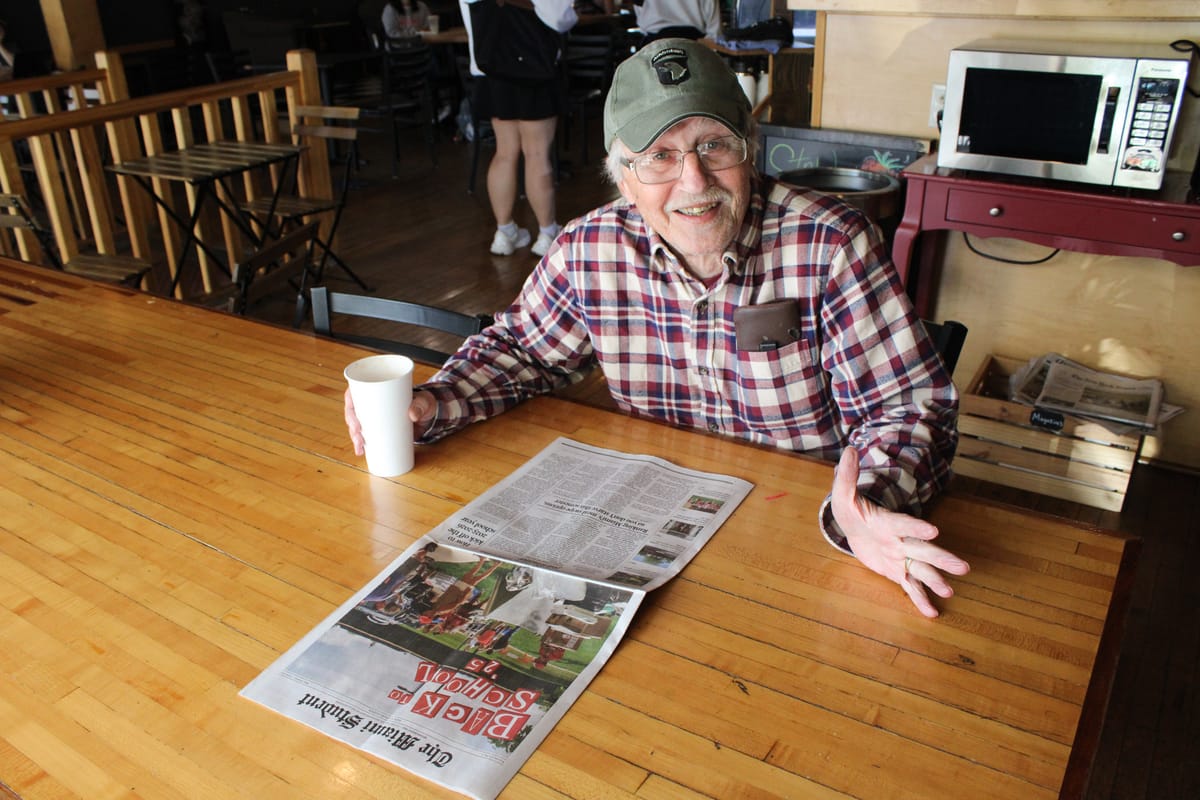
According to a business card homemade by his wife, George – better known as Lee – Fisher is a self-proclaimed “buckeye extraordinaire” from southwestern Ohio.
Fisher says on the card he specializes in “spinning tales about his wife,” “spinning tales about other men’s wives,” “the migration patterns of monarch butterflies,” “the archaeology and art of Native Americans” and “remembering the sacrifices of veterans.”
But he’s also a lifelong learner, and at 79, he wants other people his age to do what they can to “better, not just their lives, but the lives of the people around them.”
“Don’t let aging cause you to be totally self-centered because you’re still part of a community, and you can still contribute,” Fisher said. He’s now taking classes at Miami University again, 57 years after he graduated with his bachelor’s degree.
“The minute you box yourself into a corner like that … you limit your ability to learn to expand and grow.”
Fisher is a first-generation college student, and his grandfather never made it past the third grade. But a woman who graduated from Miami in 1938 became his mentor, taught him the love of reading and writing, and showed him he was capable of attending an institution of higher education.
In 1964, Fisher came to Oxford to attend Miami and would complete his undergraduate education in political science and accounting, working for four years on the railroad line that runs through Oxford to pay for school. During that time, he met his wife while singing in the choir at the Holy Trinity Episcopal Church on Walnut Street.
Life with Rosemary
“Church choirs are always lacking for singers,” Fisher said, “so the choir director at that Episcopal church said, ‘If the men don’t mind, switch to the melody when we get to this verse.’ So I did, and this girl in front of me turned on me and said, ‘What are you singing my part for?’
“That was Rosemary,” he said.
But then he was drafted, splitting the couple apart.
When he returned, just 10 days after leaving the jungles of Vietnam, he married Rosemary.
Rosemary had already started her first full-time job in Clermont County, and Fisher was trying to decide what to do with his time when he received a call from a man he knew from the railroad.
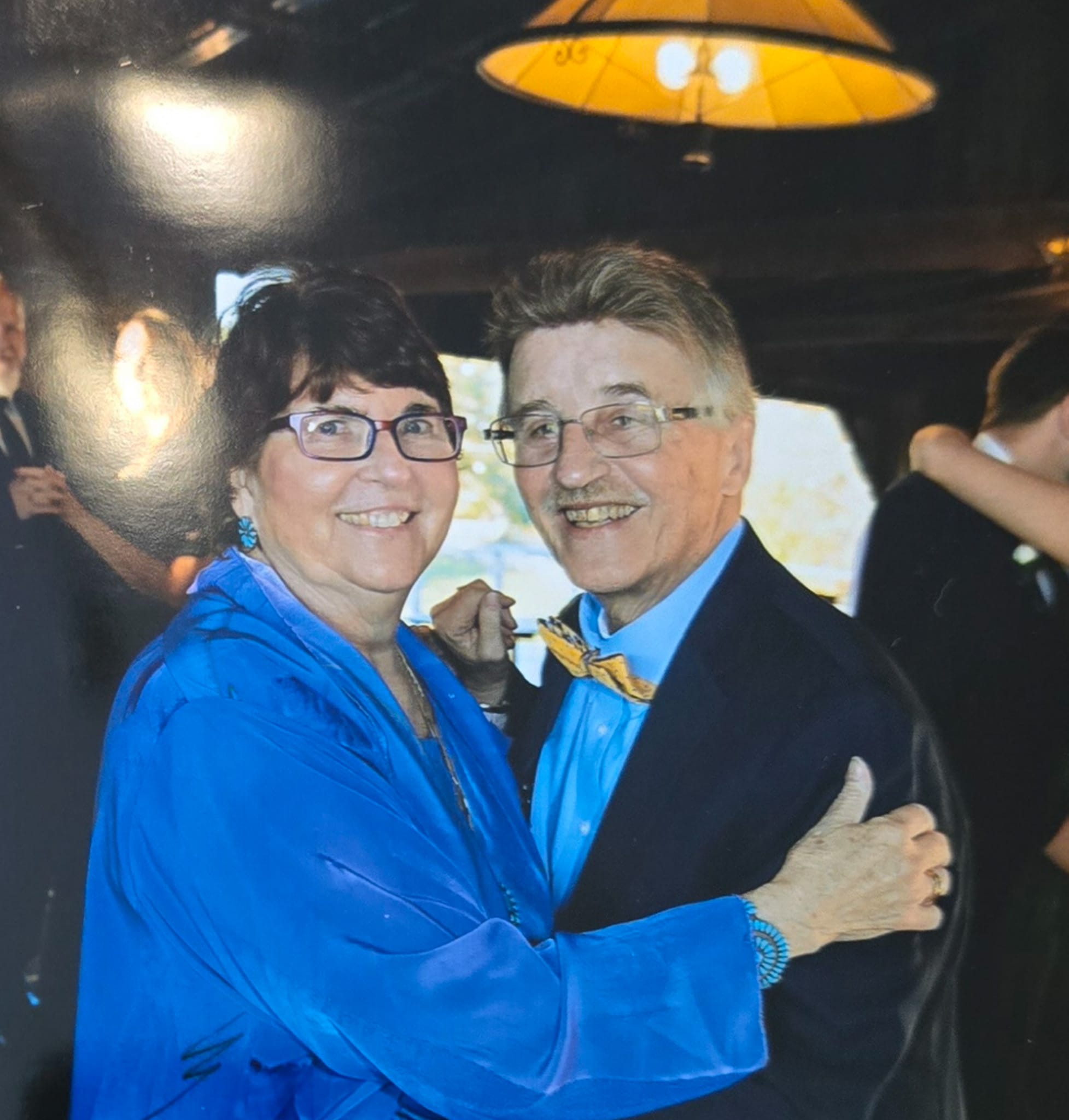
George “Lee” Fisher dances with his wife, Rosemary Fisher. Photo provided by Lee Fisher.
The man convinced Fisher to continue his work on the railroad by moving to Philadelphia around 1971, where he began his career in finance. By the 1990s, major corporations were downsizing, and Fisher was in his 50s wondering if he would be cut.
So he decided to boost his resume.
He got to work, attending night classes and studying for his broker’s license. He was certified, received his Series 7 broker’s license and worked as a financial and estate planner on the weekends with private clients while maintaining his weekly job.
Meanwhile, Fisher convinced his wife to move to an abandoned farm with him in Braxton County, West Virginia, which he bought for $50 an acre in the 1970s, and Rosemary became a “country girl by osmosis,” he said.
“It was probably because of the people there,” Fisher said. “(It was) one of the most enriching human experiences we’re ever had because, to this day, if I was sick and she called one of those families … they would say, ‘Do you need help?’ If she said ‘yes,’ they would be on their way there.
“I challenge anybody to find a group of people that way.”
That happened to him several times. Fisher said he always wanted to return to school and earn a master’s degree, but he was “wiped out” of graduate school three times by illness – once after he was accepted in Penn State, once at Temple University and again at the University of Cincinnati.
While living on the farm, Fisher was involved in entrepreneurship among other undertakings, and his wife taught elementary school.
He’d take leaves of absence from his regular job to complete work in international consulting, and in one summer, he taught transport executives how to make organizational charts in Mozambique and Swaziland in Central Africa. He once went on a rail study tour with a group of around 60 people for three months in what was then referred to as the Soviet Union.
But in 2013, when he and Rosemary became worried they would get too sick and become stuck on their farm, they decided to move back to Oxford.
Continuing education and life
By 2014, at the age of 68, he was enrolled in his first graduate class at Miami.
This semester, in the fall of 2025, Fisher enrolled in his 20th and 21st classes.
“Simply because I’ve got the time,” he said, adding that his mentor, which he called his “surrogate mother” from early on, used to always say the same phrase.
“I didn’t realize (it) was true, but I realize it’s true now,” he said. “She said, ‘Your curiosity will keep you moving forward and not backward.’ She’s right. So it’s been an interesting journey.”
Fisher had a group of adults, including his “surrogate mother” from his local community whom he said helped him along his journey. For 10 years of his childhood, he said they helped him grow, find jobs, start a savings account and get into school.
“I decided, probably in my 30s, that I had an obligation to them,” he said.
At 79, Fisher is a resident of the Knolls of Oxford senior living community, a part-time student at Miami, a member of the Miami University Men’s Glee Club, and his and Rosemary’s name are displayed on the front of a business incubator building close to Uptown Oxford.
Fisher offers his time as a consultant and on various boards and groups in the city. He’s a member of the Oxford Parking and Transportation Advisory Board, the rotary club and a flag program that displays flags around town for five holidays a year.
He’s been a big brother in the Big Brothers Big Sisters of America program and has fostered eight boys with Rosemary. He’s volunteered at the Kramer Elementary School Big Brothers Big Sisters program, as well.
He’s written columns for both The Miami Student and the Oxford Free Press.
He’s also involved in the Age-Friendly Oxford improvement initiative driven by Miami’s Department of Sociology and Gerontology that attempts to break down intergenerational barriers.
Over the years, he’s completed various overseas assignments.
Archaeology has always been a hobby of Fisher’s, for which he’s completed graduate work, including one trip where he was a crew chief on an excavation site in the Bahamas. He spent multiple summers excavating with an archaeologist from Temple University along the Delaware River. He was once considered the “archaeologist in residence” at the Butler County Historical Society, as well.
“I’ve used every skill I have to travel the world,” he said.
In the 12 years he’s been a graduate student at Miami, he estimated he’s had around 150 students eat at his dinner table. He’ll invite multiple students at a time in an attempt to teach them to “reach across” the room, abandon their social anxieties and learn to speak with one another.
He’s taken courses in topics like anthropology, entrepreneurship, gerontology and religion.
When taking classes at Miami, Fisher said he’ll sometimes offer his life experience, which he said he thinks is why professors will sometimes ask him to return. But he isn’t reaching for any particular degree or certificate.
Despite being a veteran with a lengthy career who’s flown across oceans, invested himself in many aspects of Oxford and is indefinitely furthering his education while attempting to have an impact on the younger students around him, Fisher said he feels he still has a “debt” to his country.
When asked if he thought he was repaying that debt in part by staying enrolled at Miami, Fisher said, “Yeah, I think.”
“I think I’m doing it because of the conversations I have with people 50 years younger than me,” he said. “A lot of my student friends over the years … will say, ‘Well, how did you do all this stuff?’”
Ultimately, Fisher said, “I don’t need a job. I don’t need the money, and I’m not running for political office. … I try to share with my older friends, you’re never too old to continue to learn again.”