
Local Legends: From the Cradle
One of the most notable coaches from Miami University’s “Cradle of Coaches.”
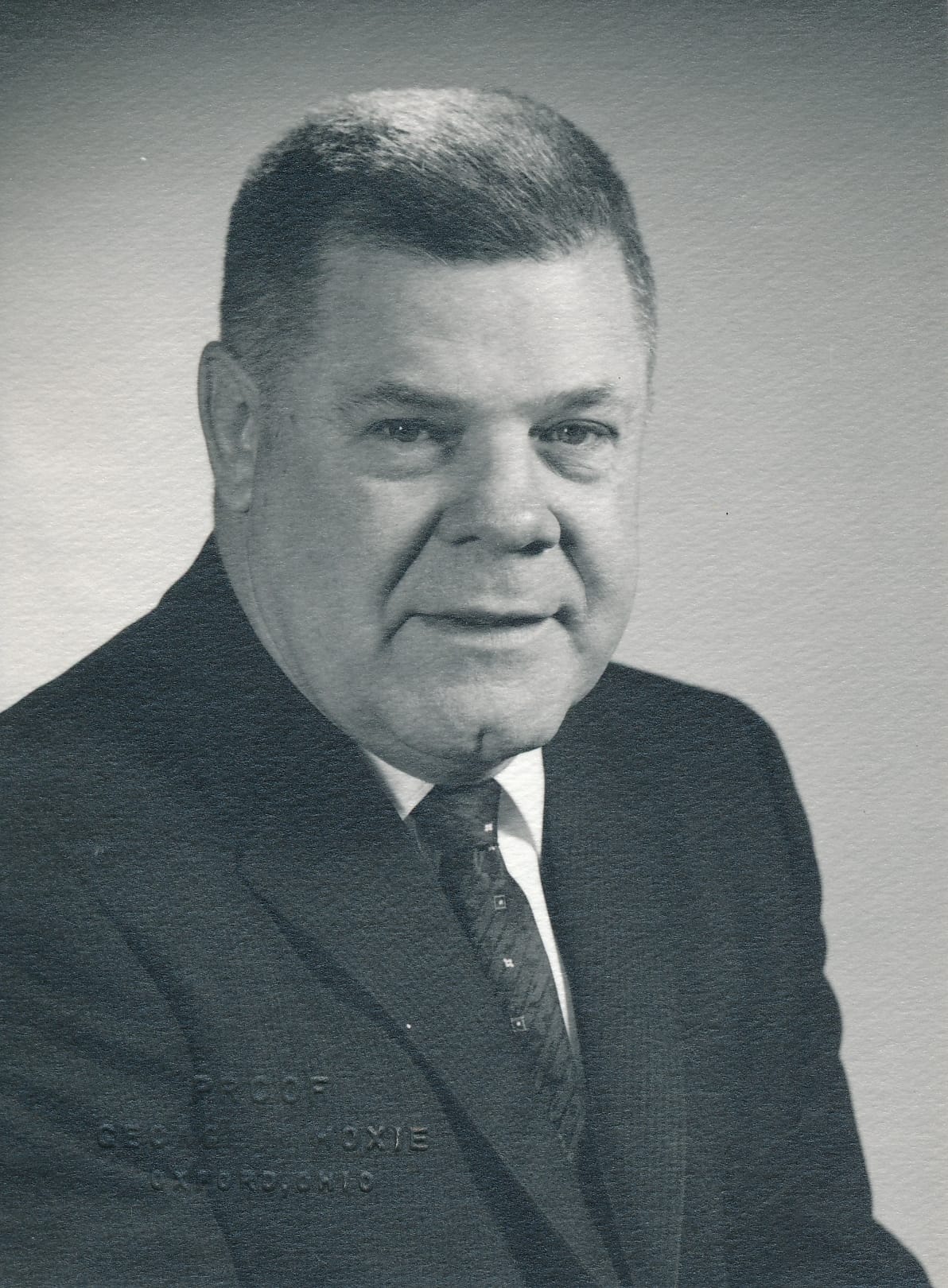
Wilbur Charles Ewbank, sometimes Ewbanks, Eubank or Eubanks in early records, rose from coaching and teaching high school to becoming one of the most notable coaches from Miami University’s “Cradle of Coaches.”
“Weeb” or “Wib,” as he was better known throughout his life due to his younger brother Myron Ewbank’s mispronunciation of his name, was born on May 6, 1907 in Richmond, Indiana at a time when football was just beginning to grow in popularity across the country. His parents were Charles C. and Stella M. (Dickerson) Ewbank. Charles loved sports and introduced his son to athletics at an early age, instilling in him the passion that would guide his life.
The predecessor to the National Football League, in which Ewbank would later play such an integral role, was just in the process of forming when he started high school at Richmond’s Morton High School. A three sport athlete, Ewbank only played football his final two years at Morton, serving as the team captain both years.
Initially playing end, he switched to quarterback his senior year, though he was said to have also been an able kicker. Ewbank’s junior yearbook recorded, “Wib won a mob of ardent followers with his I-don’t-give-a-dern-if-I-kill-ya attitude toward opposing players, big or little. He knocked ‘em for a row of goals.”
Graduating with the class of 1924 Ewbank weighed his options for college based on the likelihood that he would be able to continue playing football despite his diminutive 5’7” height. Fellow football player Bob Evans convinced him to attend Miami University and Ewbank headed to Oxford.
Miami president Raymond Hughes initiated a Physical Education and Athletic Coaching program starting in the 1925-1926 school year. Initially a business major, Ewbank switched to the new program upon its inception becoming the pupil of a cadre composed of coaches Chester M. Pittser, Roy E. Tillotson and Thomas P. VanVoorhis under the direction of professor and head track coach George L. Rider.
This would be the birth of Miami’s “Cradle of Coaches” with Ewbank being one of the first and most notable of the plethora of Miami educated coaches experiencing success at the collegiate and professional levels over the years to come. Demonstrative of his commitment to the program, in his book “Goal to Go: The Greatest Football Games I Have Coached,” Ewbank outlined his philosophy on coaching, “I believe that coaching, more than anything else, is teaching, and that’s why I love it so.”
While learning how to be a teacher and coach, Ewbank eventually once again became a three sport athlete. However, it was baseball where he stood out, not football, and in fact, he didn’t even play football his freshman year.
Lucy (Massey) Ewbank became Ewbank’s bride on June 23, 1926, the start of a 72-year marriage. Winston Hill, one of Ewbank’s professional players, later said of Lucy, “I think she was another secret to Weeb's success.” Ewbank himself called her his "number one assistant.”
The couple raised three daughters, Luanne (Ewbank) Spenceley, Nancy (Ewbank) Winner, and Jan (Ewbank) Hudson. One of Ewbank’s former collegiate players from Washington, Charley Winner, later became his son-in-law after marrying Nancy.
In 1928 Ewbank graduated from Miami and took a job as the head coach of Van Wert High School in Van Wert, Ohio, his first coaching job. However, Van Wert would prove to be just a footnote to his career and he returned to Oxford in 1930 to coach at McGuffey High School, Miami’s laboratory school for teacher training.
Being a teacher at heart and by training, Ewbank found a home at McGuffey, writing, “I tried to teach my boys how to play their game and how to conduct their lives in a way that would reflect well on themselves and the people around them…I think I taught the boys at McGuffey something about living.”
The 1940 season saw McGuffey’s team win the Little Southwestern League Championship without a single loss on their record. Ewbank reflected on the season in his book, “That may not mean as much to most people as the National Football League Championship or a win in the Super Bowl, but it meant a lot to me, and it meant as much to those boys as any super bowl victory to a pro…I’ve never since coached a team that so completely dominated its opposition.”
While at McGuffey, Ewbank also coached basketball for Miami and was briefly considered for the university’s head football coach in 1942. Instead, he was commissioned as a lieutenant in the U.S. Navy the following year and was assigned to the coaching staff of the Great Lakes Naval Training Station Bluejackets where he was reunited with former Miami teammate and Bluejackets head coach Paul Brown. Before his 1946 discharge, he had also served as an athletic officer in Memphis, Tennessee and Lexington, Virginia and as the head basketball coach back at Great Lakes.
With higher level coaching experience, Ewbank was able to secure a job as the assistant football coach and head basketball coach at Brown University after the war. He remained there for a year then moved on to St. Louis to be head coach for Washington University’s football team for a couple years.
Moving from collegiate to professional ball, Ewbank joined Paul Brown’s Cleveland Browns coaching staff in 1949. With a recommendation from Brown, Ewbank landed the job of head coach for the National Football League’s Baltimore Colts in 1953. Rebuilding a losing team, he bested the New York Giants twice in 1958 and 1959 to take a pair of NFL Championships. However, he was released by the Colts in 1962 after the few mediocre seasons that followed.
He was almost immediately picked up to be the head coach and general manager of the last place, nearly bankrupt, and recently renamed New York Jets in the fledgling American Football League. Ewbank, along with his exceptional hall of fame quarterback Joe Namath, turned the team around and captured the AFL Championship in 1968, making Ewbank the only manager ever to win championships in both the NFL and AFL. In celebrating the win his players picked him up to carry him in excitement, but accidentally dropped him and broke his hip.
Having secured the league title, the team went on to play in Superbowl III against the NFL’s top team, and Ewbank’s former team, the Colts. Despite being considered the underdogs by a huge majority, the Jets toppled the Colts earning Ewbank his only superbowl win. Ewbank continued on with the Jets for a few more seasons and retired in 1973 with a career record of 130-129-7.
In his retirement he returned to live in Oxford where he and Lucy resided for the remainder of their lives. For many years, the Cincinnati NFL alumni chapter held an annual golf tournament in Ewbank’s honor, which became a pseudo family reunion for Ewbank. Numerous other honors were bestowed upon him, including his induction into the Pro-Football Hall of Fame with the Class of 1978.
It was hard for the old coach to stop teaching and he greatly enjoyed offering insight to young Miami players, even in his retirement. Miami Athletic Director Dick Shrider shared that "Weeb was always available to the athletes…he loved Miami University and anytime we called on him he was available to help us in any way he could."
Ewbank died in his sleep on Nov. 17, 1998, at age 91, at his home in Oxford and is buried in Oxford Cemetery. Lucy survived him to the age of 105, dying on Jan. 16, 2012.
Brad Spurlock is the manager of the Smith Library of Regional History and Cummins Local History Room, Lane Libraries. A certified archivist, Brad has over a decade of experience working with local history, maintaining archival collections and collaborating on community history projects. He also serves as a board member for Historic Hamilton Inc. and the Butler County Historical Society.