

Local Legends: Much faithful work
"Iliff-Davis took up the cause of temperance, becoming a charter member of the local Daughters of Temperance when it was formed in 1844. She would also later be a member of the Temple of Honor and the Good Templars, other temperance organizations."
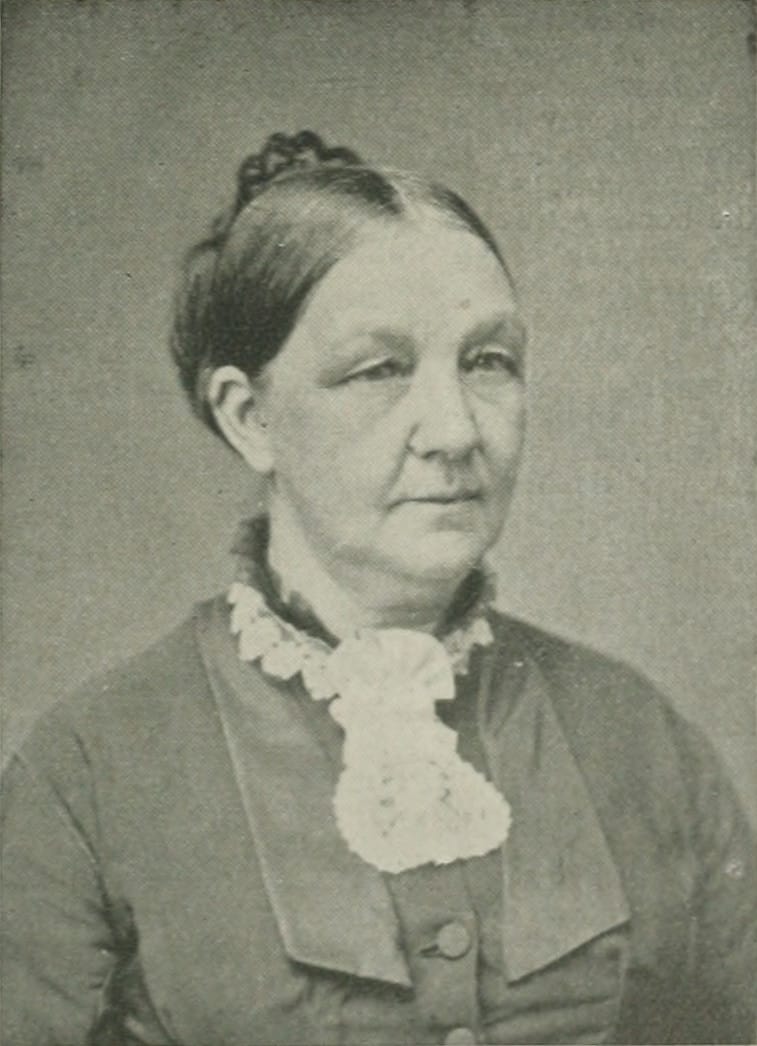
Although a native of Oxford, Sarah Ann (Sausman) Iliff-Davis made a name for herself conducting business, pioneering social movements and promoting women’s causes in Richmond, Indiana.
Iliff-Davis was born in Oxford on Feb. 19, 1820. Her parents’ first names are unconfirmed, though her maiden name was Sausman and her mother’s maiden name was Ward. According to her death certificate, her father, a German immigrant, was named Joseph, while her mother’s name is illegible and may have been Sheba, Rheba or Rheta. The 1830 census for Oxford shows only a Daniel Sauceman residing in the village, though Daniel is shown with a wife and a daughter under ten years old.
When Iliff-Davis was 12, in 1832, the family left Oxford for Richmond, Indiana where she would live for the remainder of her life. Her experience with supporting the people of her community began when she became a teacher for the inaugural Sunday school class at Richmond’s Methodist Episcopal Church, having joined the church around 1835.
This led to a brief teaching career as a hired instructor, but Iliff-Davis quickly found that education wasn’t her calling. As a young woman at the age of 18, she went into business for the first time, operating a millinery where she sold women’s hats, accessories and related products. The local Quaker community proved to be a strong customer base and she conducted her business in Richmond for the next 66 years.
She married her first husband, John K. Iliff, on Feb. 23, 1841 and together they raised Mary (Iliff) Strattan, Joseph P. Iliff, Catherine P. “Kate” (Iliff) Engle, John Edgar Iliff and William S. “Will” Iliff. Two other sons were lost in infancy.
Iliff-Davis took up the cause of temperance, becoming a charter member of the local Daughters of Temperance when it was formed in 1844. She would also later be a member of the Temple of Honor and the Good Templars, other temperance organizations. As a hobby she wrote poetry.
With the onset of the American Civil War, Iliff-Davis sought to be of service and, as president of the society, organized for the Women’s Aid Society of the Union Chapel ME Church to begin packing bandages to send to the front lines. In recognition for her successful work, Governor Oliver P. Morton appointed Iliff-Davis as president of the Indiana State Sanitary Commission where she served throughout the war.
Her work also extended to the children of those who were killed in battle or died in service. Following the cessation of hostilities, Iliff-Davis was a promoter for the creation of the Indiana State Soldier and Sailors Orphans Home. In the aftermath of the war, she also worked to assist the Freedman’s Aid Bureau and was a member of the Women’s Relief Corps of the Grand Army of the Republic.
While working on her lobbying efforts and running her business, Iliff-Davis was also taking care of her husband who was suffering from a long illness that would ultimately result in his death on Nov. 9, 1867. Three years later, on April Fool’s Day in 1871, she married for a second time, wedding widower Benjamin W. Davis. Davis was the editor of the Richmond Palladium and the city’s postmaster. While variations exist in historical records, most show that Iliff-Davis chose to retain the surname of her first husband, hyphenating it with that of her new husband.
The following year, she and Rhoda M. Coffin, who was described as “a pioneer minister of the Friend’s Church,” partnered with the Richmond YMCA to create the Home for Friendless Women. For the next 20 years, Iliff-Davis served as president of the organization with Coffin serving as vice president. In her annual reports for the Home for Friendless Women, Iliff-Davis listed new arrivals to the home as, “admitted as members of the family.”
With stories of abuse at the hands of male guards emanating from women prisoners of the Indiana State Penitentiary, Iliff-Davis and Coffin, in 1870, made an appeal to the Wayne County commissioners to send women convicted of crimes to the Home for Friendless Women instead of the state penitentiary. By successfully arguing their case, the two protected the well being of women offenders while also providing a place where they could serve out their sentences.
Their first woman inmate arrived the same day that the approval was received and Iliff-Davis and Coffin set about arranging for the construction of an addition to the home to house the inmates. Coffin went on to champion the establishment of the first exclusively female state prison in the United States with the opening of the Indiana State Reformatory for Women in 1873.
Iliff-Davis lost her daughter Mary on Aug. 31, 1873 and her husband on May 3, 1885. While she remained a Methodist for the entirety of her life, she also appears in surviving records of the Religious Society of Friends.
Throughout this period, Iliff-Davis continued on with her business and with the Home for Friendless Women. A newspaper ad from 1877 read, “Sarah Iliff Davis, the pioneer milliner on North Franklin Street wishes to inform her old-time customers, as well as the young ones that continue to fill up the ranks, that she has new attractions for all in her fall invoices, and can offer big inducements on last year’s prices. The young ladies particularly, will find it a pleasure to inspect her new goods.”
That same year, Iliff-Davis published her ninth annual report for the Home for Friendless Women, showing that the organization housed 20 women and 18 children, procured homes for 15 women and 8 children, transferred two women to other institutions and cared for 21 incarcerated women.
The “Richmond Independent Telegram” recognized Iliff-Davis on her 59th birthday, “She has done much faithful, self-sacrificing work.” In 1893, she was profiled in the work “A woman of the Century: Fourteen Hundred-Seventy Biographical Sketches Accompanied by Portraits of Leading American Women in All Walks of Life.”
Iliff-Davis finally retired in 1904, at the age of 84, and died in Richmond five years later on Sept. 28, 1909. Her friend and long-time collaborator, Rhoda M. Coffin, died the exact same day 200 miles away in Chicago.
Iliff-Davis was buried in Earlham Cemetery, along with her daughter and both of her husbands.
Brad Spurlock is the manager of the Smith Library of Regional History and Cummins Local History Room, Lane Libraries. A certified archivist, Brad has over a decade of experience working with local history, maintaining archival collections and collaborating on community history projects. He also serves as a board member for Historic Hamilton Inc. and the Butler County Historical Society.