

Media Matters: Good news, bad news
“Every generation trusts its newspaper more than other media, but here’s what may surprise some publishers: Millennials lead the way at 54%. Boomers (at 53%) aren’t the only ones who value their newspaper.” – Dean Ridings, president and CEO of America's Newspapers, 2026
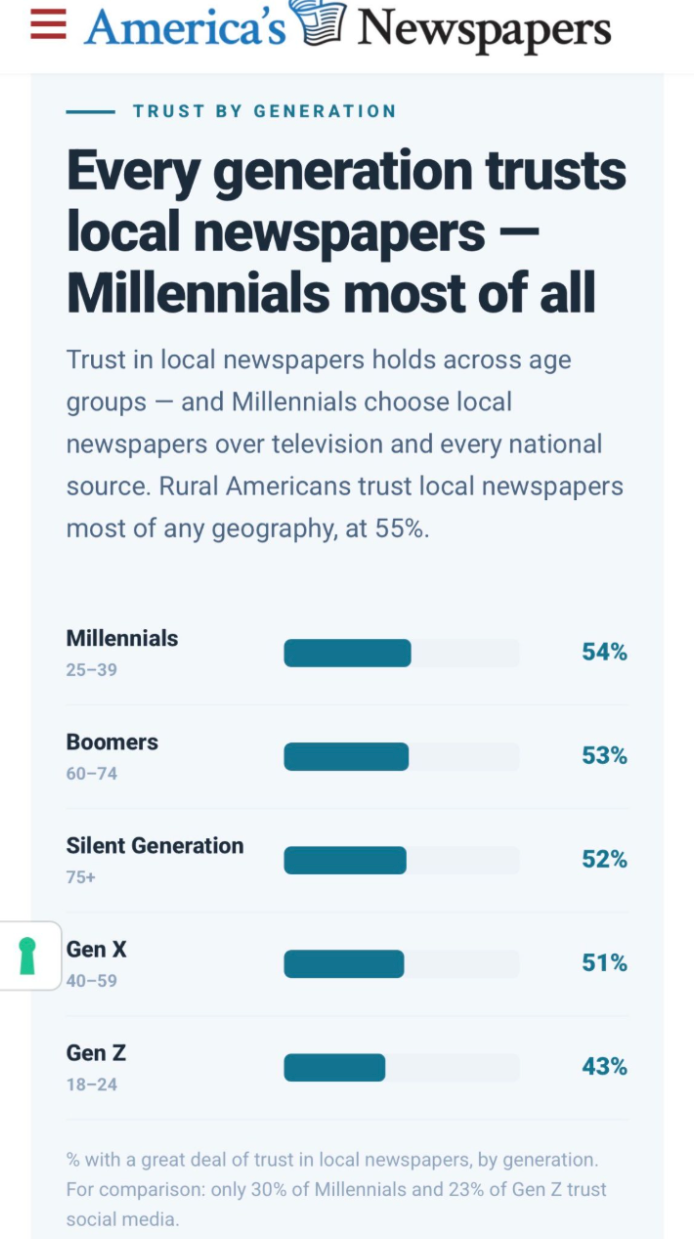
First, the bad news.
Just out is the latest U.S. local news study from the Northwestern University’s Local News Initiative: “In the past year, 170 newspapers have closed or merged, at a rate of nearly three a week, and many of these were the last remaining source of original news in their communities.” The number of counties that are now news deserts – “places where there is no locally based source of professional local news remains” – has risen to 238. We also know from Rebuild Local News that 25 years ago, there were 40 reporters for every 100,000 residents, but today there are fewer than eight per 100,000.
In another key finding, Rebuild Local News and Muck Rack reported in their study of news websites during the first quarter of 2026 that “nearly 77% of U.S. counties produced zero education articles mentioning a local community during those three months. Some 76% had no local articles about health.” Also, in communities with no journalists reporting on local government, costs for municipal borrowing were 17% higher than in communities with reporters, aligning with “studies showing that news deserts raise such costs by at least $1.1 billion across the U.S. annually.”
Now, some good news.
In that same Rebuild Local News study, researchers found that communities “with more local journalism per capita score higher on the Civic Participation Index, which includes measures of voting, volunteering, charitable giving and community involvement.”
To bolster journalism, at least 20 states have either passed legislation or are working on laws to support local reporting. The single most hopeful development happened Sept. 30 when California Governor Gavin Newsom signed the Community NEWS (Newsroom Employment and Workforce Sustainability) Act (AB 2222) into law.
Sponsored by Rebuild Local News, the law “creates refundable tax credits for local news organizations based on the number of journalists they employ.” Rebuild Local’s press release notes that this “landmark” legislation will provide more than $200 million over a 5-year period to California news outlets “that hire or retain local journalists.” Representing the nation’s largest state investment in local news – “a model for other states” – the bill provides:
- $20,000 per reporter “for up to five full-time positions each year, plus $15,000 for each additional journalist”
- $15,000 for new hires
- $7,500 credits for part-time reporters
A coalition of more than 150 local, state, and national organizations in California supported this effort, “making employment tax credits available to eligible community news providers across print, digital, broadcast, and public media, regardless of whether they operate as for-profit businesses, nonprofits, or sole proprietorships.”
In states that have yet to address the crisis in local news – including Ohio – it’s often up to the community to support the newspaper, as is the case of the Oxford Free Press, where roughly 60% of our revenue comes from our donors, allowing us to grow our reporting staff from one in 2024 to three full-time journalists today.
In his new book, “Deserted: Life Without Local News in Rural America,” University of Missouri journalism professor Nick Matthews tells this story of a rural Virginia newspaper, The Recorder: “In April 2020, at the height of the coronavirus pandemic (when two-three U.S. newspapers a week shut down), Anne Adams, the owner, publisher, and editor of the nearly 150-year-old weekly newspaper for the last three decades, wrote an editorial to her readers,” telling them that “the newspaper … had just five weeks left before shrinking finances would force its closure.” Mathews recounts what happened next: “The community came to the rescue. Nonsubscribers started subscriptions. Subscribers extended subscriptions into the future. Businesses bought advertising. Donations came in droves.”
In 2023, a neighboring newspaper, the Foothills Forum, profiled Adams, calling what happened “a small-town success story.” Adams told the Forum that The Recorder has not missed an issue “since October 1877 and I didn’t want to miss one on my watch.” The Forum article noted in closing that Adams was determined that her paper keep living up to its slogan: “Inclusive, Independent, Indispensable.”
Dean Ridings, president and CEO of America's Newspapers, which advocates for “family-owned, independent and group-owned newspapers,” notes this recurring finding in his foundation’s recent study: “When Americans rank the media they trust, local newspapers come out on top.”
He wrote these cautionary but encouraging words in a recent essay in Editor & Publisher: “The challenges facing newspapers aren’t going away, and AI will only add to the disruption. But in the race to compete with technology, newspaper publishers shouldn’t overlook what technology can’t provide. You know the people, the businesses, the schools and the issues that matter to your communities. That local connection is your superpower.”
Richard Campbell is a professor emeritus and founding chair of the Department of Media, Journalism & Film at Miami University. He is also a co-founder of the Oxford Free Press.