
Miami committees receive updates on new rec fields, arena costs

Students to see rise in tuition, faculty pay still not agreed on
The Miami University Investment and Finance and Audit subcommittees were given updates on the costs and progress of the expected multipurpose arena project the day before a Miami Board of Trustees meeting on May 15.
The trustees approved the construction of a $280 million multipurpose arena on Cook Field, a campus green space, during a meeting on Feb. 27. According to renderings provided to the board, the arena is projected to be a 223,532-gross-square-foot facility.
The renderings also showed a hotel, a development space for a potential conference center and a new parking lot on the site of Cook Field.
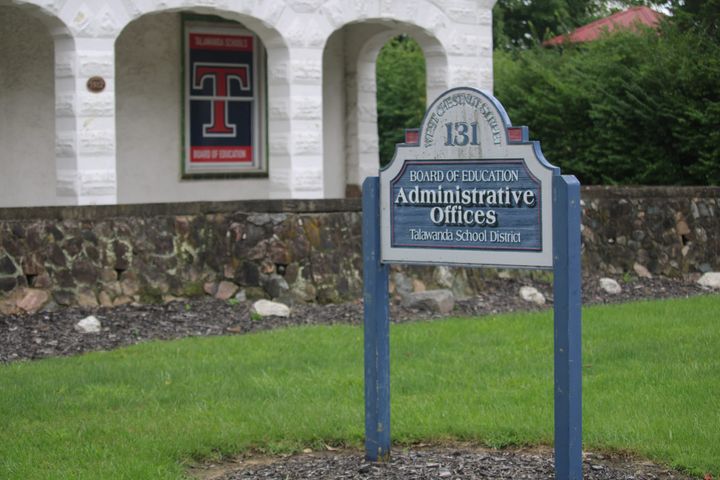
Board members were told the new recreational facilities to replace those at Cook Field would be located at Millett Hall and Chestnut Fields, or formerly the site of Talawanda High School, which was purchased by Miami from the Talawanda School District Board of Education in 2013.
New recreation space
On May 14, Vice President of Facility Planning and Operations Cody Powell told the Finance and Audit Committee the university has already begun leveling and prepping the land at the two sites. He said about 5 acres of artificial turf will be installed on Chestnut Fields, which is equivalent to the turf area of Cook Field.
Powell said the dirt removed from the Chestnut Field area was relocated to the south lawn of Millett to level the space. About an acre and a half of turf will be installed next to Millett, and both fields are expected to be open to students when they return to campus in August.
The Chestnut Fields will support two full-size soccer fields, two softball fields and three flag football fields, according to a news release from Miami. It will also include concrete walks, lighting, a plaza with benches and a drinking fountain.
Powell said the south lawn of Millett will support intramural soccer and flag football, and the university will be installing lit pickleball, tennis and basketball courts. A dog park will be installed in the grassy area across Weeb Ewbank Way. A walking trail will also be installed, which he said will travel across Weeb Ewbank Way and around the courts, with some outdoor workout stations incorporated along the trail.
The additional installations at the south lawn of Millett are expected to be complete by the end of September, according to the release. Relocating the recreational facilities is costing the university $13 million.
The walk for students from Cook Field to the south lawn of Millett is about 17 minutes, while the walk from Cook Field to Chestnut Fields is nearly 30.
Millett is still part of campus, so the pedestrian infrastructure exists to support students walking to and from the south lawn, Powell told the Oxford Free Press following the May 14 meeting. As for the Chestnut Fields, he said Miami might consider partnering with the city to make pedestrian improvements along Chestnut Street.
Powell said Miami has also worked with the Butler County Regional Transit Authority (BCRTA) to find how to best access the fields if there’s a student interest in using transportation. Students living both on and off campus have free access to the BCRTA buses.
Construction on the multipurpose arena is scheduled to begin following the completion of the new recreation fields and is expected to be finished by fall 2028.
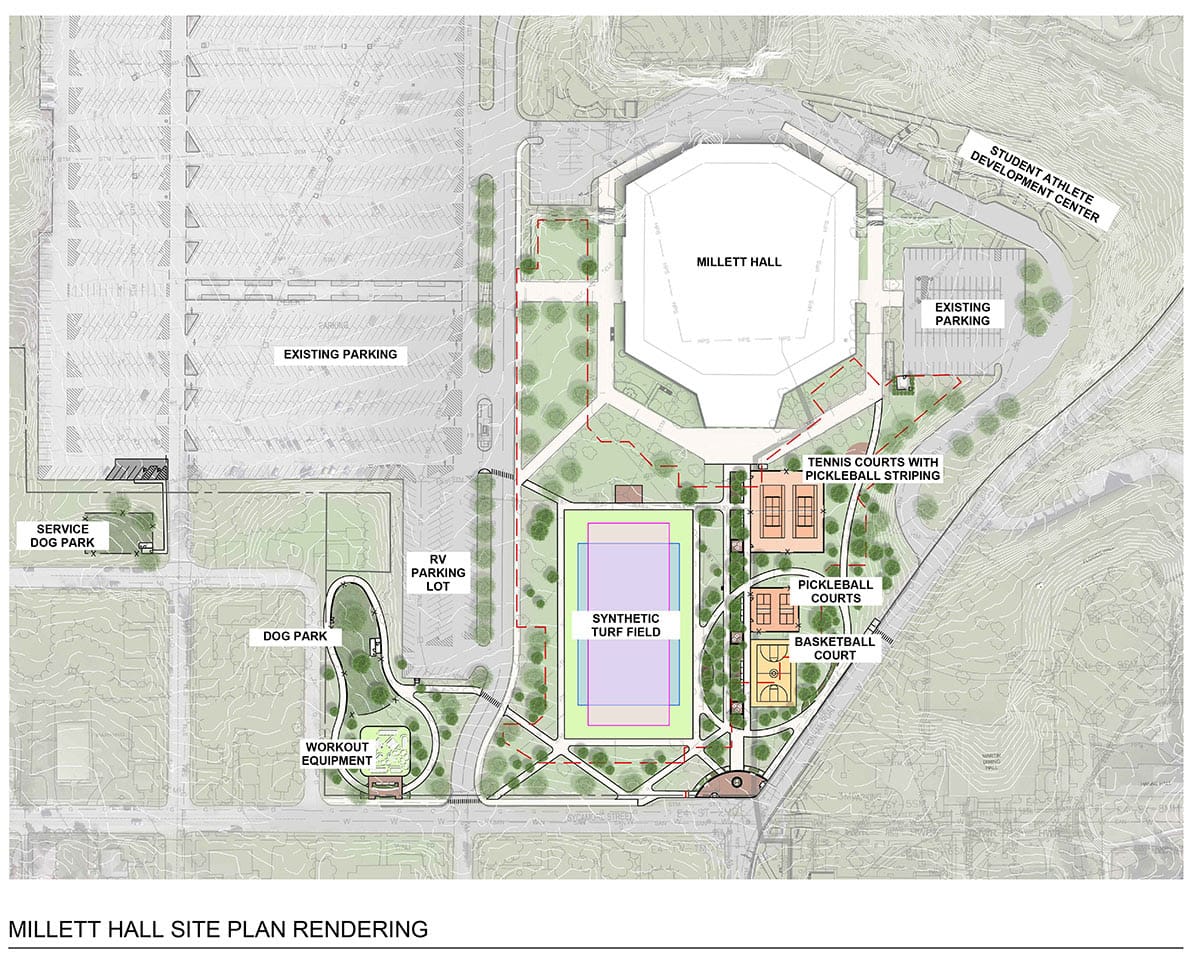
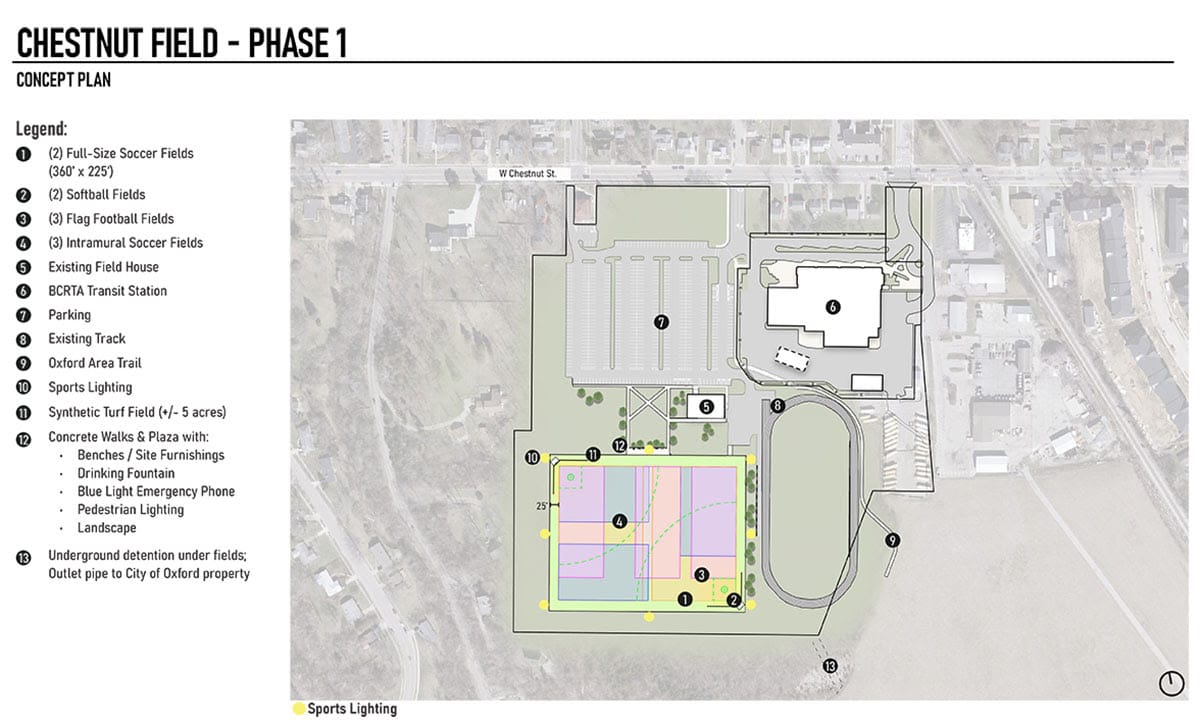
Rendering of the planned recreation field, courts and dog park on the Millett Hall south lawn and nearby grass area. Rendering of the planned recreation area on Chestnut Field at the site of the former Talawanda High School along West Chestnut Street. Photos courtesy of Miami University.
Project costs
A breakdown of expenses reviewed by the Finance and Audit Committee meeting on Feb. 26, showed the total cost of the arena is expected to be $280,240,288.
Over $242 million of this total was expected to be dedicated to the main arena, volleyball arena and a practice court. The rest will be dedicated to surface parking and site improvements, the demolition of Millett Hall, relocating the recreation space currently at Cook Field and renovating Harris Hall for the ROTC program.
But during the Investment Subcommittee meeting on May 14, Senior Vice President for Finance and Business Services David Creamer said the overall costs of the project could be impacted by rising oil costs as a result of the war with Iran.
“Any sort of substantial blow-up with the flow of oil could have an eventual impact on total project costs, because we won’t have a full GMP guaranteed maximum price on that project until the end of the calendar year,” Creamer said. “What I’m concerned about is that even if they settle in the Middle East, there may still be some inflationary pressures coming out that would affect interest rates.”
While the university could delay the project, Creamer said if it doesn’t go ahead while the market is “somewhat stable,” it risks the increased interest rates. As of last week, Creamer said the university was presented with rates that fit closely with what was presented to the committee earlier this year, which it could lock in for the duration of the project.
Creamer also noted to the Finance and Audit Committee how the use of artificial intelligence (AI) and construction of data centers is driving up prices in several industries and has raised the cost of steel and roofing.
“The Trustees have already voted,” Creamer said in an email to the Oxford Free Press when asked if the university would proceed with the arena as planned. “We are keeping them informed about changes that affect the project, but we remain confident that the project can be delivered within the resources available to the project.”
Creamer told committee members he aimed to issue the new debt for the arena project as early as the week of May 18.
Tuition, revenue and pay
Creamer also announced a raise in tuition for new undergraduate resident and non-resident students on the Oxford campus of 2% for the 2026-27 academic year, from $9,259 per semester to $9,445 and from $21,020 to $21,441, respectively.
On the regional campuses, new resident and non-resident students will see an increase in tuition of 3%, from $3,854 to $3,970 per semester and from $10,087 to $10,389, respectively.
Graduate tuition for resident and non-resident students will also increase by 3%, from $8,706 to $8,967 per semester and from $19,647 to $20,236, respectively.
All miscellaneous fees, course overload fees and room and board will also increase by 3%.
Returning students will continue to pay the same rates they paid during the 2025-26 academic year, as long as they graduate in four years.
“We continue to work with enrollment management on what is a targeted rate that we would like to hit that gives them some flexibility on the tuition discounting or scholarship fee for incoming students, but also recognizing that Miami does remain the highest sticker price of any public university in Ohio,” Creamer said. “We try to come in at an … increase that is less than what we expect our sister schools … will be approving.”
Meanwhile, Creamer told the Finance and Audit Committee the incoming cohort for the Oxford campus will provide a “record tuition year.” Still, he told the Oxford Free Press in an email, spending will also be at an all-time high, and tuition revenue overall will be well below its peak in 2018.
Miami is predicting $330 million in total tuition revenue for Fiscal Year 2027, according to data provided by Creamer. Tuition revenue in FY18 was $352.3 million.
Currently, 70% of Miami’s budget is paid for through student tuition and fees, according to Creamer.
Creamer told the Finance and Audit Committee compensation is the “major issue” driving university expenses.
He told the committee that university representatives were still bargaining with faculty and librarian union representatives, who are asking for a more than 15% raise for faculty base pay over the course of three years to keep up with inflation. This would be a 4% raise each year for three years plus equal dollar amounts.
Cathy Wagner, an English professor and member of the Faculty Alliance at Miami (FAM), told the Oxford Free Press the university originally countered this proposal with a flat raise of 1.25%, calling its offer “extremely insulting,” adding members are currently paid “well below” what’s needed to keep up with the rising costs of living.
The Oxford Free Press reached out to the university regarding this bargain, and Senior Director of Communications Seth Bauguess said, “The university follows a best practice of not commenting on on-going labor negotiations.”
Executive Vice President of FAM Elena Jackson Albarrán told the full board of trustees on May 15, during the most recent bargaining meeting, Miami offered members a raise of 1.8% over 10 years, adding a story about her being asked to purchase her own mobile whiteboard for her classroom.
“Students noticed the jarring disconnect between the announcement of a nearly-$300 million arena project at a university where their professor could not get a chalkboard,” Albarrán said.
Provost Chris Makaroff told the Academic and Student Affairs Committee on May 14 over 19% of faculty are teaching more because of the university’s updated faculty workload model.
The Miami Board of Trustees will meet again on June 26.