
Oxford aims to place solar array on closed landfill

The city is exploring options for a solar project aimed at expanding renewable energy, reducing emissions and stabilizing energy costs
The City of Oxford is working on plans to install a solar array on its closed municipal landfill, located behind the City of Oxford garage and SDS Pizza.
Reena Murphy, sustainability coordinator for Oxford, said 23 gas vents are present on the site, which help lower emissions, which are made up of greenhouse gases, including methane, which is created by the decomposing waste present in the landfill.
Murphy added that an effective way to lower these emissions is by adding flares to these vents, which help burn the methane released and turn it into water and carbon dioxide.
Currently, the city has installed two flares, with hopes of adding another soon, Murphy said. Flare installation is dependent on which vents release the most methane.
The city’s goal is to create a solar array on the site, which would generate energy for Oxford residents as part of the city’s electrical aggregation program.
Oxford’s landfill history
David Treleaven, environmental specialist for Oxford, told the Oxford Free Press about the landfill’s history.
The landfill started somewhere between May of 1953 and April of 1954, according to Treleaven.
The landfill stopped accepting trash in January 1987, and, in December 1995, the closure procedures and construction began. On May 20, 1996, it officially closed.
Since 2020, the city has worked to add a solar array on top of the closed landfill to maximize the space’s utility, Murphy said.
The group working with the city initially decided in 2024 not to lease the landfill. The group asked for an extension for the agreement, but it was rejected by the city council during a meeting on Sept. 17, 2024. The city council rejected a nearly four-month extension due to the lack of progress and potential for a better option.
“You can’t really build much else on a landfill,” Murphy said. “Installing solar on the landfill is kind of a win-win.”
The decision to proceed with a solar array on the site is anticipatory, Murphy said, who cited growing energy costs as a factor.
“We live a very energy-intensive life,” Murphy said. “And as that intensity is anticipated to go up, our energy demand is anticipated to go up.”
Murphy added that the city’s goal is to create renewable-sourced energy that would work with the city’s electrical aggregation program, which allows Oxford residents to purchase energy from the city “at a competitive price, saving money and the planet at the same time,” according to the City of Oxford website.
Murphy said she views this opportunity as a “triple win.”
“It reduces our emissions, it increases our resiliency (and) … it’s investment,” Murphy said.
In terms of resiliency, Murphy said that with this solar array connected to the city’s electrical aggregation program, electric generation would travel quicker to residents.
On investment, Murphy said this project would create more jobs and infrastructure.
The project would also contribute toward the city’s goal of carbon neutrality, Murphy said.
As part of Oxford’s role in the Global Covenant of Mayors for Climate and Energy, the city is required to report its gross emissions, which are the total amount of greenhouse gases produced by an entity, and not the city’s net emissions, which are the total amount of greenhouse gases produced by human activities, after removals and offsets are taken into account, according to greencalculus.com.
“The project will reduce our gross emissions as well, so it’s not a dig at our (electrical) aggregation program, (which) reduces our net emissions,” Murphy said. “Any new solar, any new wind, any new renewable energy helps reduce our emissions and reach our climate goals.”
October work session
During a work session on Oct. 6, the city council directed Murphy to work with the Sustainable Ohio Public Energy Council (SOPEC) to get the project going.
“We will be working with their partners, and we will be directing, hopefully, the generation of all the electricity (from the project) into our (electrical) aggregation program,” Murphy said.
Murphy said one of the project’s main challenges is interconnection costs.
“That is the cost that Duke (Energy) stipulates (for the city) to connect to their grid,” Murphy said. “In order to have solar at (this) location, there’s a decent amount of upgrades that Duke Energy does need to make to safely accept and distribute that (energy) distribution.”
Interconnection costs are based on the size of the system, according to Murphy.
According to the presentation given at the work session, implementing a 1.75 milliwatt (mW) system would cost $243,200; implementing a 2.75 mW system would cost $1,138,200; and implementing a 5 mW system would cost $2,268,200. Notably, these numbers are from when the city first tried to build a solar array on the landfill in 2020.
While Murphy said the landfill can fit a 5 mW system, she also said it doesn’t “necessarily make it the most economically feasible option.”
While the city council prefers the biggest system, the city will work with a developer to find the best and most feasible option, Murphy said.
Now, Murphy is working on finding a non-binding agreement, which would help get a better look at what the project looks like in the near future, rather than in 2022 or 2023 with the previous developers.
Murphy said she is also learning from other communities who have both successfully and unsuccessfully worked on similar projects.
If successful, this project would create renewable energy for Oxford residents, which can increase sustainability long-term. “Renewable energy is a good hedge against future energy costs,” Murphy said. “We’ve all felt it; our energy bill has skyrocketed … By investing in renewable energy, we are investing in stability.
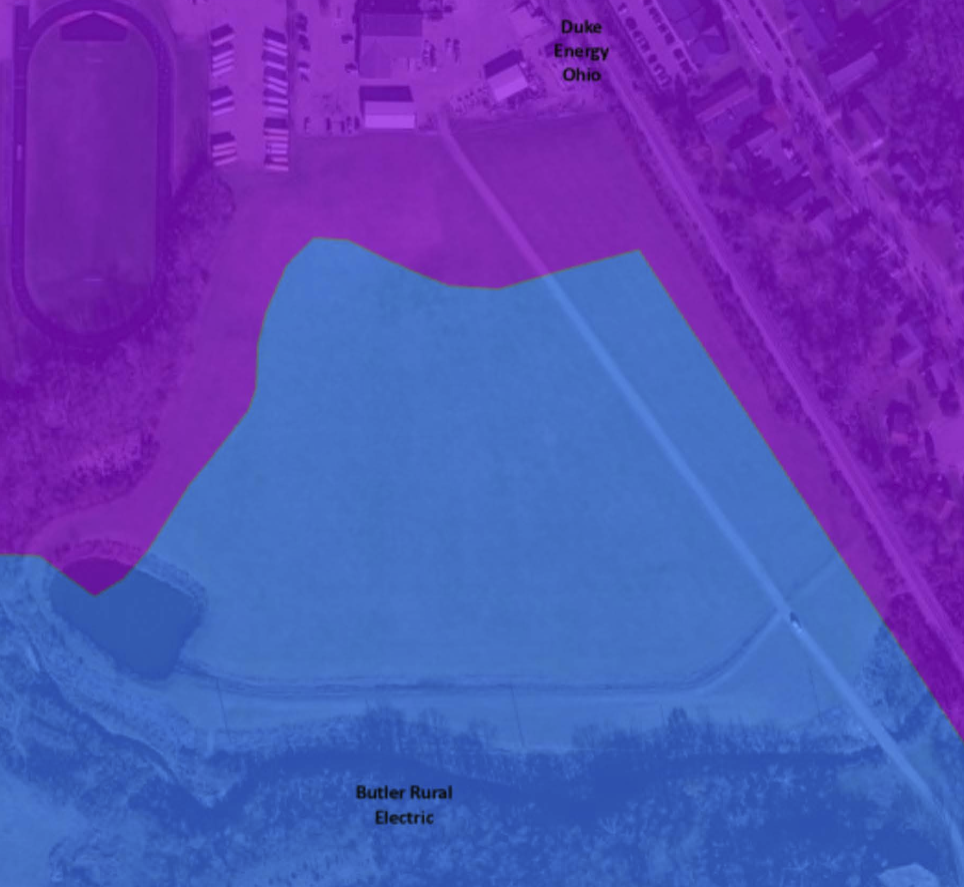
Oxford’s landfill, where the proposed solar project is slated to break ground in the future, shares electric ownership between Butler Rural Electric Cooperative and Duke Energy.
Additionally, the presentation also noted that the project is still more than two years away from groundbreaking, and the potential array would likely be more expensive than Duke’s standard service offer (SSO), which is the base price for the supply portion of electricity and can entail monthly changes.
Oxford’s Electric Aggregation Program is resting at 10.251 cents/kWh until June 2027, while Duke’s SSO is resting at 10.69 cents/kWh as of September 2026, where the city has saved around 0.439 cents/kWh, according to the presentation.
The City of Oxford is also a member of SOPEC, which allows the city to join a larger purchasing group and have a voice in its own organizational structure.
Murphy said residents in Oxford have saved just short of $200,000 since joining the program in January.
According to the presentation, the city being a part of this group can be “advantageous” if the city decides to go into the aggregation program.
“If the electricity goes to SOPEC, it increases our chances of staying below the SSO at the start,” according to the presentation.
According to the presentation, the option wouldn’t give much control to the city, and it could result in the city purchasing energy at an unknown cost.