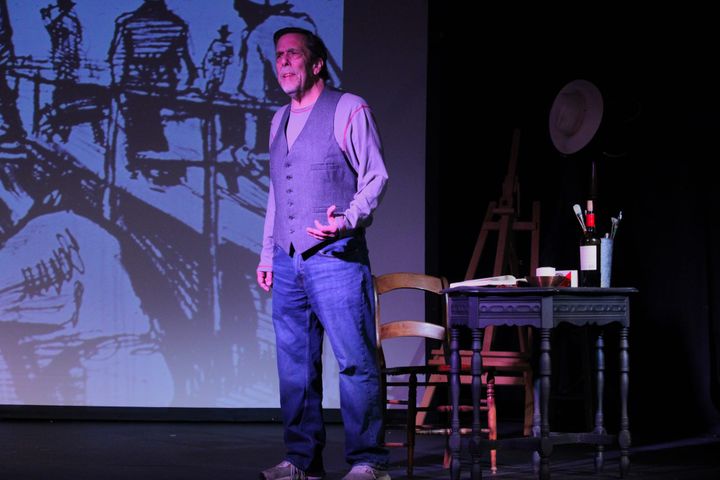

Pete Carels, ‘the pied piper of rhythm,’ and his drum circle
“Somebody in the group will start something and then more people will join in. And pretty soon everybody has found a place in their mind and heart to kind of jump in and say, ‘I think this will go good with that.’”
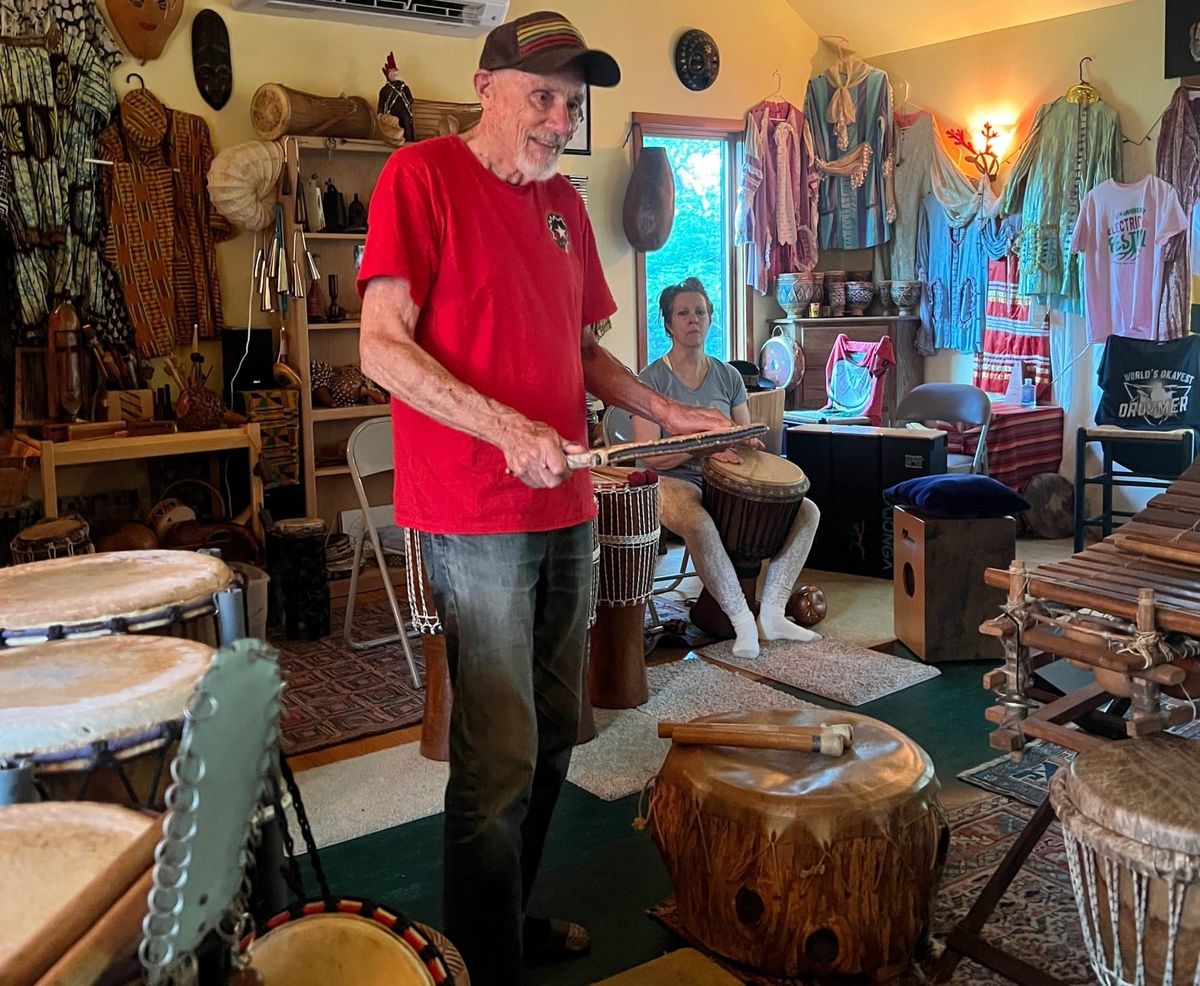
The only clue that Pete Carels’ driveway leads anywhere but his house is a simple white sign with a hand-drawn djembe drum hanging from a tree. But for 24 years and counting, Carels has hosted open gatherings at his drum barn on Tuesday nights.
Carels’ love of hand-drumming began in the mid-90s when he and his wife, Kathleen, attended a performance of African djembe in Presser Hall at Miami University.
“We were practically the only people in the audience. We sat in the very front row, practically my chin on the stage,” Carels said, reenacting his awe at seeing someone dance and cartwheel all while managing to play the drums.
He left that performance thinking, “I really want to do this” – the drumming, not the cartwheels. Then a few weeks later, he and Kathleen saw Baba Charles Miller and his band playing djembe at the Contemporary Arts Center in Cincinnati.
“And there was no looking back,” Carels said. “So that became my passion, and it still is.”
Carels started taking hand-drumming lessons from Miller every Saturday for three years. They alternated between different African and Latin American styles, and Carels learned all about rhythm, technique and the other instruments used to accompany the drums.
Sometime in 2000, Carels worked with a local architect to design the drum barn. The space is part-garage – for the drums Carels regularly loads in his car and old house-concert posters (plus Kathleen’s car in the winter) – and part-studio, giving Carels a dedicated space to play music.
Traditional African garments and other colorful costumes cover the walls starting in the stairwell leading up to the studio space.
“I’ve enjoyed decorating this place over the years,” Carels said. “People have brought things to us, or I’ve gone out and collected them.
The clothing serves a practical purpose too by helping absorb some of the sound.
Most things in the studio are like that. Maryland flags – Carels got his doctorate at Johns Hopkins University in Baltimore – have been hung as curtains, and what look like the ends of crutches are waiting to be used as drumsticks.
Even the ladybug-themed trinkets and decor have hidden meaning, since the ladybug serves as the group’s mascot and represents an easy way to teach rhythm.
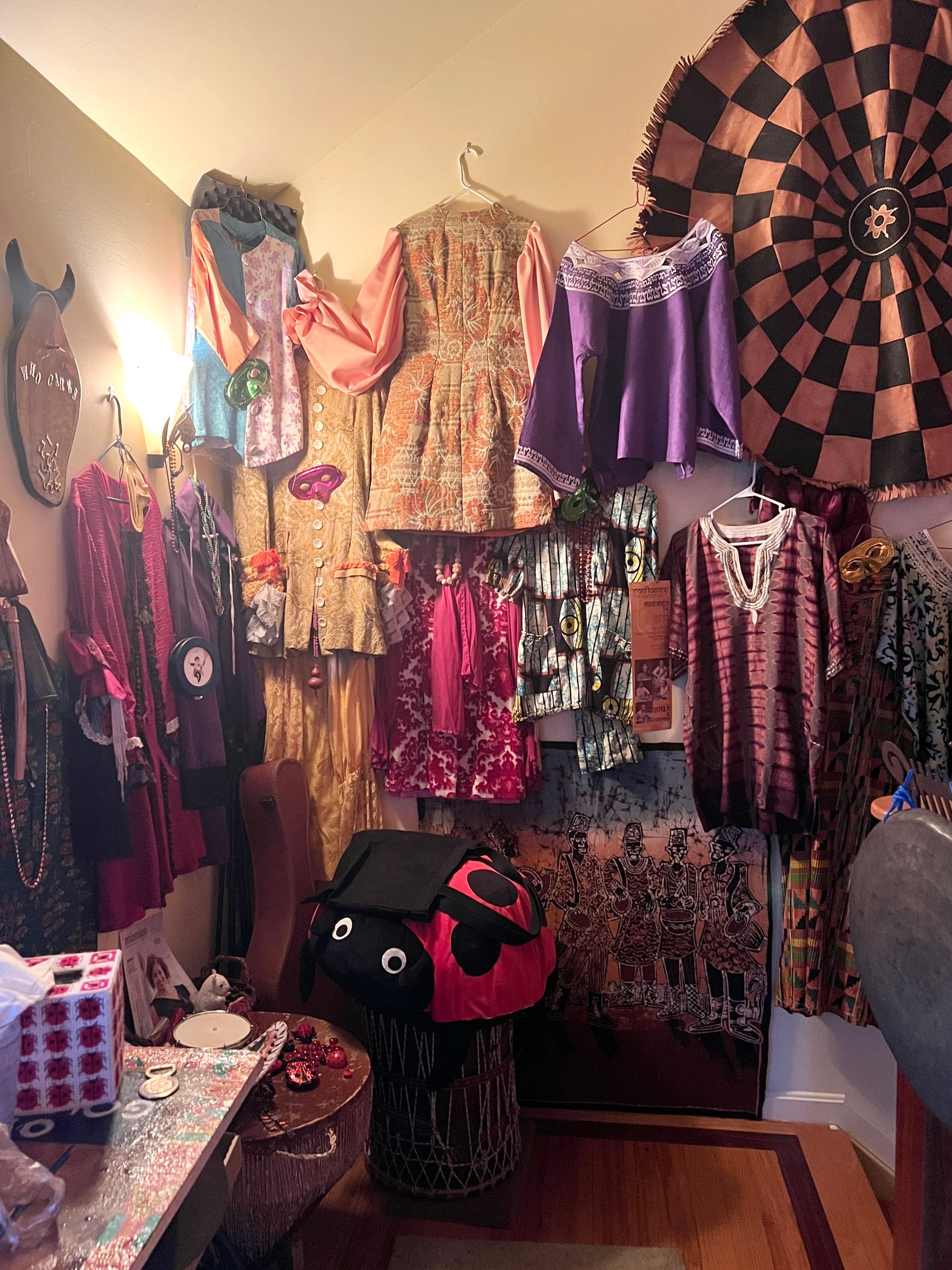
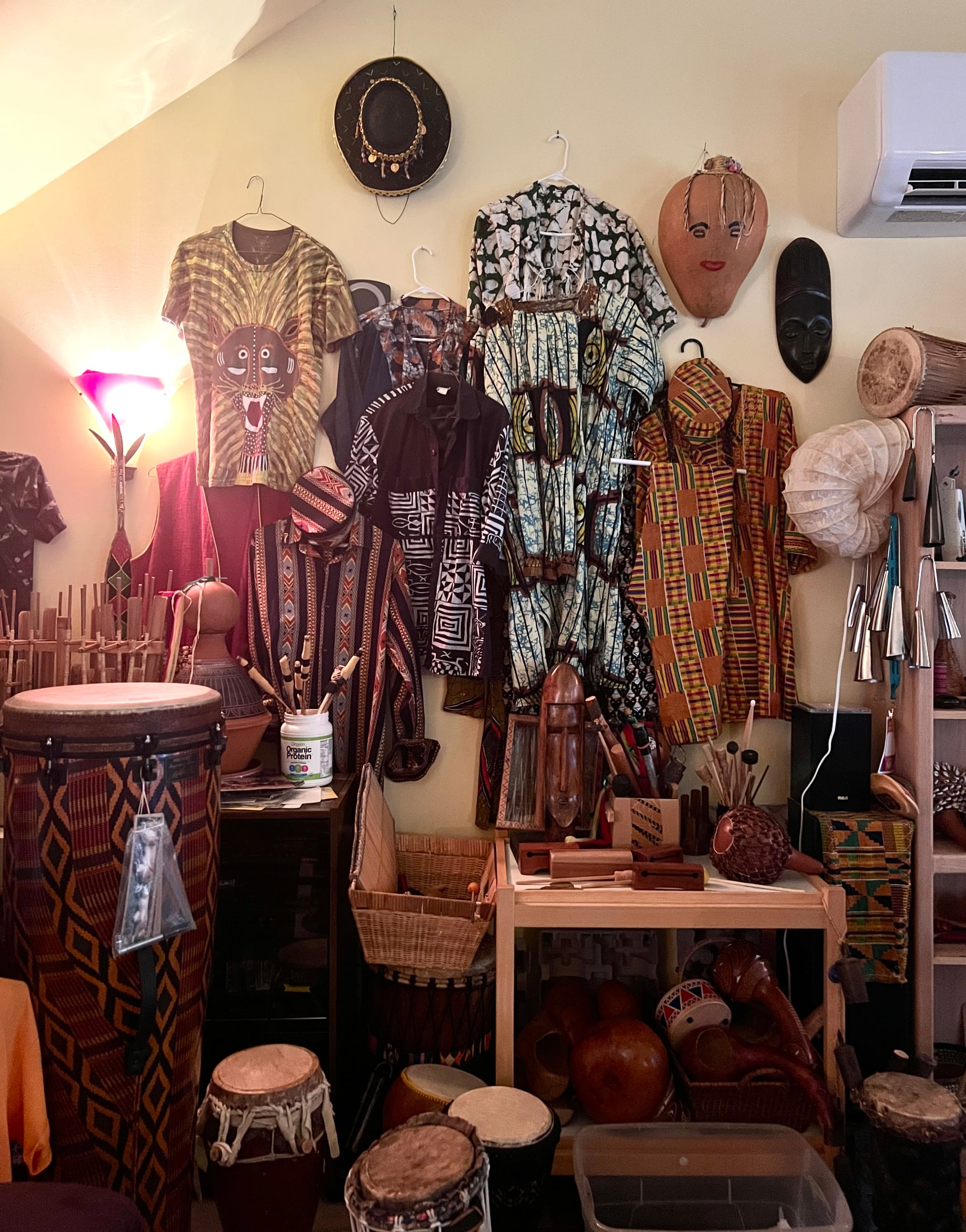
Traditional African garments and old costumes from Miami University’s theatre department decorate the drum barn. Photo by Alison Perelman.
The unofficial members of the drum circle trickle in around 7 o’clock, starting with Bill Hickman, who has been attending gatherings for 12 years and is always the first to arrive.
Everyone chooses an instrument and starts playing, the sound building and blending as each person joins in and finds their place in the rhythm.
“Somebody in the group will start something and then more people will join in,” Carels said. “And pretty soon everybody has found a place in their mind and heart to kind of jump in and say, ‘I think this will go good with that,’ or ‘I’m going to play bell with that.’”
In the early days, the drum circle gatherings were more structured like lessons. The group would listen to tapes to learn different rhythms and even get to know some of the words to the songs, but about eight years ago they shifted to just playing.
“We keep finding our own voice within a chorus of other people who have their own voices to find as well,” Carels explained.
The drum barn is, of course, full of drums of all different sizes and cultural significance, but Carels’ collection has grown to include many other percussion instruments such as bells, tambourines, shakers made of Oxford-grown gourds and two balafons (a gourd-resonated xylophone).
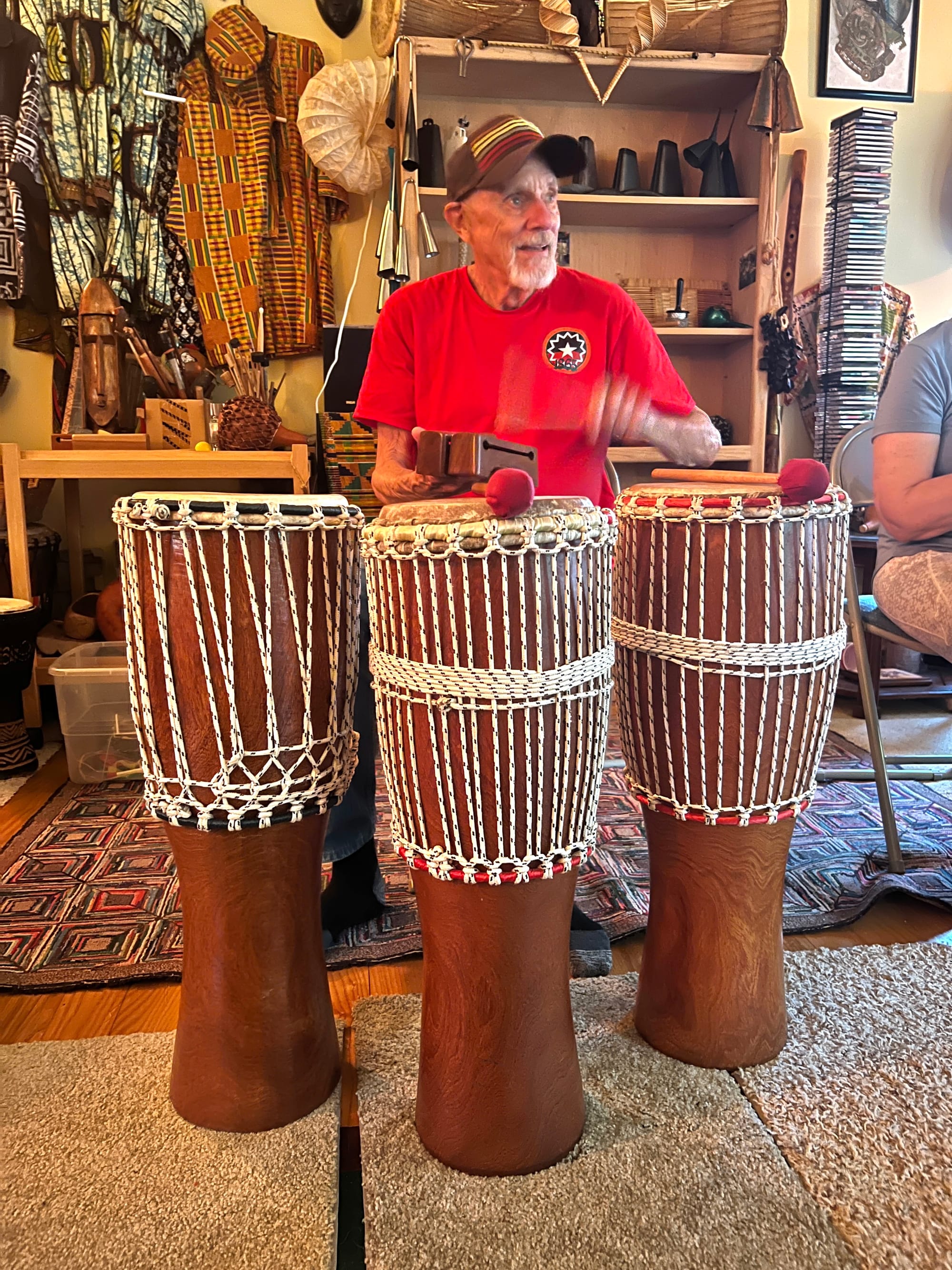
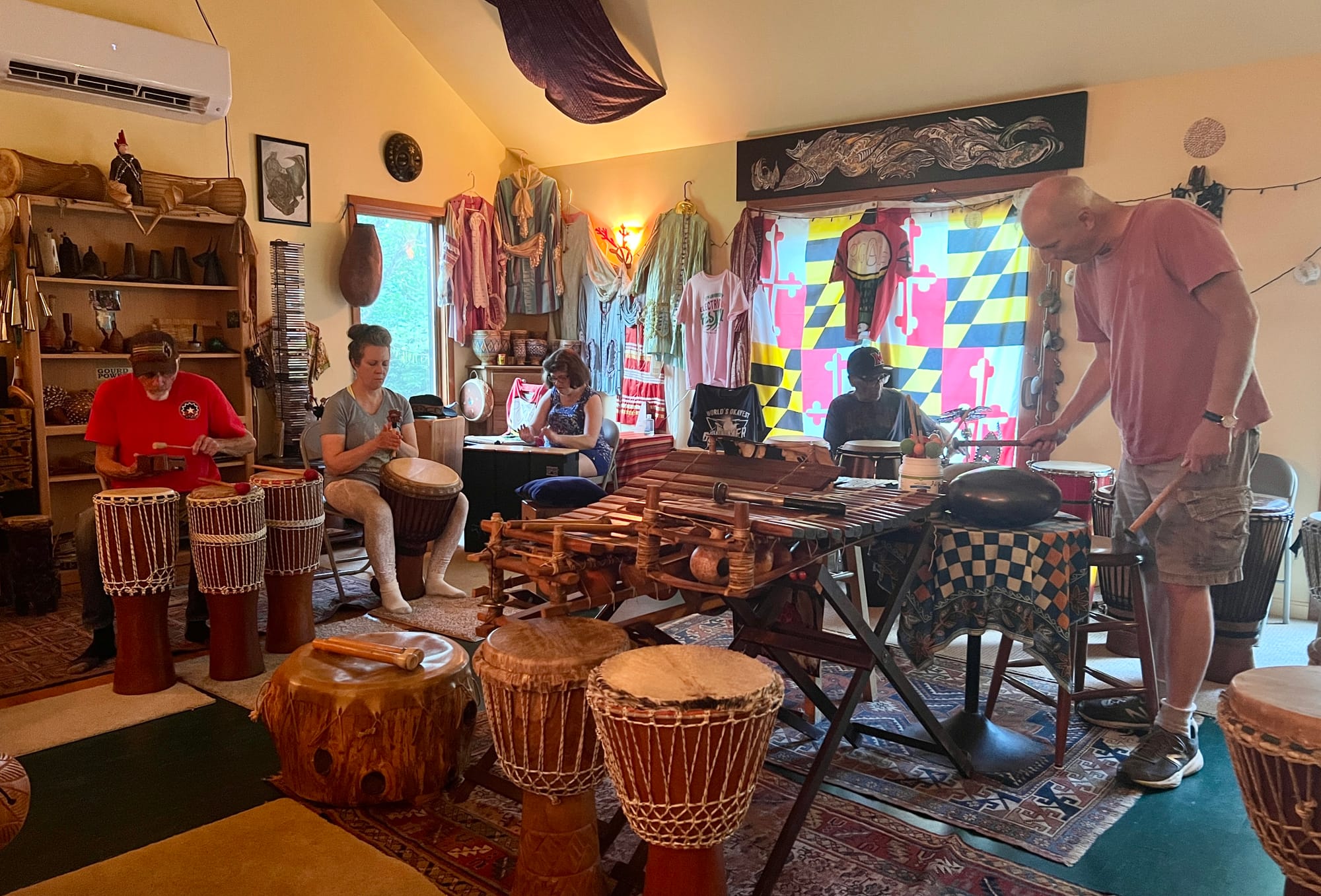
Pete Carels and other regular participants of the drum circle play some of the instruments available in the studio. Photos by Alison Perelman.
Throughout the night, the amateur musicians are free to move around the studio and switch instruments whenever they like.
At one point, Carels leans over to instruct Sherrie Skipper on the best form for the drum she’s chosen so that playing is easier on her wrists and more sound can escape out the bottom.
Skipper was a regular for six months but had to step away to care for her parents. This is her first time back in over a year, and even though she feels a little “klutzy,” she also feels safe and free.
“Pete’s enthusiasm is quite contagious,” Skipper said. “There’s no judgement. Just joy with a really solid beat.”
Carels does seem to almost skip around the room, moving his body along to the beat while shaking his favorite instrument, the kayamba.
Watching him, Skipper noted, “Pete is like the pied piper of rhythm.”
Carels is naturally encouraging. He spent 35 years at Miami as a German professor teaching in various disciplines – German literature, linguistics, culture, history and business.
“That was what kept me really interested and fired up,” Carels said, “moving around to all the different things that you could do with your German degree.”
And, of course, Carels traveled. He lived in Vienna for a year and took student groups to Berlin during the summer in the late ’80s. He’s visited some African countries as well – Tanzania, Tunisia and Kenya more than once.
Ironically, he’s never been to any of the West African countries where most of the drums originate, but both of his children have.
Carels’ son was an architecture student at Miami and took part in a class that went to Ghana to design a school. He visited an Ashanti drummaker while he was there and brought one back for Carels with a symbolic red and black checkerboard pattern.
Along with weekly drum circle gatherings, Carels drives to Cincinnati once a month to work with the Cincinnati Music and Wellness Coalition, visiting places such as children’s hospitals and care centers for people with disabilities.
“The music is self-evident,” Carels said. “The wellness part is because there are different ways of speaking to the human mind, soul, spirit and body that can improve one’s health.”
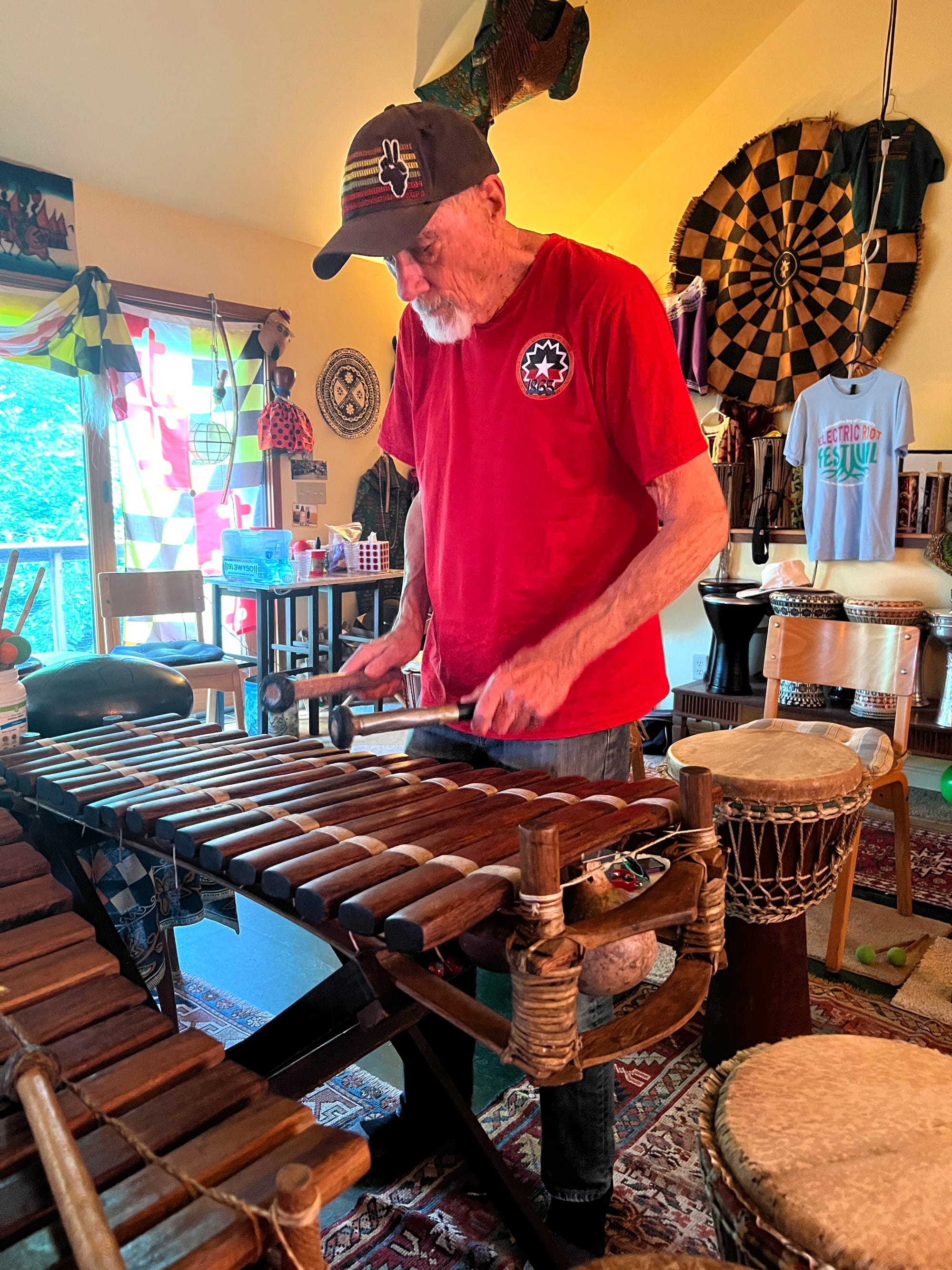
It’s not an official rule, but there’s not usually much talking during drum circle sessions. Instead, they just play for several minutes straight, listening and watching each other for cues and how they can add to the beat.
Skipper recalls the time a famous drummer visited, and because she was sitting next to him, she played so hard she thought her hands might fall off.
“Maybe that’s how marathon runners feel about their feet,” she said.
Dean Wilkins compares coming to the drum barn to when he used to go to church since they both have a lot of rhythm.
Carels only interrupts this session to remind everyone about a possible change to the upcoming 2nd Friday Celebration at the Oxford Community Arts Center, during which they typically play on the porch to welcome people inside.
Much like the improvised songs they create, there isn’t an official end to the drum circle. Some people leave earlier, and sometimes they lose track of time, but Carels doesn’t mind.
The couple of times Carels has had to leave before someone else, he simply tells them, “You know where the light switches are, close the door behind you.”
On this Tuesday night, Wilkins lingers by the stairs before heading home, making sure to say, “Thanks, Pete. I needed this.”