
Talawanda Middle School course teaches careers, professionalism in agriculture
An agriculture class became available to eighth graders at Talawanda Middle School for the first time this year.
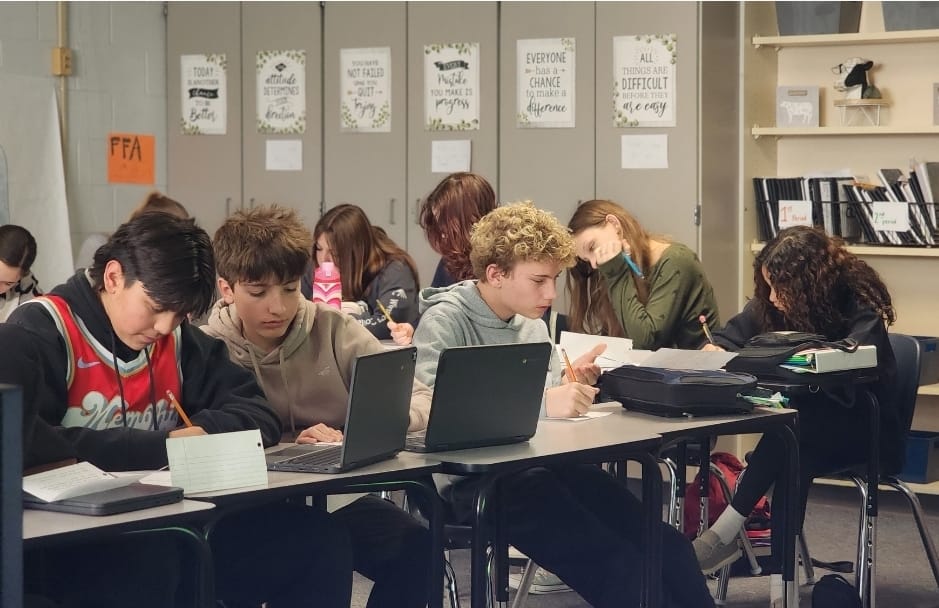
An agriculture class became available to eighth graders at Talawanda Middle School for the first time this year at popular request.
“We’ve always wanted middle school ag(riculture),” Talawanda Schools teacher and Future Farmers of America (FFA) chapter advisor Kari Roberts said. “We have a very rural community, and we’ve had lots of … middle-school-age students always interested in ag.”
When another teacher retired last year, an opening was created for an elective class, and Roberts, who teaches agriculture at Talawanda High School, was able to step in. Now, she starts her day at Talawanda Middle teaching an agricultural food and natural resources class and switches over to Talawanda High around 10 a.m.
Next semester, she’ll teach a plant and animal class. Students who take her classes all year can earn a full credit for high school.
“We talk (about) anything from ag careers, leadership, professionalism, soft skills they need to have for any job down the road,” Roberts said, adding the class also discusses plant nutrients, the FFA and agricultural history.
So far, guest speakers have come in to talk to students about different industries in the agricultural world, she said, and high school students have come in to help instruct eighth graders on topics they’ve also learned.
“I look at it as like a … mixed appetizer course,” Roberts said. “(You) get a little bit of everything. And then once they have that course, if they really like something, then maybe that could be their first ag class (for Talawanda High). … It helps them kind of guide what individual ag courses they want to take while they’re in high school.”
All of Roberts’ students are considered FFA members, and the Talawanda-Butler Tech FFA chapter spans eighth through 12th graders. Students in the chapter may travel to any contest, event or convention hosted for FFA students, which has previously included a Farm Science Review field trip hosted by The Ohio State University, as well as the National FFA Convention & Expo in Indianapolis, Indiana.
At Talawanda Middle, students have a small “hobby-sized” greenhouse, Roberts said, which they’ll mainly use during the second semester course. She said there’s also a shop for engineering courses that her students have been able to use.
“There will be lots of hands-on opportunities throughout the year for them to just start building that good foundation that they can build on when they get to high school,” she said.
Overall, she said this course is important for students’ education because “Everybody eats food everyday, and everybody has to wear clothes and be housed, and all of that stems back to agriculture.”
“My goal is just to remind everybody that agriculture is important to each and all of us,” Roberts said. “Even if their goal was not to be a producer or a farmer one day, knowing where their food supply comes from, how to grow their own food supply, how to network with people.”
She said most of her students have no agricultural background when they enter her classroom. Some of her students may have siblings at the high school who took the class before them or just “want to be part of an organization where they get so many different opportunities.”
The standards of the eighth grade agriculture course overlap with those of other general courses, including science, English and history, Roberts said, which builds on their knowledge of those topics.
The course is funded through Butler Tech, the career technical education school, while the Talawanda Schools provides a classroom. Moving forward, Roberts said Talawanda Middle would like to have a full-time teacher so sixth and seventh graders can be included.
For now, there’s a program called “Little Aggies” going on its 11th year at Talawanda Middle as an afterschool program for any students with an interest in agriculture.
For Roberts’ first semester teaching the eighth grade course, she has 36 students.
Sadie Watkins, 13, said she decided to take the course because she has seen how other students, including her family members, have enjoyed FFA and found what they wanted to do as a career through the program. So far, she said she’s enjoyed the Farm Science Review field trip and learning how to act in job interviews.
“I don’t know what I want to do yet, but having connections through the FFA and learning how to do certain stuff for other jobs … is really helpful,” Sadie said.
Carter Johnson, 14, said he joined the class because his family owns a farm, and he wanted to learn more about “how everything works and what it’s all about.”
“I’ve learned a lot on how to better my communication skills and all the stuff (my family) does and just getting to know people,” Carter said. “I’d like to take over the farm when my parents can’t do it and try to get more involved into all of it.”