
Upgrade your trees
It's easy for trees to be an afterthought, but many benefits lie in their shade.
By Carla Blackmar
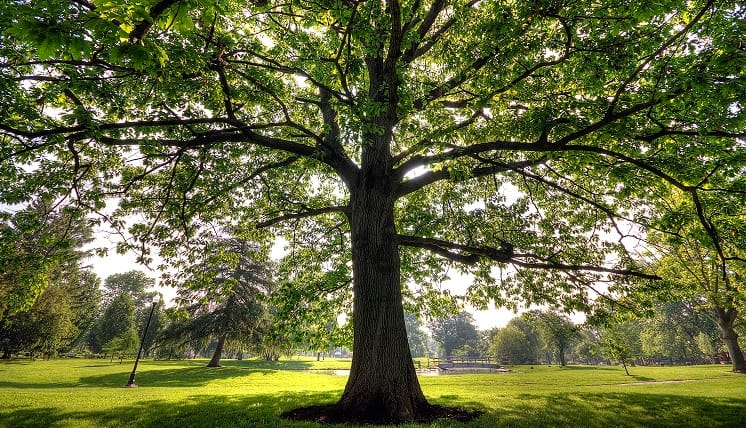
If you are fortunate enough to own a home, a small investment with tremendous return potential is to upgrade your trees. It’s easy for trees to be an afterthought, or worse, for homeowners to view trees as a liability – thinking about the risks (fall damage, maintenance costs) while ignoring the many rewards. But trees have been proven to reduce utility costs with their seasonal shade and to increase property values with their canopies. To maximize benefits, it is important to know what trees you have, and, in some cases, to replace some of the “problem” trees that were planted by homebuilders and prior gardeners.
Most readers will have noticed that Southwest Ohio has an Amur Honeysuckle (Lonicera maackii) problem, and communities are increasingly aware of the hazards of Callery Pear (Pyrus calleriana) trees. Once thought to be sterile, these commonly-planted street trees hybridized with other pear trees, and, with the help of birds, have now spread and colonized every roadside, railway cut and vacant plot of land in our area. Though they were banned from commercial sale in Ohio in 2023, it is dispiriting to realize that many of the mature trees on High Street in Oxford, and lining subdivisions of the early 2000s, are Callery Pears.
While humans may have many reasons for disliking Callery Pear trees, such as their weak wood, which is susceptible to broken limbs in our wild weather, or the fishy scent of their (admittedly) pretty white blossoms, the real problem is that they don’t help us a lick in our attempt to stave off the insect apocalypse. Yes, believe it or not, insect populations are declining.
Insects and other invertebrates have the ability to transform seemingly inedible plant materials into animal protein – and as such, they form the base of our local ecology. Many caterpillars, and the adult moths and butterflies they become, have a special relationship with specific types of plants, aka a host plant. This means that they can only eat the leaves from that plant to grow and reproduce. Caterpillars grow fat on the fresh spring leaves of trees like oak or black cherry, and in turn, many become a stomach-filling meal for the baby chickadees we hope will be our neighbors into the future. If their plant hosts are not present in our landscapes, the insects won’t be either, and the baby chickadees will find it that much harder to thrive as our neighbors.
My proposal is this: start by finding out what trees you have. You can use google reverse image search on your phone, or iNaturalist Seek, if you want to download a cool app. Once you identify your tree, find out where in the world it originated. If it is anywhere other than Eastern North America, it’s likely time to upgrade.
What to upgrade to? That’s something that many members of our local Wild Ones Miami Valley Chapter would like to talk to you about! It’s good to pick out something that will work with your space and something that will help you grow a lot of caterpillars. If you like detail, make yourself a warm beverage and check out: https://nativeplantfinder.nwf.org/ for our area. The number next to the little butterfly icon is the number of invertebrate species each tree supports. Pick a tree with a big number!
The short and sweet version is a follows:
Big and Best:
- White Oak (Quercus species: Swamp White, Burr Oak, Chinkapin)
- Red Oak (Quercus species: Shumard, Shingle)
- Black Cherry (Prunus species)
- Persimmon (Diospyros virginiana)
- Hickory (Carya species)
Smaller but Mighty:
- Willow (Native Salix species)
- Chokecherry/American Plum (Prunus species)
- Witch Hazel (Hamamelis virginiana)
- Dogwood (Cornus species)
- American Hornbeam (Carpinus caroliniana)
You may need to pay an arborist to cut down your problem tree, and if you are short on space, you may need to ask them to grind the stump for your ‘upgrade’ tree. Nurseries like Shademakers will help you prepare for and plant your upgrade(s), or you can once again reach out to Wild Ones Miami Valley and we will be happy to advise.
As your upgrade tree grows, you will be glad to know that you will not only be reducing your energy costs and adding to your home’s beauty, you’ll be ensuring that the next generations of bird neighbors will be living alongside you, raising their families on the foods they like best.
Carla Blackmar the Membership and Media Officer for Wild Ones Miami Valley, and is a curatorial assistant at the Hefner Museum of Natural History at Miami University.