
‘Channel 85:’ Talawanda High School students produce their own broadcast news show
“The goal of this class is to get these kids experience and then to cover things that showcase stuff inside the school that doesn’t usually get showcased.”
In 2012, Talawanda High School computer information technology specialist Andrew Zimmerman started a broadcast news class with five kids and a closet.
He saw how other schools in Southwest Ohio had put together their own productions, and the principal at the time, Tom York, wanted to see if students at Talawanda could create their own.
Back then, the production was called “Channel 85,” because it ran on a closed-circuit television station under channel 85 on all the screens in the school. Students would record their news segments on iMovie, and the show would run on a loop on the channel for the entire day.
When the school upgraded its equipment, the closed-circuit station was lost, and the class switched to YouTube. Today, that channel still operates under the same name – Channel 85 – with nearly 2,700 subscribers and 1,300 listed videos.
“We’ll try to reach as many people as we can, but that’s not really the goal,” Zimmerman said. “The goal of this class is to get these kids experience and then to cover things that showcase stuff inside the school that doesn’t usually get showcased.”
The class operates almost like a job, Zimmerman said. Broadcast co-teacher Matthew Aerni, an English teacher who formerly taught the high school’s journalism class, wakes up early every morning to prepare a script.
When students arrive at school at 7:30 a.m., the sports team reviews the events of the previous day’s games and looks at what’s coming up or turns in individual videos they’ve created about their own sports feature stories for Aerni to piece together. Images for all coverage are pulled from social media or submitted photos from sources.
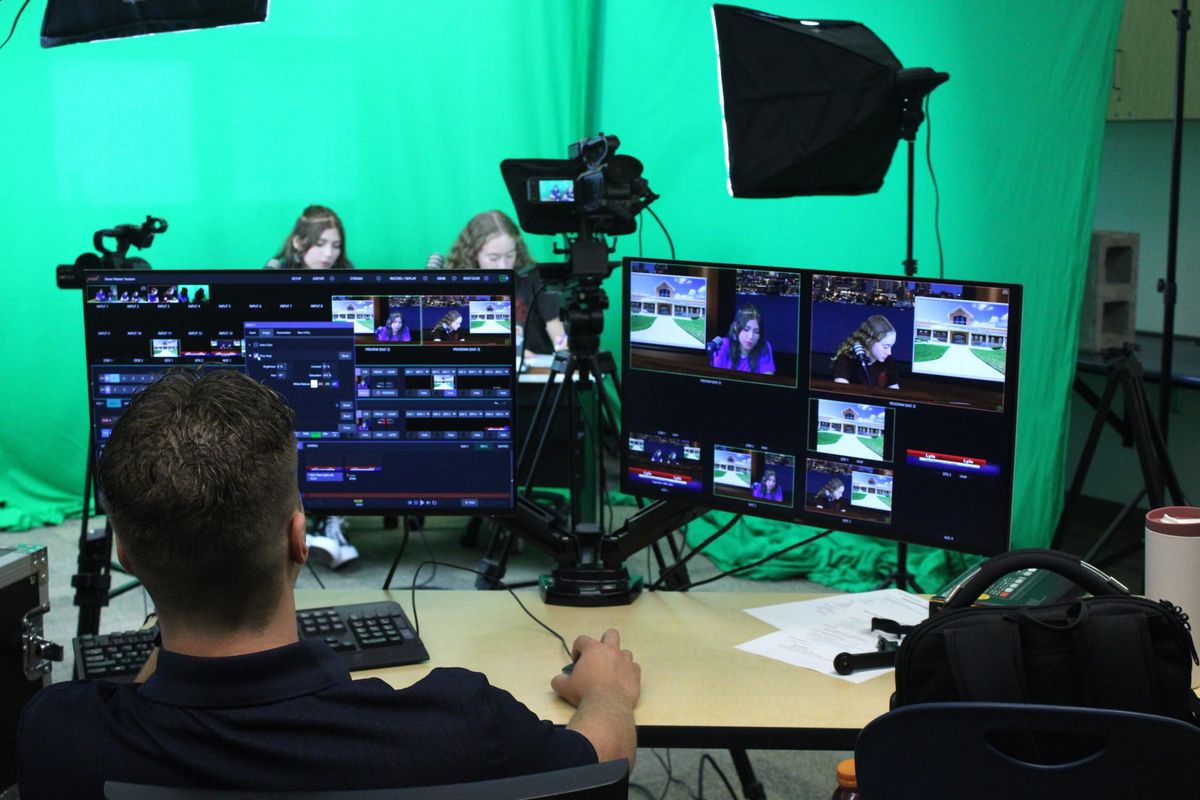
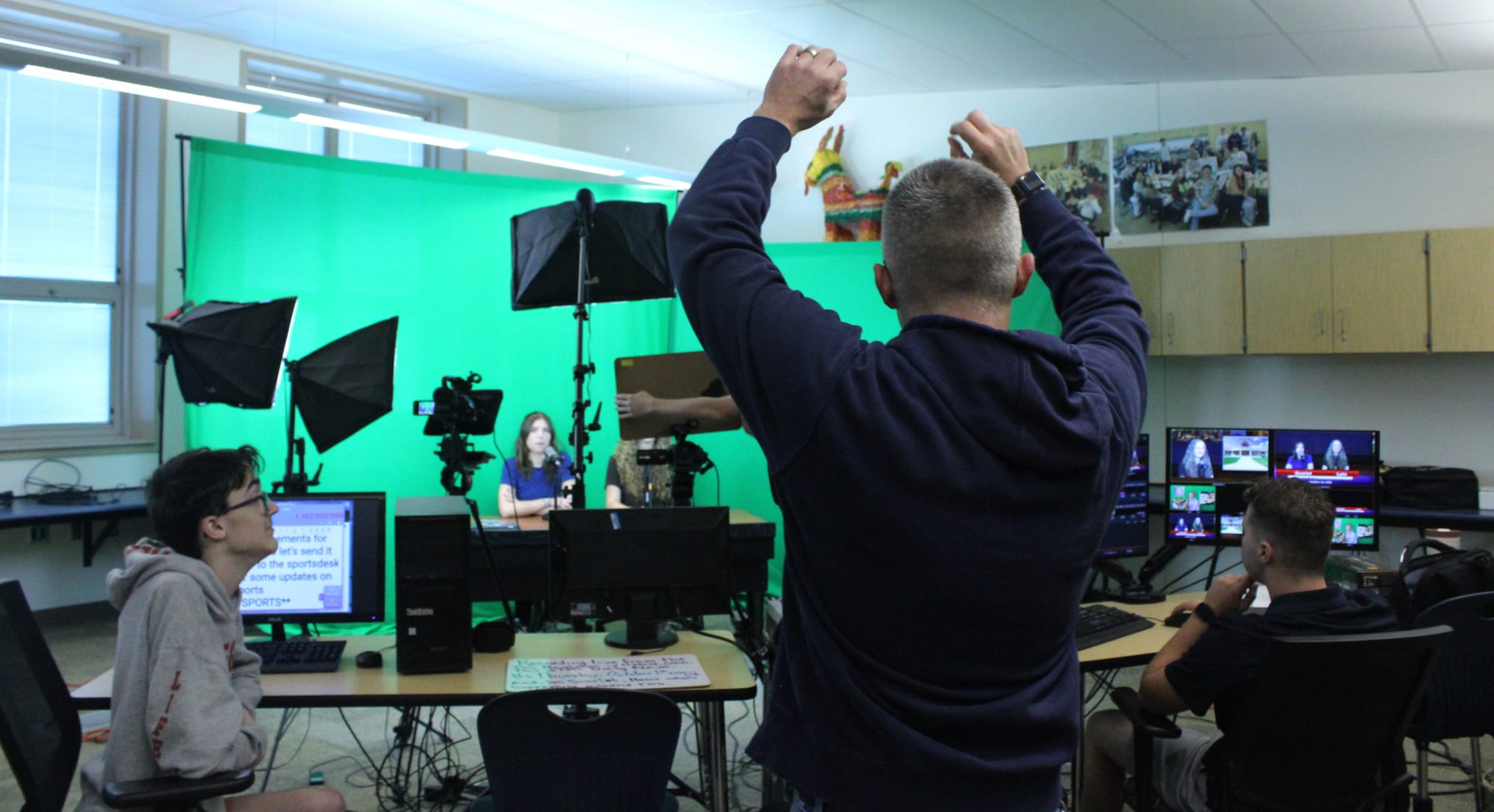
During class, starting at 8:45 a.m., the news team records the full production for the following morning. The class is set up like a broadcast studio, complete with light posts, a soundboard, multiple viewing screens, camera equipment and a green screen.
Photos relevant to students’ stories in the class are edited in next to the anchors as they speak. Similar to a live production, their spotlight is casually interrupted with cutaways to footage from other broadcast students interviewing classmates or teachers about their own stories.
Altogether, it takes the entire class period to film the news, while the sports coverage students have an additional “zero” period in the morning, adding up to around 70 minutes of in-class broadcast time.
But that doesn’t account for the work students are doing outside of class to collect their stories and create footage. The class will also take live streams of sporting events, music concerts and other school events for their final exam, which typically requires an additional 40 minutes of setup and 20 minutes of cleanup, adding up to around three to four hours of work.
The students have their pick of what they want to cover with help from their instructors – from school clubs to daily events, the lunch menu and afterschool programming – and every student focuses on a different element of the production.
Aerni said some of the skills he tries to teach students are how to frame a subject while using a camera; how to conduct interviews; complete voiceovers; edit video; shoot b-roll; write scripts using news-speak, including pacing, transitions and simple vocabulary; and overall public speaking, all while maintaining a line between professionalism and entertainment for the student body.
Over the past two years, Aerni said he and Zimmerman have also been pushing the video feature story element of the class to help students learn how to build a narrative.
“Most other projects inside the school, it’s really a closed system,” Zimmerman said. “When you create a presentation, you’re either presenting it to the class, or maybe you turn in a paper that’s just yours. But it’s really hard for kids to kind of start thinking about an audience and, ‘How do I do something for someone else rather than trying to build a grade for myself?’”
While some students join the class because they’re interested in the syllabus, Zimmerman said others come in already laser-focused on their career. He’s seen some students graduate and go into Miami University’s broadcasting program, and a couple went into Ball State University’s program.
Aerni said he attended a two-week journalism workshop at Kent State University to learn more about news reporting, film editing and story building to bring back to his students. He said he and Zimmerman have taken their students to see the WLWT studio, and they’re trying to take students this year to a workshop with the Ohio Scholastic Media Association or another at Kent State.
“It’s just a chance to do something that’s not in the normal school day,” Zimmerman said of having the class. “We don't grade the kids on like a rubric. … These kids come in, and they just do. I think that’s important.
“The kids understand that the product that they produce is not just going to be seen by me and Mr. Aerni. It's going to be seen by the entire student body.”
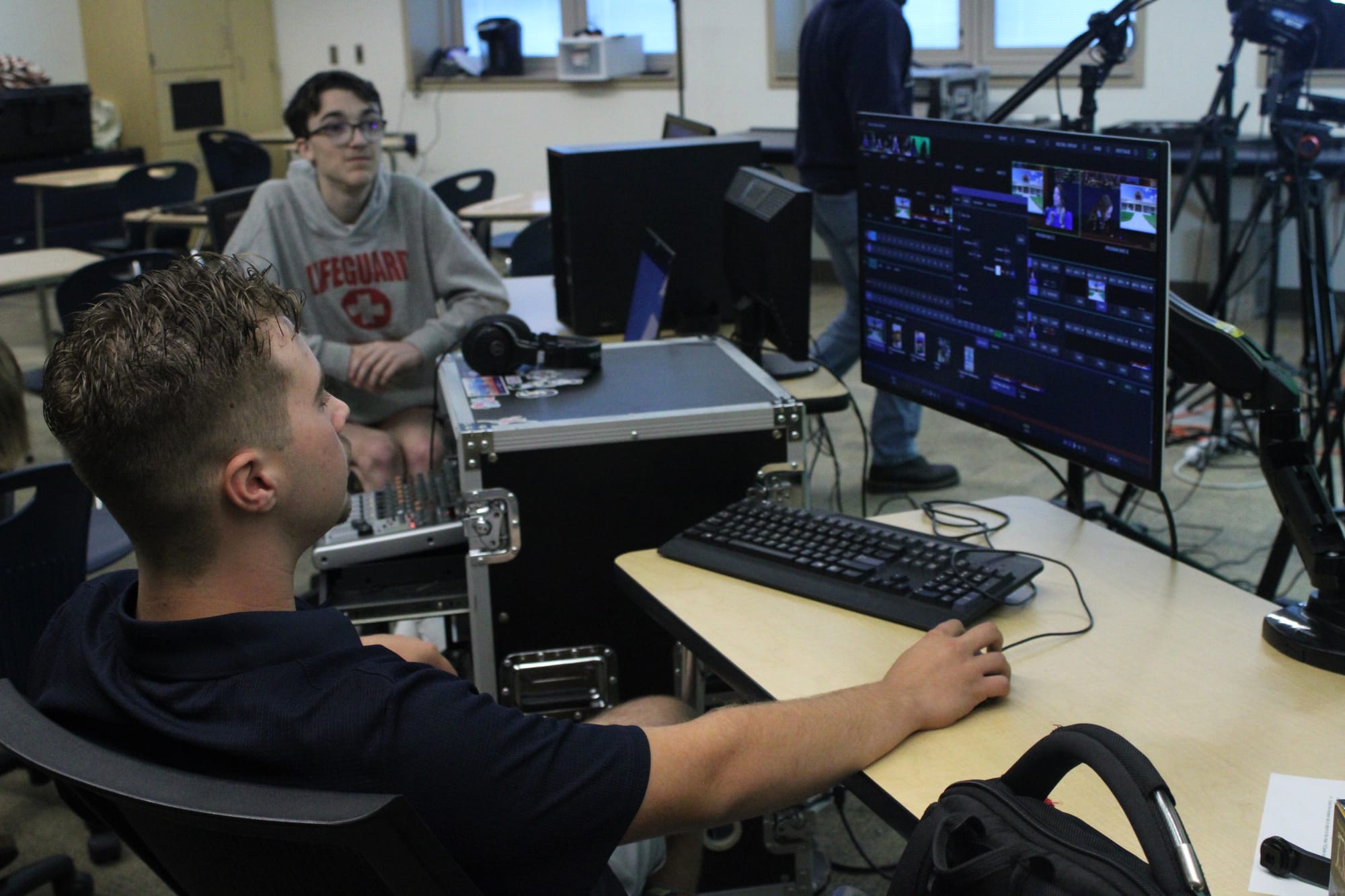
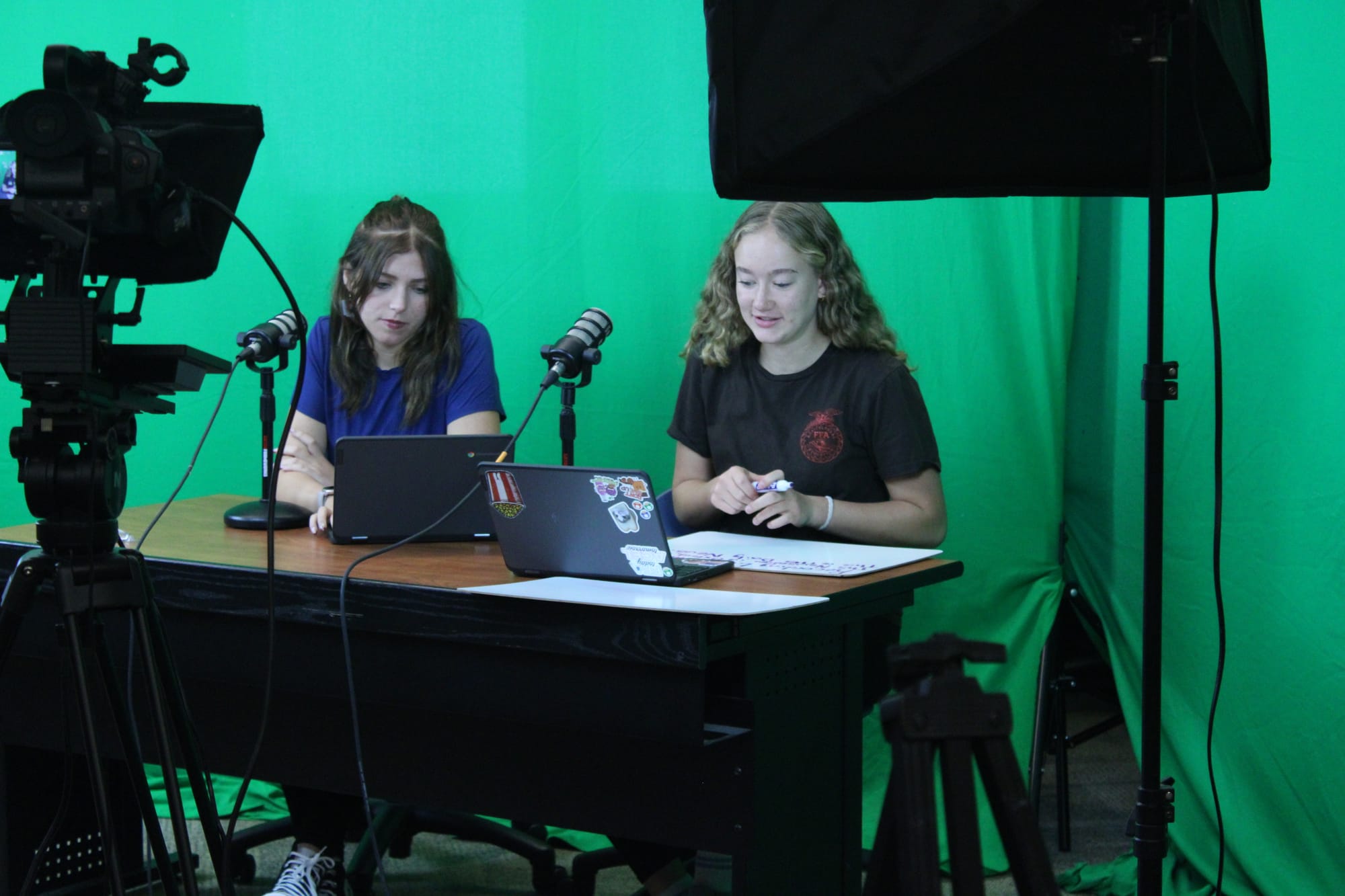
Students in Talawanda High School’s broadcast news class produce an episode of their own daily YouTube show, “Channel 85,” on Sept. 30, 2026. Photos by Katelyn Aluise.
Junior Sophie Stigall, 16, is one of the sports anchors for Channel 85 and films every Monday, Wednesday and Friday. She also occasionally takes pictures, videos and sideline interviews.
“I always loved watching the news, and I thought it was a really cool program to get involved more in school,” Stigall said of why she joined the class. “I just love public speaking, and so it’s a great way to continue to do that and to learn new skills like how to use a camera, how to make a script, how to use a teleprompter. It’s just really fun.”
Stigall said she likes coming up with interview questions and producing feature stories, including more students in the daily program. Although she said she is more interested in entering a career in math or forensics when she graduates, she is enjoying the class.
“Last year I featured a girl who was a national fishing competition winner, and so it was cool because a lot of people didn’t know she did that,” Stigall said. “It was fun to just find people in school who were talented at things no one knew about and really highlight them and make them feel special.”
Junior Lyla Perry, 17, said she also joined the class because she enjoys watching the news and speaking in public. As an anchor for the station, she’s learned how to speak and read more fluidly while being recorded.
Perry said she’s thought about a career in broadcast journalism, but hasn’t settled on an idea. For now, she said she enjoys making the “fun” videos for Channel 85, including where they play games or trivia.
All in all, Stigall said she feels like the broadcast class is a great opportunity to learn different skills, as there’s “something for everybody.”
“If you like public speaking, you can be an anchor. But we have two guys who are really good at technology, and so they come in, they set up the computer, they do the teleprompter, they do sound,” Stigall said. “It's cool because you can kind of do whatever you want in a way. … It's a great way to bring a bunch of people together and use everyone's ideas to make the program grow.”
Channel 85’s videos are posted every morning on YouTube @bravetv_channel85, and other coverage is featured on the class Instagram page @channel85_thsnews.