
‘Talking Trees:’ Local scientist, city councilor encourage tree planting, preservation techniques
“This is one way for me to continue … that public education, and to get people involved, because I have a lot of passion about it.”
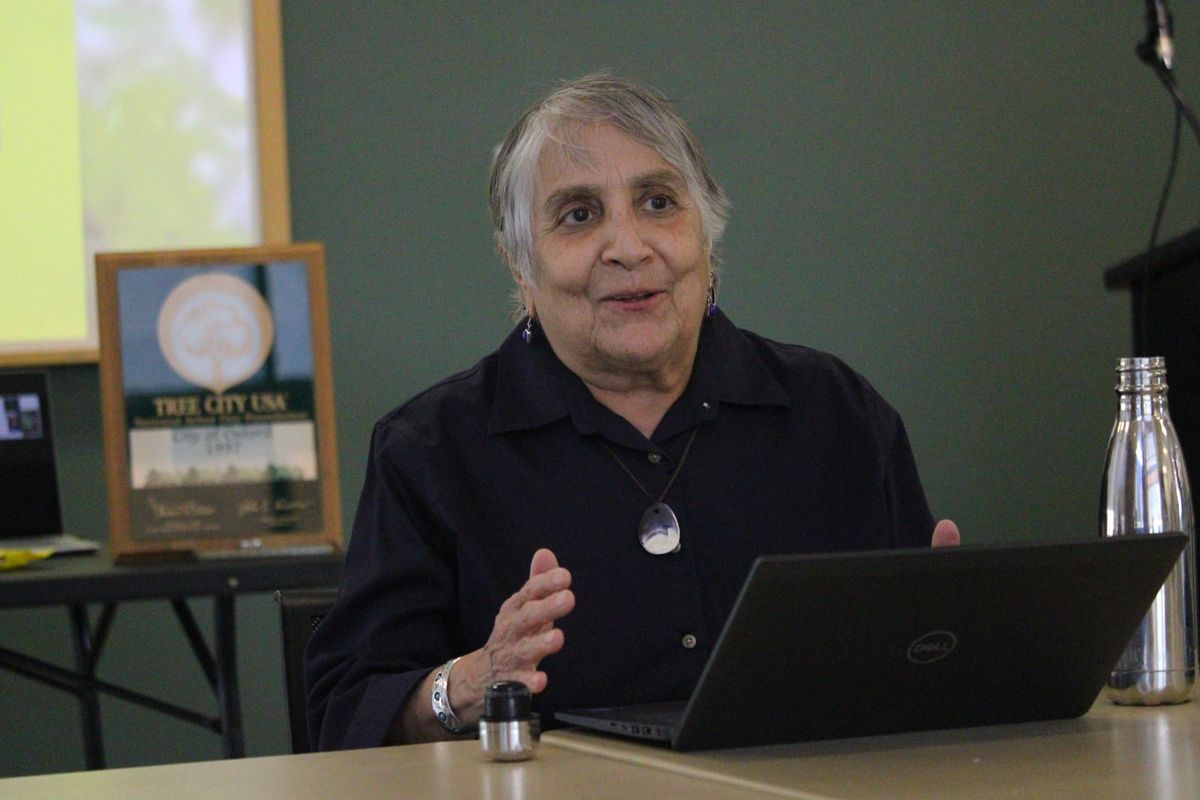
Roxanne Ornelas sees trees as “fellow beings” with whom humans share a planet that require care and nurturing, just like any other living species.
As an Indigenous-identifying person and Water Walker, Ornelas said there’s an interconnectedness of all life.
For example, she said trees contribute to everything around them by releasing oxygen into the atmosphere; providing a home for birds, insects and woodland creatures; providing for humans through food, medicine and other uses; and upholding the local biosystem and water table.
“We have these different types of connections, these stories that we've told over time,” Ornelas said. “It's not just a tree; it's so much more. It's alive.”
That’s why Ornelas decided to host a “Talking Trees” forum at the Oxford Lane Library, for which the first meeting was convened on Sept. 17.
The quarterly chat, she said, is meant to raise awareness about trees, native tree species and ensure people are being thoughtful about what trees are contributing to a place, while also learning how to care for them.
“Some of the types of trees that we've planted in town are not adapting to this climate very well, and so they have problems,” Ornelas said, adding the city council spoke earlier in the spring about recommendations for types of native trees to plant that will stay healthier over the years. “We have to be conscious of the types of trees that will thrive in the changing environment of where we live … because we all want to have more trees.”
Oxford was officially designated as a Tree City in 1997 by the Arbor Day Foundation, according to the Oxford Press archives, which considers four standards that must be met. The city must have a tree board or department, a public tree care ordinance, an annual expenditure of $2 per capita on community tree care activities and an Arbor Day observance and proclamation.
In 2025, the City of Oxford spent $78,098 on tree care activities, or around $3.56 per capita, according to Oxford Environmental Specialist David Treleaven.
Oxford maintains an Urban Forestry Program and cares for and maintains more than 3,000 street, park and public trees, not counting wooded lots, according to the city website. Oxford also sponsors a Tree Replacement Program to remove and replace dead ash trees and provides a complete list of approved street trees for viewing online.
Oxford also has a landscaping and tree preservation section (Chapter 1148) in its codified ordinance to “promote clean air quality; to reduce noise, heat and glare; to improve surface drainage and minimize flooding; to provide visual buffers; to beautify and enhance both improved and undeveloped areas;” among other listed purposes.
Each year since the city’s designation, it has continued to meet national Arbor Day Foundation requirements as a Tree City, according to Treleaven.
Ornelas said, as an academic who has done research on trees, she wanted members of the Oxford community to have a chance to come together to brainstorm ideas and share their concerns about trees in the area.
“This is one way for me to continue … that public education, and to get people involved, because I have a lot of passion about it,” Ornelas said.
As a city councilor, Ornelas said after hearing from constituents who attended the Talking Trees program, she plans to pay close attention to future development plans to see how trees intersect with those plans and how the city can be supportive of nurturing the environment.
For the first discussion, Ornelas invited Oxford native Kirsten Conrad, a landscape designer with horticulture experience and retired agriculture and natural resources extension agent for Virginia Tech.
Conrad served Arlington County and the City of Alexandria, Virginia, during a major initiative to preserve and increase the amount of tree canopy coverage. While working with local governments, she also collaborated with three volunteer programs to educate residents about the benefits and necessity of trees.
“It's kind of ingrained in my blood,” Conrad told the Oxford Free Press of why she wanted to present to locals at the library. “I'd like to promote a better understanding and appreciation for the cultivation and preservation of particularly street trees, but also (the) tree canopy for residential neighborhoods.”
Conrad presented the science behind the benefits of trees and plans that worked for her community.
“If you have a view of trees and a beautiful landscape out your hospital window, they have research that says you will heal faster. If you have a view, or even indoor plants in your office space, you will be more productive. Who knew?” Conrad told the group.
Among other benefits, Conrad said trees filter out pollutants in the air and water, protect biodiversity, cool city streets by two to four degrees Fahrenheit, delay damage to roadways, manage stormwater, increase property values and reduce rates of cardiac disease and strokes.
Conrad pointed to the need for cities to construct places for tree roots to grow when installing them near roadways or sidewalks so they’re not confined to a small patch of land. She said excessive salting in the winter can dry tree roots up that likely don’t get watered enough if the city doesn’t keep watch.
“I do think that Oxford residents need to think about what's important to them,” Conrad said. “I strongly believe that a community without trees is a very poor one, and we need to do what we can to not only protect older trees and take care of them, but also continue to plant and continue to educate people about the need for tree coverage.”
Conrad also pointed to the need to test soil before planting, as well as tree diseases and pests attacking trees in Ohio like Dutch Elm Disease and the Spongy Moth. She said trained professionals are available through the International Society of Arboriculture to assess the health of trees, which becomes important in conversations about saving older trees.
Conrad pointed to a tree sapling donation program from her community as an example of what Oxford residents could be doing to plant more native trees in the area. She asked if local organizations could come together with a shared vision or if business owners could look into planting more trees on their own properties.
In Virginia, Conrad said volunteers would often venture out and advise residents about tree selections and tree care for their properties. She also advised residents on pests and tree diseases and gave pruning classes.
Conrad said she feels there are many people in Oxford who care about the benefits of trees, like having cooler cities and healthier streams, who might be willing to create a volunteer force to help.
“I think the city does a pretty good job,” Conrad told the Oxford Free Press about tree maintenance in public spaces. “I also think that if there was more understanding, a better appreciation for the value of tree canopy coverage, that the city’s job would be easier.”
Ornelas said the next quarterly chat, centered on tree selection, planting and location, will be from 6-7:30 p.m. on Nov. 12 at the Oxford Lane Library at 441 S. Locust St.