
Classrooms on the ballot: How Butler County is navigating school funding
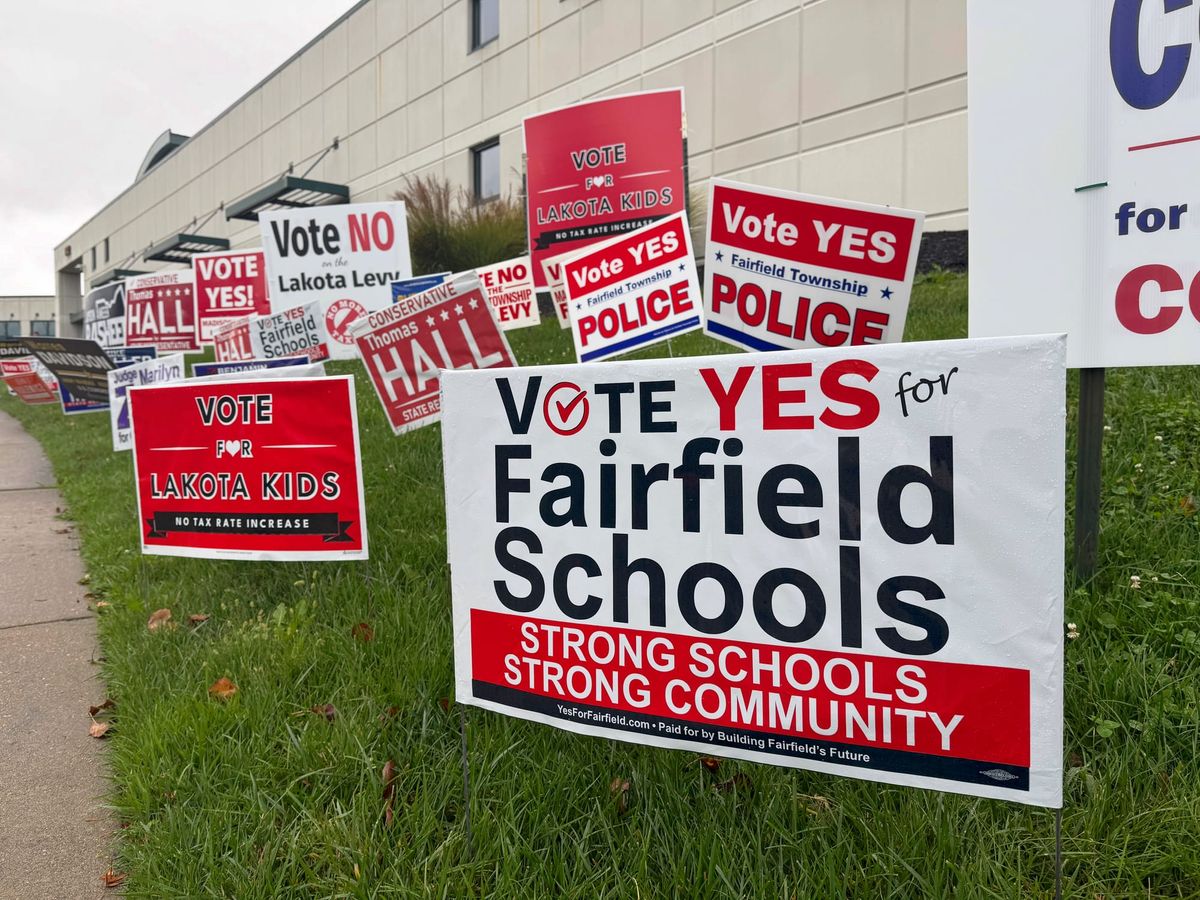
In Butler County, residents will see funding measures for Fairfield City School District, Lakota Local School District and Northwest Local School District when they vote. For some, this will be an attempt to pass a ballot initiative after several previous failures.
This story was produced by Miami University journalism students Molly Fahy and Mia Zurich in partnership with The Oxford Free Press.
For many Ohioans, it’s not unusual to see a school funding issue on the ballot. In fact, Ohio consistently has more school-funding ballot initiatives than any other state.
For school districts, a tax levy is often their primary source of income. Many see this as disadvantageous to low-income districts in Ohio.
In 1997’s DeRolph v. State, the Ohio Supreme Court ruled the use of property taxes as schools’ primary funding source unconstitutional. Schools in Ohio have struggled with funding since the initial ruling came down.
How does Ohio fund public schools?
Currently, the Ohio State Legislature allocates approximately $8 billion for public K-12 schools. However, many policy watchdogs, such as Policy Matters Ohio and Ohio Honesty for Education, argue that amount is $2.75 billion less than it should be, based on the number of schools in the state and the number of students they serve.
The Ohio Legislature uses the Fair School Funding Plan, based on 2022 financial data, to allocate dollars. It calculates how much money schools receive by assessing a district’s ability to raise revenue through local funding streams, like property taxes or tax levies. In low-income districts, the state provides extra funding to cover the gap, but there is often concern about how the state calculates low-income districts.
Additionally, the EdChoice voucher program allocates state money for scholarships that Ohio parents can use to send their K-12 students to non-public schools. In FY26, $1.17 billion of the state budget was earmarked for this program.
For schools that ask their communities to approve tax levies to combat funding deficits, fewer than 40% pass. This is partially due to financial concerns among those on a fixed income and a lack of connection to the school district.
Piet van Lier, the deputy director of Ohio Honesty for Education, a group that tracks legislation and helps schools during elections, says that many of these levies don’t pass because of a long history of the Ohio government devaluing public education.
“If people are struggling economically, it can be a big ask, if you don't feel connected to the schools,” van Lier said. “I think we've lost sight of that idea of public education as a common good. It's not just helping the students and families who use them. If it's done right, it is helping everybody.”
The Fair School Funding Plan was created in response to DeRolph v. State. Until then, schools were funded through property taxes allocated under H.B. 920, which capped levy funding. Under the bill, property tax levies for schools and libraries would not adjust with inflation, so if a school wanted more money, it was required to propose a new levy.
DeRolph argued that this system of school property taxes unfairly favored districts with higher property values. Since then, the Ohio Legislature tried several different funding avenues before establishing the Fair School Funding Plan in 2021. DeRolph also determined that schools could no longer use property taxes as a primary funding source, but could utilize other taxes instead.
In Butler County, residents will see funding measures for Fairfield City School District, Lakota Local School District and Northwest Local School District when they vote. For some, this will be an attempt to pass a ballot initiative after several previous failures.
Fairfield City School District
Voters in the Fairfield City School District will consider a temporary five-year, 1.25% earned income tax to support the district's general operating expenses. It would generate $23 million annually and apply only to wage earners, not those on investment or retirement incomes.
The Fairfield City School District has not passed an operating levy since Nov. 2011, which was projected to fund the district for two to three years. State funding has also decreased from 42.91% of covered costs to 24.23%. After several ballot measures failed, the district cut 84.5 positions and $5.7 million from its budget.
The district is Ohio's 17th-largest and serves more than 9,000 students. If the levy does not pass in the 2026-27 school year, Superintendent Billy Smith says that the district will have to make an additional $11 million in cuts. These cuts would include removing specials for elementary grades, reducing electives for middle and high school students and eliminating even more staff positions.
“I want to make sure (voters) have a clear understanding of what this district will move forward with at the beginning of the next school year if we don't pass a ballot issue by the end of this year,” Smith said. “I want people to have an open mind, look at the facts, understand the ramifications and vote appropriately.”
Lakota Local School District
The Lakota Local School District will vote on a 2.2 mill bond issue to fund the Master Facilities Plan (MFP). A levy is a direct property tax that funds day-to-day operating expenses, while a bond issue is a voter-approved request to borrow money.
The district would not begin collecting until 2029, when it pays off current bonds. Because the new bond replaces an existing one, the district does not anticipate increasing the current bond tax rate. The bond would help reduce overcrowding through smaller class sizes, increase electives, reduce transitions between schools and create more efficient bus routes for grades preschool-12.
Voters last approved an operating and permanent improvement (PI) levy for Lakota in 2013. The 2013 levy was forecast to last five years but is still funding the district in 2026, 13 years later. Voters last approved a bond issue for Lakota in 2005.
“We're going to have to work within our means. We're going to have to decide. If they vote no, is it worth pursuing a third time? Will the state money still be available?” said Lakota Local School District Treasurer Randall Bertram. “Those are all things that we're not sure of at this point. But we would relook at the situation at the time it comes to make that decision.”
Northwest Local School District
The Northwest Local School District ballot includes a 1.5% earned income tax levy. The incoming levy replaces two existing property taxes instead of adding a new net tax and will be phased in over 18 months, if approved.
The intended use of the levy is to maintain current levels of operations. This includes staff salaries and benefits, purchasing educational supplies and technology, maintaining and cleaning 1.3 million square feet of school facilities, funding extracurricular activities and programs and other operating costs.
Over the last two fiscal years, the district has operated in a deficit. Without additional revenue, the district will need to cut approximately $7 million in programs and services each year beginning in the 2027-28 school year.
“We are seeing incredible gains as a district, and we are having an incredible impact on children. In order to continue to have that positive impact on children and community, we are coming to them for this ballot issue that honors our commitment to being fiscally responsible and transparent,” Northwest Local School District Superintendent Darrell Yater said. “So it does, in essence, honor our partnership that we have committed to with the community over time.”
As school districts across Butler County return to voters seeking support, Ohio's decades-long struggle over how to fund public education continues. A recent appeals court ruling declared Ohio's EdChoice voucher program unconstitutional, finding that it diverts public dollars to a parallel education system and undermines funding for public schools.
Voters can find information on early voting, polling locations and view a sample ballot on www.ohiosos.gov/elections.