
Local Legends: Energy and enthusiasm
Along with organizing and carrying out programs, and teaching, Artz also spoke to local community groups, carried out fundraising activities, hired seasonal staff, coordinated volunteers, and oversaw the municipal pool and playgrounds.
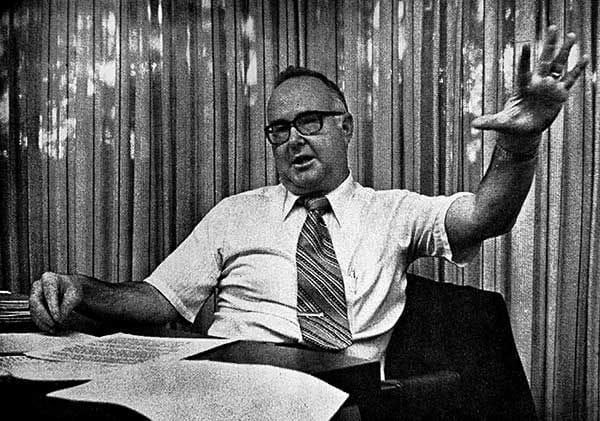
Robert Manford “Bob” Artz packed a lot of progress into only three years in Oxford, greatly enhancing the quality of life for Oxonians and loving what he did along the way.
Born on April 22, 1931 in Whitefish, Flathead County, Montana, he was the son of Manford Othello and Gladys M. (Caughren) Artz. His father’s career spanned over 48 years as a clerk for the Great Northern Railroad while his mother worked as a bank teller. Artz grew up in the area of Cut Bank, Montana where he attended school. His senior yearbook from Cut Bank High School described him as “a friendly boy, who has a word for everyone.”
Graduating from high school he went on to Montana State University and was listed in the 1950 census as living on campus and working as a soda jerk. After completing his bachelor’s degree, Artz transferred to Indiana University and earned a master’s degree in recreation and health.
Receiving a commission as a first lieutenant, Artz served a two-year stint in the U.S. Army from March 1954-March 1956. Likely because of his completed degree, Artz was placed in charge of recreation and stationed at Fort Lewis, Washington. Prior to his discharge, he married Patricia Lee “Pat” (O’Grady) Artz, on June 25, 1955, at Great Falls, Montana.
At the same time that his military service was drawing to a close, the City of Oxford and the Talawanda School District were working out a deal to split the cost of a year-round recreational director who would also serve as a phys-ed instructor at the high school. Artz started in the position on Sept. 4, 1956 and rapidly became a driving force in revolutionizing recreation in Oxford. This was illustrated by a Hamilton Daily Journal News headline three weeks later, “Recreation Leader Praised for Work.”
Artz briefly worked in a small town in North Dakota before coming to Oxford. While there, he set up a municipal recreation program, building it from the ground up. Working closely with the Oxford Federation of Clubs under president Herbert B. Weipking, Artz set to work designing a similar plan for Oxford, bringing in experts and coordinating with other regional municipalities undertaking the same type of work. The Federation had been the driving force behind the creation of a recreational program and the Oxford Press reported on their delight with Artz’s performance, “Federation members who were instrumental in getting a year-round program underway are happy to see a man with such thorough training for the job and so much energy and enthusiasm.”
However, Artz wasn’t just planning, he was also doing. One of the first professional actions he took was to join the board of the Oxford Baseball Association at the time of its formation, studying the feasibility of creating Little League and Babe Ruth League baseball.
Between 1957 and 1959, Artz also put on a bowling clinic with a professional bowler, held an educational session for women’s volleyball, organized a roller skating trip to Richmond, Indiana, held special recreational sessions for the holidays, organized a softball league, held a day of camping in the woods near Western College, started an indoor recreation program for adults and developed a Senior Citizens’ program.
Taking over an initiative that had been introduced at the same time as his position, Artz brought the Oxford Teen Canteen into being in November 1957. The Teen Canteen, which was held at various times at the Talawanda High School and Stewart buildings, was an informal club where local teenagers could come and play games and dance. Not only did Artz manage the program, but he also arranged for the canteen to acquire and install a shuffle board at Talawanda High School for club use.
Along with organizing and carrying out programs and teaching, Artz also spoke to local community groups, carried out fundraising activities, hired seasonal staff, coordinated volunteers, and oversaw the municipal pool and playgrounds. This included arranging for Phi Delta Theta fraternity members to donate labor for rehabilitating two village playgrounds ahead of the Summer of 1958.
He wasn’t alone in the effort. Pat, who also taught at Talawanda, donated a lot of her time to the recreational programs organized by her husband. On Jan. 16, 1958, Artz announced the formation of a recreational board for Oxford – a board that he would work closely with to ensure the long-term success of local recreational programs.
After initially suggesting to Mary Jo Branch, Talawanda’s librarian, that a program be started to circulate books for adults in the community, he and Branch instead ended up advocating for the creation of a public library for Oxford. The idea, which sources credited to Artz, culminated with the opening of the Oxford Lane Library on Sept. 26, 1958 at its original East Park Place location.
The nontraditional nature of Artz’s job and the split payment arrangement between Oxford and Talawanda led to turmoil at times, especially when pay increases and more paid time off were being considered. In December 1958, village councilors debated each other over the return of a pay increase for Artz, given his split-time job. Even as the discussions were ongoing, Artz was organizing a craft program for local children.
The uncertainty over the future growth of his position may have been a factor in Artz’s decision to resign in December 1959. He had been given the opportunity to become the director of the Willamalane Park and Recreation District in Springfield, Oregon and saw it as a major opportunity.
Artz stayed in Oxford long enough to help with interviewing for his replacement, a position that ultimately ended up going to fellow IU graduate John Howe. Artz’s move proved to be the start of a major upward trajectory that would take him next to Annandale, Virginia, then to California, where he ran the Rancho Simi Recreation and Park District and would eventually lead to him becoming the director of parks for the State of Illinois in January 1979.
When he moved to Chicago for the position, Pat remained behind in California to care for her aging mother, Elizabeth Josephine (Pilgeram) O'Grady. In an effort to surprise his wife with an unplanned trip home for Memorial Day, Artz bought two plane tickets to ensure that he could catch one of the flights. He ended up boarding American Airlines Flight 191 on May 29, 1979.
As the McDonnell Douglas DC-10 took off from O’Hare International Airport en route to LAX, wind ripped one of its engines off of the aircraft, damaging a wing and causing it to fall on the runway below. The heavily damaged aircraft entered an unrecoverable bank and slammed into the ground – exploding less than a mile from the airport with a full load of fuel.
Artz, at 48 years old, was killed instantly along with 272 other souls aboard the DC-10 and two others on the ground – victims of the deadliest plane crash in the history of the North American continent. The engine detachment was later attributed by the National Transportation Safety Board to poor maintenance on the part of American Airlines.
Artz made a positive impact on the lives of an untold number of children and other community members across the country. By the time of his death, Artz had already received a distinguished alumni award from IU and a distinguished service award from the National Recreation and Park Association. Oxford’s Artz Park, at South Main and Chestnut Streets, was named in his memory on Feb. 3, 1981.
Brad Spurlock is the manager of the Smith Library of Regional History and Cummins Local History Room, Lane Libraries. A certified archivist, Brad has over a decade of experience working with local history, maintaining archival collections and collaborating on community history projects. He also serves as a board member for Historic Hamilton Inc. and the Butler County Historical Society.