
Media Matters: Polls, politics and $$$
This election cycle was “the most expensive in history,” with total spending at $11.9 billion, according to OpenSecrets.
So, how did the pollsters do in predicting the big Ohio elections last week? Here are snapshots of polling averages from RealClearPolitics on the day of the election.
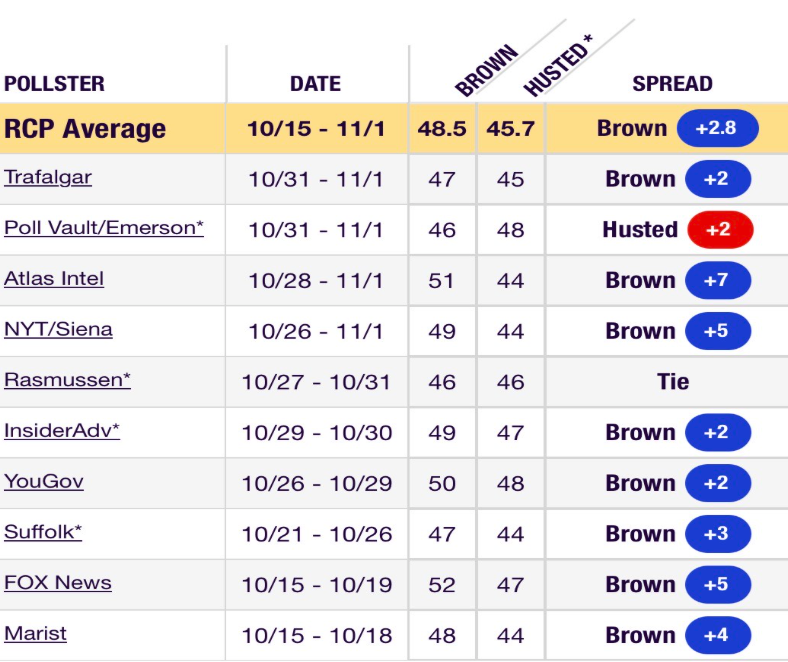
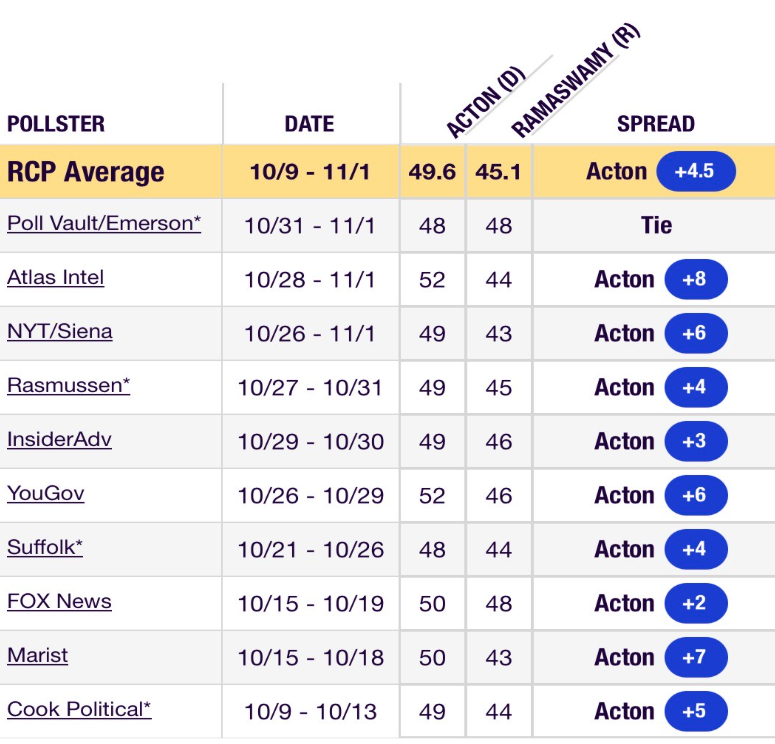
Polling averages from RealClearPolitics.com on the day of the election. Charts courtesy of RealClearPolitics.com.
Amy Acton, elected as Ohio’s first woman governor (why did it take this long?), had a 4.5% advantage in the final poll averages, but won by almost 8%. The Atlas Intel and Marist polls got this one right. In the U.S. Senate race, Democratic candidate Sherrod Brown had a 2.8% edge in the spread over Republican Jon Husted. Brown’s win was closer to 5%. New York Times/Siena and Fox News pollsters nailed it. Both winning candidates beat the polling averages.
Now, let’s talk about money.
In Ohio’s Senate race, Brown’s campaign outspent the incumbent Husted $68 million to $20 million, according to OpenSecrets, a nonpartisan research group that tracks ad spending. But in the governor’s race, the Republican candidate Vivek Ramaswamy spent $82 million, including $41 million of his own money, Open Secrets reported. Acton’s campaign spent $37 million. In sum, money did not explain the results.
The Ramaswamy campaign also can claim credit for producing the sleaziest and most controversial ad of the entire campaign season. According to OpenSecrets, Donna Arthur – Acton’s birth mother – calls her daughter a “liar” in the ad and suggested she had mental health problems. Acton, who, along with her brother, experienced homelessness and abuse as a child, has not seen her mother since 1978 – the year Donna Arthur lost custody. Cledith Arthur, Donna’s husband and the children’s stepfather, was arrested in July 1978 and charged with raping Acton when she was 12, the Associated Press reported, citing court and police records. The stepfather pleaded not guilty but was indicted by a grand jury. He fled the state and remained a wanted fugitive until at least 1983. He died in 2004. Donna Arthur lives in Pennsylvania, where Cledith hid out for more than 25 years.
Although Ramaswamy spent $1 million on this one ad, his campaign eventually pulled it. Ohio’s Republican governor (and Miami University grad) Mike DeWine condemned the ad. Both President Trump and Vice President Vance, however, defended the spot.
So how effective is all the political ad spending these days, where many of us can avoid advertising altogether by staying away from commercial TV and staying off YouTube? A recent headline from a Reuters news service website captures the massive failure of this election’s political ads: “How much does it cost to lose the Senate? More than $1 billion.”
This election cycle was “the most expensive in history,” with total spending at $11.9 billion, according to OpenSecrets. In the U.S. Senate races alone, outside groups and individuals spent more than $2 billion. That was separate from all of the candidates’ own spending. Republican-connected organizations spent 60% more than Democratic-affiliated groups – but that did not prevent the GOP from losing the Senate.
Back in 2021, a Cambridge University study of national elections between 2000-2018 showed “that television advertising is related to election outcomes: the larger a candidate’s advantage in advertising compared with that of their opponent, the larger their share of the vote.” That has changed. In 2026, Republicans lost more than 40 House seats and at least seven Senate seats (maybe nine when all the voting is tabulated) even though they outspent Democrats nearly 2-to-1. It seems that anxiety about rising food costs, soaring gas prices, masked ICE thugs and the neverending Iran war trumped the money.
In addition to the Ohio governor's race, Texas was an outsized example of the failure of TV ads. “They say everything is bigger in Texas,” Reuters reported, “and that was certainly true in the state’s U.S. Senate race. The world’s richest person, Elon Musk, and other deep-pocketed Republicans spent $316 million to back state Attorney General Ken Paxton, who struggled to raise money on his own. Democratic groups spent $109 million to support James Talarico, whose campaign raised more than $146 million directly.” Texas’ other GOP senator, Ted Cruz, said in a social media post, “2026 was not simply a blue wave. It was a blue tsunami.” While I like the Cruz water metaphor, a better one might be that a very large posse of unhappy voters ran a lot of the Texas GOP out of town.
During the election cycle, Ohioans reported “widespread irritation with the onslaught of political ads.” Those not annoyed by the ads were TV station owners. According to AdImpact, the U.S. Senate race in Ohio alone brought in $88 million in TV ads. Nationwide, local TV station owners, like Nexstar (which owns 132 stations), Gray (122) and Sinclair (82), raked in nearly 50% of all political TV dollars spent this election cycle. But anxious voters had to endure (or mute) a deluge of negative ads that rudely interrupted everything from local news to the World Series. While overall Republican candidates benefited little from all the ad spending, TV stations raked it in. I wonder if they will hire more reporters?
By the 2028 election, local TV stations will face a challenger. The Economic Times reports: “Harvard Kennedy School strategists from both parties described a future in which AI could reshape how campaigns find voters, create political advertising and even figure out what might persuade someone to cast a ballot.”
Stay tuned.
Richard Campbell is a professor emeritus and founding chair of the Department of Media, Journalism & Film at Miami University. He is also a co-founder of the Oxford Free Press.