
Local Legends: Old Stoddy
"Stoddard was born on Aug. 23, 1812 in Lisle, New York, the son of James Stoddard and Lucy (Steele) Stoddard. Little else is known of his early life."
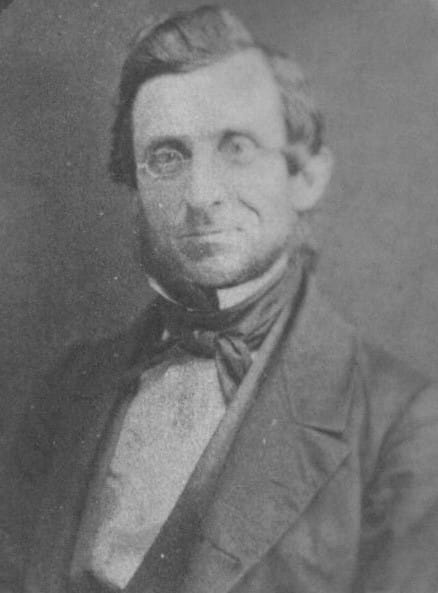
Orange Nash “O.N.” Stoddard loved science and teaching, but wasn’t too big a fan of pranks, evolution, or the curveball.
Stoddard was born on Aug. 23, 1812 in Lisle, New York, the son of James Stoddard and Lucy (Steele) Stoddard. Little else is known of his early life.
After completing his undergraduate studies at Union College in 1834, Stoddard became a teacher, working mostly in Virginia. In 1839, he moved to Washington, D.C. where he took over as the principal of Capital Hill Seminary for three years.
Almira Griffith (Clark) Stoddard became his first wife in 1837, though she died within the first three years of their marriage. Stoddard was married a second time in 1840, to New Hampshire native Eliza (Wheeler) Stoddard, who would remain with him for the majority of his life.
In 1841, Stoddard took his new bride west, first to Kentucky where he taught at an academy in Bardstown and then to Indiana where he became a professor of natural sciences at Hanover College in 1843. However, the Stoddards possibly returned to Kentucky in 1846 where their first child Lucy E. (Stoddard) Hamilton was born.
Although he remained a professor of natural sciences for the remainder of his academic career, and life for that matter, Stoddard relocated in 1845 to the first of the two institutions with whom he would be most closely associated, Miami University. Stoddard arrived to fill a position left open by John Witherspoon Scott, father of future first lady Caroline Scott Harrison, who had left the university with Robert Hamilton Bishop following a series of ideological disputes among the Presbyterian leadership of Miami.
Eliza gave birth to three children in Oxford, for a total of four daughters, Louise W. Stoddard, Alice or Alace M. (Stoddard) Ankney and Mary E. (Stoddard) Longbrake. Also living in the Stoddard home at 14-16 South Campus Ave., now the Interfaith Center, was Emily B. (Stoddard) Corey and a Black domestic servant named Phoebe Dickinson.
Stoddard carried out his work in a one-room laboratory on Miami’s campus referred to as “Old Egypt.” An extremely intelligent individual, Stoddard was described in the “Cincinnati Enquirer” as being “of giant intellect.” However, he was also a highly capable teacher, being able to break down extremely complex subjects to the level of understanding of his students, especially through the use of metaphors.
This was a strong contributor to the great deal of respect shown to him by his students. They called him “Old Stoddy” and “The Little Wizard,” the latter of which being a reference to his diminutive stature and ability to tinker any needed tool or contraption into existence. However, that didn’t stop them from playing an occasional prank on him.
Stoddard religiously recorded rainfall measurements, which he conveyed to the Smithsonian Institute on a regular basis. One night when a light drizzle misted down upon Oxford, two of his students, David Swing, later a nationally recognized theologian, and Benjamin Harrison, future husband of Caroline Scott Harrison and president of the United States, filled Stoddard’s rain gauge up to its brim, perplexing Stoddard as to the nature of the rainfall experienced the next morning when he took his measurements.
In another prank, students shifted the seat of the pew where six professors, including Stoddard, regularly sat for chapel two inches to the right. When the last of the professors, Charles Elliott, seated himself on the right end of the pew, it came crashing down to the floor and in the process briefly launched the slightly built Stoddard, sitting on the left of the pew, into the air.
Sitting at the crossroads of science and religion in the 1850s, Stoddard was not a fan of the man-descended-from-age argument popularized by Charles Dawin’s “Origin of Species.” He purportedly told his students, “If anyone wishes to argue the question, I will decline. To say that we are descended from the howling monkey and the yelling baboon, I will not agree to; yet I will allow it to be true in his case.”
As the American Civil War began, the University Rifles, a company of militia, was formed under the command of Ozro Dodds. Stoddard purchased the silk from Cincinnati that Oxford’s women used in making the company’s banner.
In 1865, the same year the war came to an end, Stoddard earned his Doctor of Laws from Monmouth College and later became a member of the American Association for the Advancement of Science. He was also a member of the Alpha Delta Phi fraternity.
Around that time he also lectured to female students from Oxford Female College and guest lectured at community events such as the “Elements of Natural Greatness” lecture he gave for the Cincinnati YMCA in 1869.
Stoddard made what was likely a hard decision in 1870, deciding to leave Miami, where he had not only been a professor for so long but had also served two brief terms as acting president of university, once in 1847 and again in 1854. He instead accepted a position at Wooster College in Wooster, Ohio, where he continued on as a professor of natural sciences for another decade and a half.
A resolution from Miami’s trustees was read in his honor at the 1870 Miami University commencement, “this board feel specially called upon to express their high appreciation of his ability as a scholar, and of his capacity and faithfulness as an instructor. His devotion to science, his character as a man, and his ripe experience in imparting knowledge, entitle him to the respect and confidence of those with whom he shall hereafter labor.” He was also gifted a “costly gold watch and chain” inscribed from old friends, pupils, and graduates.
In addition to Swing and Harrison, Stoddard’s students at Miami also included John Willock Noble, Secretary of the Interior, and Whitelaw Reid, notable newspaperman and ambassador to France and the United Kingdom. Stoddard’s exit was just in time, as, due to financial trouble, the university closed three years later in 1873, ending the “Old Miami” period.
The most memorable event of Stoddard’s career at Wooster involved an academic dispute with his old Miami colleague Robert White McFarland, then a mathematics and engineering professor at The Ohio Agricultural and Mechanical College, now Ohio State University, in October 1877. The burning question at the center of the debate, which was started by and reported upon by the “Cincinnati Enquirer,” was, to paraphrase, ‘is a curveball real?’
Stoddard contended that the curveball was a fallacy and against principles of physics developed by Sir Isaac Newton. McFarland, as well as Sandy Koufax, Satchel Paige and Nolan Ryan, disagreed, offering an explanation related to drag and pressure.
When then President Benjamin Harrison visited Wooster College on a rainy day, Stoddard greeted him, “I’m sorry, Mr. President, we greet you with such wet weather.” Harrison replied in reference to the 40 year old prank, “There’s not as much rain as you measured that night in Oxford” before snitching on his accomplice, “David Swing did that.”
Stoddard retired in 1883, being honored as a professor emeritus and remained in Wooster where he was a member of Westminster Presbyterian Church. Eliza died the following year on Aug. 2, 1884, and Stoddard remarried in 1886, wedding Mary J. (Beall) Stoddard, widow of Thomas Culbertson.
He died in Wooster on Feb. 10, 1892 and was buried in Wooster Cemetery. Mary survived him for five years, dying on Dec. 10, 1897.
In 1936, “Old South,” one of Miami’s original two dormitories, was renamed “Stoddard Hall” in Stoddard’s memory. The other original dorm was named for the professor at the other end of the pew, Charles Elliott.
Brad Spurlock is the manager of the Smith Library of Regional History and Cummins Local History Room, Lane Libraries. A certified archivist, Brad has over a decade of experience working with local history, maintaining archival collections and collaborating on community history projects. He also serves as a board member for Historic Hamilton Inc. and the Butler County Historical Society.
![[clockwise from top] Tatsoi, Tokyo Bekana and Komatsuma.](/content/images/size/w720/2026/02/01-5.jpg)