
Local Legends: The international architect
Even into his last years, Furth continued drawing, sketching actors on TV and objects from daily life, oftentimes giving away his sketches.
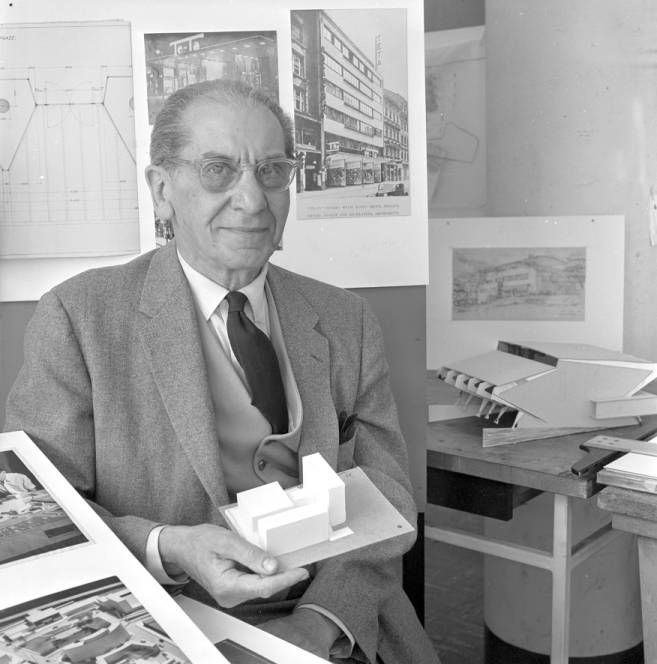
Victor Furth, anglicized from the original Viktor Fürth, lived an international life of designing International Style art.
Furth was born into a German speaking Jewish family on Feb. 16, 1893 in Horažďovice, Bohemia – at the time, part of the Austro-Hungarian Empire. His father, Rudolph Fürth, co-owned a paper company, but moved the family to Prague after his factory burned.
Furth grew up in Prague where he attended ethnic German primary and secondary schools, including Deutsche Volkschule and the Mikulandská Street school. His studies in Prague were interrupted by World War I, during which Furth served in the Austrian cavalry and saw combat against Russian forces in Galicia where he was wounded by a bayonet to the abdomen.
In 1918, he completed his service while stationed on the Italian Front and returned to his architecture studies at K.K. Deutsche Technische Hochschule, a German polytechnic school where he had begun studying architecture prior to the war. Graduating in 1923, Furth partnered with his classmate and best friend Ernst Mühlstein in co-owning a design firm. For the next decade and a half, Furth and Mühlstein worked in Prague, mostly designing multi-unit residential structures in the emerging International Style.
The International Style became a specialty of Furth. Considered avant gard at the time of Furth’s early work, especially in the highly ornate medieval city of Prague, the modernist architectural style featured flat roofs, smooth white stucco surfaces, large linear window groupings and an intentional lack of ornamentation.
In 1929, Furth married Martha Maria (Stein) Furth and their only child Martin Furth was born the following year. With the exception of the death of Furth’s father in 1937, all was well until the annexation of the Sudetenland by Nazi Germany in late 1938 and subsequent invasion of Czechoslovakia the following March.
Furth’s family was splintered and fled Europe with Martha ending up in Egypt with British forces while his son was in Great Britain. Furth himself was in Italy at the time and traveled to France where he enlisted in the Czech Army in the Nice-Marseille area on Nov. 16, 1939, though the extent of his service was likely limited. Mühlstein also made it out, but went to Australia where he enlisted in the Australian Army Reserve and again worked as an architect after the war.
Although Furth survived the war, the Holocaust decimated this family. His sister Elsa (Furth) Pollak and brother-in-law Oskar Pollak were transferred from Prague to Łódź in 1941, where they were murdered by the Nazis. His mother, Anna (Weil) Furth, and brother, Arnost Furth, were interred at the Terezín Concentration Camp, where Anna was killed in 1944. Arnost was killed at Auschwitz in 1943, after being transferred there from Terezín. Other members of his extended family were also killed in the Holocaust with only “nieces and nephews in Europe” being listed as surviving him in his obituary.
Furth was a British subject living in London at the end of World War II, during which he had worked as an architectural engineer. Furth found himself at the forefront of the monumental effort to rebuild Europe. Between 1945 and 1947, he served with the United Nations Relief and Rehabilitation Administration, working to rebuild 32,000 replacement structures in Germany and Greece that were destroyed during the war.
In 1947, Furth opened his own architectural firm in London and was later registered as a member of the Architects Registration Council of the United Kingdom. Two years later, he received a job offer to be a visiting professor at Miami University. Accepting the position, he immigrated to the United States, landing in New York on Sept. 19, 1949.
Martha and Martin remained in London until 1954, when Furth returned to get them and brought them back to Oxford with him to live permanently. His sister-in-law Catherine (Stein) Guckler also joined the family living in Oxford at the family home at 103 W. Walnut St.
Furth flourished as a member of Miami’s faculty and gained a reputation for the speed at which he could create a sketch. He believed in a strong link between art and architecture – a topic he presented on to community groups and included within his classroom lectures. In 1956, he helped create a graduate program in city design, an early version of urban planning studies.
In addition to teaching, he also worked in Oxford with examples of his International Style designs including the Bern Street Apartments, created for local real estate developer Paul W. Baer in 1969, and the Macklin House at 211 Oakhill Dr., built in 1963.
Furth retired in 1963, but continued on with Miami as a part-time lecturer for another 13 years as a professor emeritus. Speaking volumes as to his commitment to his students, when Miami wanted to put on an exhibition of his work in 1972, Furth only agreed on the condition that the work of his former students also be included.
Even into his last years, Furth continued drawing, sketching actors on TV and objects from daily life, oftentimes giving away his sketches. When asked in 1982 why he continued drawing, Furth replied that it was for the same reason he had always drawn, to record his “personal, visual, and emotional relationship with our environment.”
He died at McCullough-Hyde Hospital on Aug. 23, 1984 and was buried in an unmarked grave. It was only through the efforts of other Miami University professors in 2009 that Furth, along with fellow German speaking Jewish architect and Miami professor Rudolf Frankel, was posthumously granted emeritus status and was reburied in the Miami University section of Oxford Cemetery with a university headstone. Martin and Martha were interred alongside him following their deaths Martin in 1993 and 1997, respectively.
Following his death, an editorial by the Oxford Press remembered Furth with affection, “He remained interested in the world about him and jaunty almost to the end, slower of step perhaps, but always with a friendly “hello” and wearing a bright-colored ascot or a stylish cap as he passed by The Oxford Press on his walks uptown. Neighbor Victor Furth is another longtime friend whom we shall miss.”
Brad Spurlock is the manager of the Smith Library of Regional History and Cummins Local History Room, Lane Libraries. A certified archivist, Brad has over a decade of experience working with local history, maintaining archival collections and collaborating on community history projects. He also serves as a board member for Historic Hamilton Inc. and the Butler County Historical Society.