

Local Legends: Forlorn hope
In July 1894, DeWitt received news that he would be awarded the Medal of Honor for his actions during the Battle of Vicksburg, Mississippi on May 22, 1863.
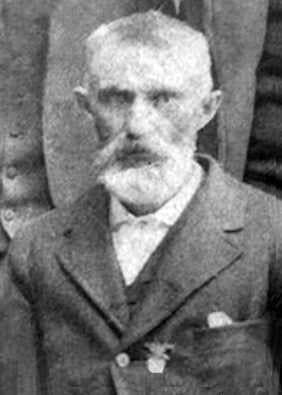
Medal of Honor recipient Richard Willis DeWitt was one of only six Butler County soldiers to receive the nation’s highest military honor for service during the American Civil War.
Born on June 25, 1838, DeWitt was the son of William R. and Elizabeth (Beard) DeWitt. The DeWitts were part of the extended family of Zachariah DeWitt, one of the first settlers in the Oxford area.
Growing up on the family’s 205-acre farm in Section 18 of Milford Township, DeWitt was working as a farmhand for his father when the first states in the American South began to secede from the Union. With the onset of the American Civil War, DeWitt enlisted as a private in Company D, 47th Ohio Volunteer Infantry (OVI) Regiment on July 15, 1861.
The 47th OVI was mustered into service at Camp Dennison the following month and sent to the Kanawha Valley in present-day West Virginia. DeWitt’s regiment served in support of the Union forces that were engaged in a series of smaller scale battles in the Kanawha Valley over the next several months.
After the Battle of Shiloh, Abraham Lincoln instructed General Ulysses S. Grant to take the critical Confederate stronghold of Vicksburg, Mississippi with the idea of splitting the Confederate States in two and taking total control of the Mississippi River. Planning a daring operation, Grant attacked from the west side of the Mississippi, below Vicksburg, using U.S. Navy gunboats for artillery support while other navy vessels conveyed his troops across the river.
Having successfully completed the move and engaged and defeated enemy forces to the south and east of Vicksburg, Grant now moved directly against the Confederate stronghold, surrounding it and commencing a siege on May 18, 1863. The first Union assault against Vicksburg was launched the following day, but failed.
DeWitt, who had been promoted to corporal on April 1, and his regiment reached the front line while Grant was in the midst of planning his second attack against Vicksburg. One particular Confederate defense proved formidable, a v-shaped high parapet surrounded by a moat called Stockade Redan.
To overcome these obstacles Grant directed Major General Francis Preston Blair Jr. to assemble a party of 150 unmarried volunteers, mostly from his command’s 3rd Brigade, to form an ad hoc assault unit. However, rather than carry weapons, the men would advance in waves with the first 50 carrying heavy timbers to lay across the moat, the next 50 carrying planks to lay across the timbers, creating a bridge, and the final 50 carrying ladders that they would place against the parapet. The line infantry regiments that followed the advance party would then cross the bridges and scale the ladders to take Stockade Redan.
Although the mission meant almost certain death, DeWitt volunteered anyway. On May 22, he stepped off for his pioneering mission, using the cover of the terrain to move up to the road, called Graveyard Road, that led to Stockade Redan. However, from that point forward, the terrain favored the defenders. DeWitt sprinted across 150 yards of open killing ground under heavy enemy fire, while his fellow volunteers began to drop around him.
One of the four infantry regiments that followed made it to the enemy parapet, but the next became pinned down by the Confederate fire, creating a bottleneck that disallowed the last two regiments, including the 47th OVI, from continuing the attack. Major General William Tecumseh Sherman, who was observing the attack, commented on what he saw, “A small party, that might be called a forlorn hope, provided with plank to cross the ditch, advanced at a run, up to the very ditch … the lines of infantry sprang from cover, and advanced rapidly in line of battle.”
Sherman had unknowingly given the unit of volunteers, as well as their mission, its name. The survivors of Forlorn Hope, including DeWitt, took cover at the base of Stockade Redan, where the slope of the parapet prevented the rebels from being able to depress their weapons far enough to fire on them. With the assault clearly having failed, Forlorn Hope remained in that position until nightfall when they withdrew under cover of darkness back to the Federal lines. DeWitt survived the mission unscathed, though 19 of the 150 were left dead on the field with another 34 wounded.
The Siege of Vicksburg continued until the Confederate garrison finally surrendered on July 4, 1863, the nation's 87th birthday and the day after the major Union victory at Gettysburg in the eastern theater. DeWitt was promoted to sergeant on Aug. 20, 1864. His war was far from being over, and the 147th OVI took part in the Chattanooga Campaign, Atlanta Campaign, Sherman’s March to the Sea and the Carolinas Campaign, seeing plenty more action along the way.
DeWitt was discharged at Little Rock, Arkansas on Aug. 8, 1865 and returned to the farm. On Dec. 19, 1865, he married Harriet (Morris) DeWitt. Together they raised three children, Ada (DeWitt) Simonson, Elizabeth (DeWitt) Palmer, and Clinton DeWitt, born in 1866, 1868 and 1875 respectively.
In July 1894, DeWitt received news that he would be awarded the Medal of Honor for his actions during the Battle of Vicksburg, Mississippi on May 22, 1863. He was one of 78 survivors of Forlorn Hope who were all awarded the Medal of Honor 31 years after the action. The citations for their medals were identical reading, “gallantry in the charge of the volunteer storming party.” Another Butler County native, Benjamin W. Schenck, who had served with an Illinois regiment at Vicksburg, was also one the 78.
The DeWitts retired from farming in 1902 and moved to 214 South Main St. in Oxford. DeWitt died of liver cancer on Sept. 16, 1909 in Vigo County, Indiana and was buried in the family plot in Oxford Cemetery. He was given honors from the International Order of Odd Fellows as well as the Grand Army of the Republic.
By 2005, DeWitt’s headstone was in poor condition and continuing to disintegrate. Acting on behalf of the Oxford Cemetery Association, Jack Beaton acquired a new headstone for DeWitt, funded through the Medal of Honor Historical Society, marking the lasting impact DeWitt’s actions on the battlefront and back home in Butler County continued to have on the community.
Brad Spurlock is the manager of the Smith Library of Regional History and Cummins Local History Room, Lane Libraries. A certified archivist, Brad has over a decade of experience working with local history, maintaining archival collections and collaborating on community history projects. He also serves as a board member for Historic Hamilton Inc. and the Butler County Historical Society.