
Local Legends: The reluctant president
“Hughes was regarded by former associates as an administrator combining the scientist’s emphasis on method and detail with shrewd judgment of persons and warm regard for their welfare.”
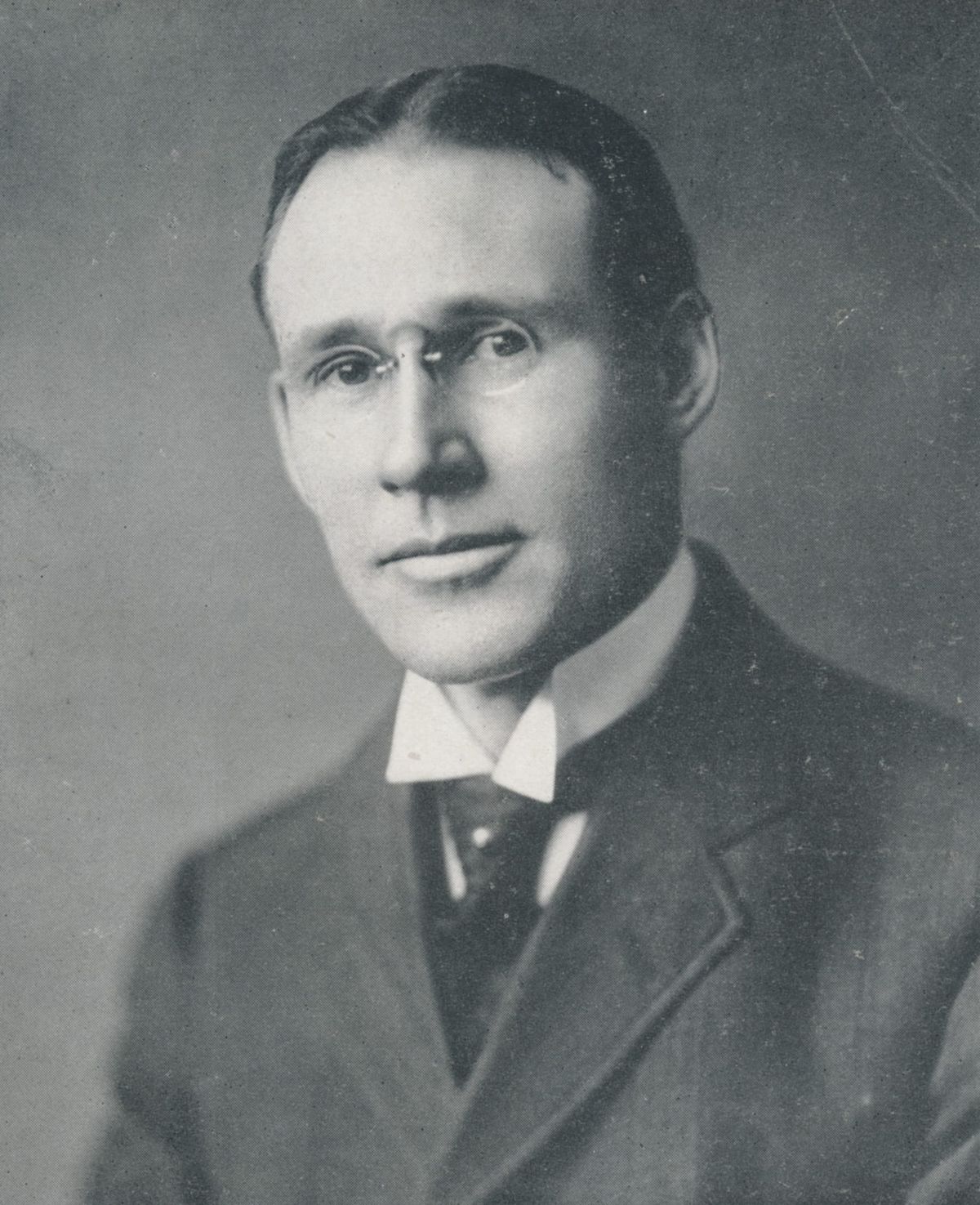
Raymond Mollyneaux Hughes was unsuccessful in his efforts to refuse to serve as the president of Miami University, going on to greatly expand and modernize the university.
Although born in Atlantic, Iowa on Jan. 14, 1873, Hughes had a strong connection to Oxford. Both his parents, Melancthon and Emily A. (Mollyneaux) Hughes, were natives of the village and graduates of Miami University and Oxford College for Women, respectively. His paternal great-grand-uncle had been the headmaster of Miami’s grammar school which opened prior to the establishment of college classes.
It was Hughes’ father’s missionary work on behalf of the Presbyterian church that led to his western birth. The family traveled throughout the Wild West, eventually landing in Sante Fe, New Mexico in search of a dry climate to relieve Melancthon’s tuberculosis.
Although he appeared to rally at one point, Hughes’ father died on Nov. 18, 1873, when he was just 10 months old, prompting his mother to return to Oxford.
Hughes came up through Oxford’s public school before attending Miami’s preparatory school and entered the university at age 16 for the 1888-89 school year. At Miami, Hughes exhibited a thirst for knowledge, being recorded in his senior yearbook, the first “Recensio,” ever published, as having, “to be versed in everything.” His scholarly work led to Hughes being made a member of Delta Kappa Epsilon.
Hughes sought to pursue a career in electrical engineering, having developed a strong personal interest in electricity. Instead, he ended up teaching science and physical geography classes at Hamilton High School as a result of limited professional opportunities available during the Panic of 1893.
Taking classes at the University of Chicago during the summers of 1894 and 1895 led to Hughes being offered a fellowship at The Ohio State University by Dr. William McPherson. Completing his master’s from OSU, Hughes also studied for a year at the Massachusetts Institute of Technology before returning to OSU to begin his career in higher education.
However, Hughes was only there for part of the summer before being offered the position of professor of chemistry and physics, a position that later evolved into two entire departments, that had been vacated just before the beginning of the school 1898-99 year as a result of professor Henry Snyder’s suicide. With his acceptance of the post, Hughes returned home to Oxford.
Two years later, Hughes became acquainted with Ella Brainerd (Rogers) Hughes during a visit she made to Oxford – the beginning of a courtship that resulted in their marriage on July 11, 1901. Their first child Thomas Rogers “Tom” Hughes followed in 1902 with a daughter Ella Rogers (Hughes) Boyce being born in 1908.
In 1908, Hughes became dean of the College of Liberal Arts, but occupied the office for only three years before president Guy Potter Benton left to become president of the University of Vermont. He had been on sabbatical and when he returned was convinced to accept the presidency on an acting basis only as he wished to remain a chemistry professor. However, Hughes was not a man to sit idly by and began steering the university toward progress.
His actions were so favorably viewed by the board of trustees that even while Hughes sought to find a permanent president, Walter L. Tobey, president of the board, communicated to him, “we will not consider any other man, unless you absolutely forbid us to elect you.” Finally assenting, Hughes became the official president in 1913.
The decision of the trustees proved to be as solid as bedrock over the next 15 years. It was later written of him, “No one knew more about Miami or had his interests more at heart than this young man of 38. He had already seen Miami grow from an enrollment of 55 to one of 503. He knew all of his students and all of his faculty personally; he knew his Board and most of his alumni. He had helped to build the Miami of 1911; he kept on building, in every way he knew, not neglecting the land and structures on the land, but concentrating first and always on the quality of instruction and of student work.”
In addition to his institutional knowledge, Hughes also had foresight and leadership ability, “Hughes was regarded by former associates as an administrator combining the scientist’s emphasis on method and detail with shrewd judgment of persons and warm regard for their welfare.”
He accomplished much during his tenure, including the creation of 25- and 50-year campus expansion plans, a land acquisition program, a student loan program, Miami’s Department of Religion,and the Miami Chest campaign.
The land initiatives of Hughes proved to be especially important in the long term and was largely responsible for allowing Miami to have the physical space it needed for expansion, especially during the post-war period.
Taking the concept from the establishment of an artist in residence at Western College, Edgar Stillman Kelley, by president William Waddell Boyd, Hughes became a strong vocal advocate for having artists and authors in residence at state universities. Statements he made in support of artists in residence received national recognition in 1920.
In 1916, Hughes also began the student medical service positioning Miami to respond to the coming of the Spanish Flu pandemic better than most colleges, having two nurses and a medical director, Dr. Wade MacMillan, on staff by that time. With the involvement of the United States in World War I, Hughes was selected to take over the Student Army Training Corps (SATC) of all colleges in Indiana, Ohio and West Virginia, taking him to Columbus most days and requiring Alfred H. Upham to temporarily run the university in his stead. SATC was just one of many state and national agencies and organizations that Hughes served throughout his career.
Hughes’ contributions had redefined Miami University by 1927, when he was approached by professional acquaintances with the Iowa Board of Regents about possibly filling an opening as the president of Iowa State University. Hughes returned to the state of his birth within the year to assume the responsibility of being Iowa State’s president.
His time there was just as transformational as it had been in Oxford. He guided Iowa State through the Great Depression, even as he suffered personal loss as well. Hughes lost his son, Thomas, on Aug. 2, 1931 followed by his wife, Ella, on Jan. 28, 1933.
Although he continued his academic endeavors, by that time writing and theorizing on educational systems in the United States, his biographer, Arthur C. Wickenden, points out that his vigor was declining. He retired on March 17, 1936, but stayed on with some of the committees he was a part of and kept writing and researching for several years.
He often traveled to Georgian Bay in Canada and there Hughes met Helen (Richardson) Isardi in 1935. They were married on June 14, 1938 in Cambridge, Massachusetts. In his retirement, he traveled extensively with Helen and until suffering a heart attack in 1950. Hughes died on Sept. 22, 1958 at a nursing home in Hinsdale, Illinois and was buried in Oxford Cemetery.
As a testament to his work and the care he gave to his students, faculty and alumni, Hughes, who had never completed a doctorate, was awarded an honorary LL.D. from Miami, Iowa State and Coe College. Hughes Hall, Miami’s chemistry building, was also named in his honor.
Brad Spurlock is the manager of the Smith Library of Regional History and Cummins Local History Room, Lane Libraries. A certified archivist, Brad has over a decade of experience working with local history, maintaining archival collections and collaborating on community history projects. He also serves as a board member for Historic Hamilton Inc. and the Butler County Historical Society.