
Media Matters: ‘Bowling Alone’ revisited
“I've never lived in such a civically-active place my whole life as Oxford. I joke that if you walk too slowly down the street you'll get drafted onto a committee.” – David Prytherch
“Our national myths often exaggerate the role of the individual heroes and understate the importance of collective effort.” – Robert Putnam
As a nation, we have become less communal and more tribal. COVID-19 didn’t help. Neither have cable news outlets, talk radio or social media – all contributing to increased partisanship and distrust in institutions.
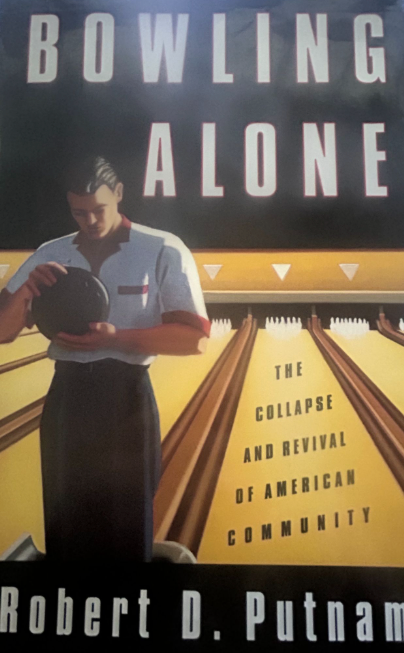
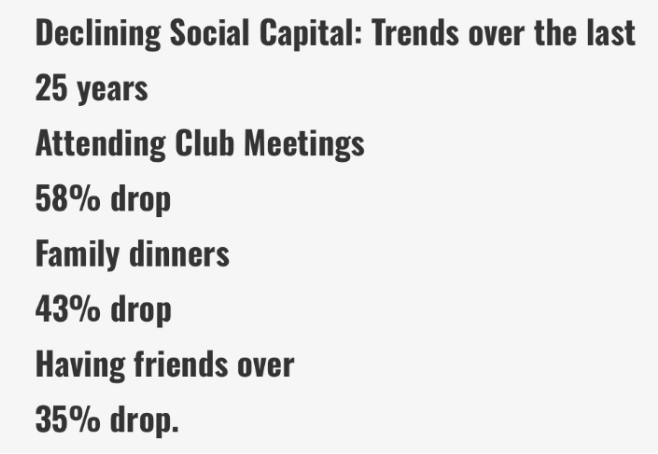
These trends prompted revisiting Robert Putnam’s landmark 2000 study, intriguingly titled “Bowling Alone: the Collapse and Revival of American Community.” A Harvard political scientist, Putnam found that participation in social groups (like bowling leagues) and civic organizations (like Kiwanis) dropped by 30 to 40% between 1970 and 2000.
For Putnam, this meant a significant loss of “social capital” – i.e., shared face-to-face civic and social networks that contribute to the cohesion of communities. In many places the decline continues.
Back in 2000, with the internet in its infancy, Putnam argued that television kept us home and away from community building, away from joining a Rotary Club or a quilting circle. His wealth of data included a bar graph that showed “More TV Means Less Civic Engagement.” But the main culprit in the decline of social capital was “generational change,” which saw decreases in newspaper reading, voter turnout and trust in people and institutions.
In 2020, Alexandra Hudson revisited “Bowling Alone” for National Affairs, echoing its thesis: “Americans just aren’t doing things together anymore. By choosing to engage in activities individually rather than communally … we are putting at risk America's capacity to build social capital and undermining our national character.”
Hudson notes that Putnam got it wrong in terms of predicting decreased voter turnout. Voter turnout did fall from the 62.8% turnout for the 1960 election (Kennedy vs. Nixon) to the 48.9% in 1996 (Clinton vs. Dole). But in 2004 and 2008 voter turnout topped 58%, and in 2020, it once again rose to 62.8% (Biden vs. Trump).
But most downward trends cited in “Bowling Alone” continued. Labor union membership stood at 33% in the mid-1950s and is 6% today. Adults volunteering regularly hovered just under 50% in the late 1990s but is only 28% today. In terms of declines in joining religious organizations, Pew Research reports that today 28% of adults have no religious preference. In 1969, that figure was just 2%.
The Observer-Reporter, which serves Washington, Pennsylvania, reported the closing of its Rotary chapter in 2024, largely due to generational change. The chapter once had 100 members but had only five when it disbanded – all retirees. Stephanie Urchick, former president of Rotary International, told the Observer-Reporter that “Rotary has a ‘Romeo’ problem – short for the perception that the organization consists of ‘Rich Old Men Eating Out.’”
In fact, one of the surprising findings of “Bowling Alone” – in a chapter titled “the Dark Side of Social Capital” – was that at the same time civic and social participation declined, tolerance improved toward racial integration, civil liberties and gender equality. One explanation is “generational change” and the recognition that many civic and social organizations “between the mid-1960s and the late 1990s” could be insular and intolerant – i.e., not accepting women or anyone not white.
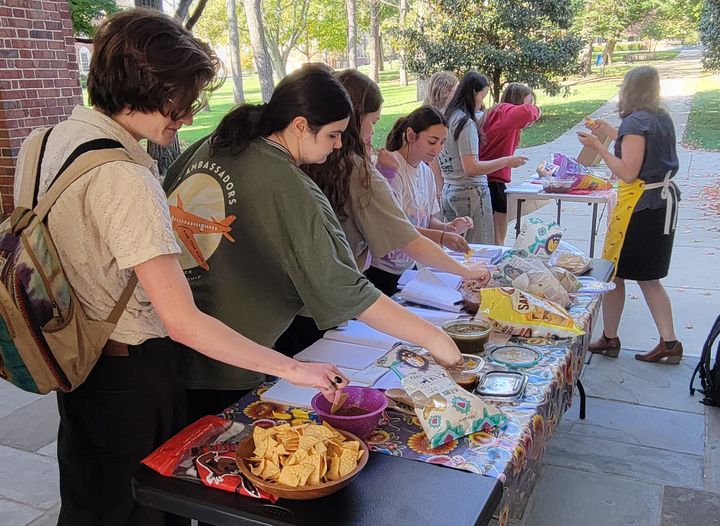
Oxford seems to have bucked many of the trends forecast in “Bowling Alone.” In addition to high family participation in youth sports, many volunteer civic organizations are at work, combining the best aspects of face-to-face and digital networking. Our Kiwanis, Rotary and Lion clubs are active. Kiwanis has 85 members, 20 of whom are women. Other active volunteer groups here include Coalition for a Healthy Community, the Hopedale Unitarian Universalist Community, Oxford Area Solutions for Housing; and Talawanda Oxford Pantry and Social Services (TOPSS). A coalition of nearly 30 of these groups meets every 3 to 4 months.
David Prytherch, a cultural geography professor at Miami, served on the Oxford City Council for eight years.
“I think that small towns where people don't have to devote/waste so much time in their cars commuting afford a greater likelihood of volunteerism and civic engagement,” he told me in an email. “I think the face-to-face interactions we experience in public places ... helps a lot too, whether that's bumping into people and getting organized in Kofenya, seeing each other on the sidewalk Uptown, or even the vegetable aisle at Kroger.”
The problems that “Bowling Alone” identified manifest in many communities with little access to local news, which often acts as a form of social and civic cohesion, providing reliable information, posting event notices, sharing communal stories and identifying problems that need fixing. As I noted in an earlier column, when a town has a local paper, there’s more focus on community issues and local organizations and often fewer problems with rabid partisanship and community disengagement.
In study after study, most people want to know what's going on in their communities. In 2024, a Pew study reported that 74% of Americans trust local news. That’s 20 to 25% higher than any national news outfit. Yet, with over 3,500 newspapers folding in the last two decades, nearly half the counties in the U.S. today have little access to local news. With the loss of reliable local information, many of us retreat from our communities – to talk radio and cable TV, many of these places infected with the partisan virus.
In the afterword to the 20-year anniversary edition of “Bowling Alone,” Putnam notes: “In 2017 Mark Zuckerberg acknowledged that social media had not replaced Rotary clubs and churches and PTAs and bowling leagues, alluding (without irony) to evidence in Bowling Alone: ‘Memberships in all kinds of groups has declined as much as one-quarter,’ [Zuckerberg] said. ‘That’s a lot of people who now need to find a sense of purpose and support somewhere else.’”
Do Facebook and Instagram sufficiently provide “purpose and support”? They certainly helped connect with family and friends during COVID-19. The Arab Spring revolution in 2010 and anti-racism protests in 2020 “played an undisputed central role in civic and political engagement,” Putnam says. In many communities, social media play significant roles in directing people to face-to-face meetings and events.
In revisiting “Bowling Alone,” Putnam takes the long view, reminding us it’s early in the internet age. He points to research showing that “online social relations are broader but shallower, while offline relations are fewer but more intimate.” Reviving “American community,” Putnam argues, will require “an alloy that blends ‘real’ and virtual networks” – a development that might “restore our bonds, mend our bridges and bend the course of history.”
Richard Campbell is a professor emeritus and founding chair of the Department of Media, Journalism & Film at Miami University. He is also a co-founder of the Oxford Free Press.