
On My Plate: Paella
The word “paella” refers to the wide shallow pan in which the dish is traditionally prepared.
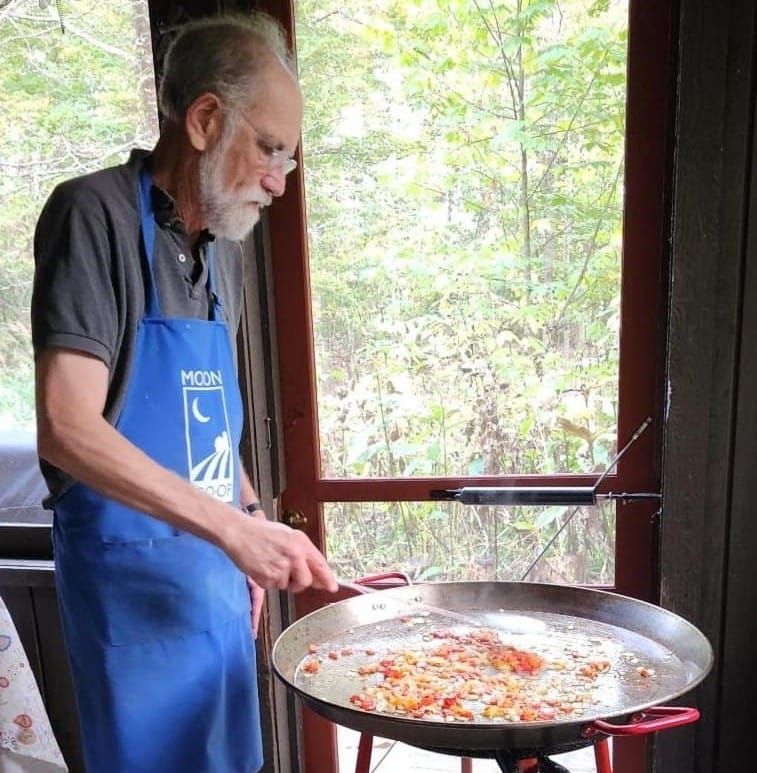
Charles Ganelin, a close friend and strong supporter of MOON Co-op and the Oxfords Farmers Market, is cooking paella in the courtyard outside MOON Co-op on Sunday, July 19, starting at 12.30 p.m. This is a free cooking class and demonstration, though those who come can help him prepare the paella.
Prof. Ganelin, professor emeritus of Spanish and Portuguese and former chair of the Department of Spanish and Portuguese at Miami University, is a well-known scholar of Spanish literature and theater, with a primary focus on the 16th and 17th centuries, including the works of Miguel de Cervantes, author of “Don Quixote.” He is also Oxford’s expert paella chef.
Paella is a one-dish meal that combines rice with a variety of meat and vegetables. The word “paella” refers to the wide shallow pan in which the dish is traditionally prepared. The Paella Company sells seven different kinds of paella pans, including one large enough to feed 300 people.
The origin of paella can be pinpointed more precisely than most foods.
“Valencia, in eastern Spain, is the undisputed home of paella,” according to the Paella Company. When the Moors, crossing over from North Africa, took control of Valencia in 718, they started growing a distinctive variety of rice in the area. Paella was a meal prepared by Valencian farmers working in their fields, made with the rice they were harvesting and whatever other ingredients were readily available.
David Prytherch, who lived for an extended period of time in Valencia, recalls massive paellas being prepared during festivals over open fires built in the middle of streets covered with sand.
Authentic paella is made with one of three varieties of rice grown in Valencia’s Albufera Natural Park – Albufera, Bomba and Sénia. These are all short- to medium-grain rice that soak up more liquid than traditional rice. Charles recommends using arborio rice, which is also the traditional choice for risotto.
A 2023 National Geographic article explained the importance of rice in Valencia cuisine by quoting Santos Ruiz, who was identified as an agronomist working with Arroz de Valencia Denominación de Origen to protect and promote Valencian rice.
“Rice in Valencia isn’t an ingredient, it’s our identity card. . . . Here, everybody is passionate about rice. . . . The way we use rice in Valencia is different from other cultures. Instead of the flavor of the rice, we want to taste the meat and vegetables in the dish – we want to taste the landscape. That’s why absorbency is the most important quality of Valencian rice.”
Documenting the number of different paellas is impossible in a 500-word column. Don Quijote, a Spanish restaurant in Valparaiso, Indiana, offers five versions. According to a 2025 article in The Independent, “the definitive paella recipe contains ten ingredients: rice, olive oil, water, salt, saffron, tomatoes, flat green beans, lima beans, chicken and rabbit.” Eschewing the rabbit, Charles is preparing a version of paella with seafood.
Ruiz explained the importance of paella in the National Geographic article. “In Spanish we say: ‘No comes paella, vas de paella.’ It means that if someone invites you to their home for paella, you can’t just turn up to eat it – you have to be part of the cooking process. It’s where Valencians share family news and argue about how to cook rice. It’s a social event!”
In November 2021, the government of Valencia declared paella a protected cultural asset for “the art of uniting and sharing.” You are invited to MOON Co-op’s courtyard on July 19 to experience a paella-inspired social event for uniting and sharing.
James Rubenstein is president of the Board of Directors for the Oxford Free Press and professor emeritus of geography at Miami University.