
Media Matters: Detectives, reporters … and crime
Our fascination with crime stories, whether in fact or in fiction, endures.
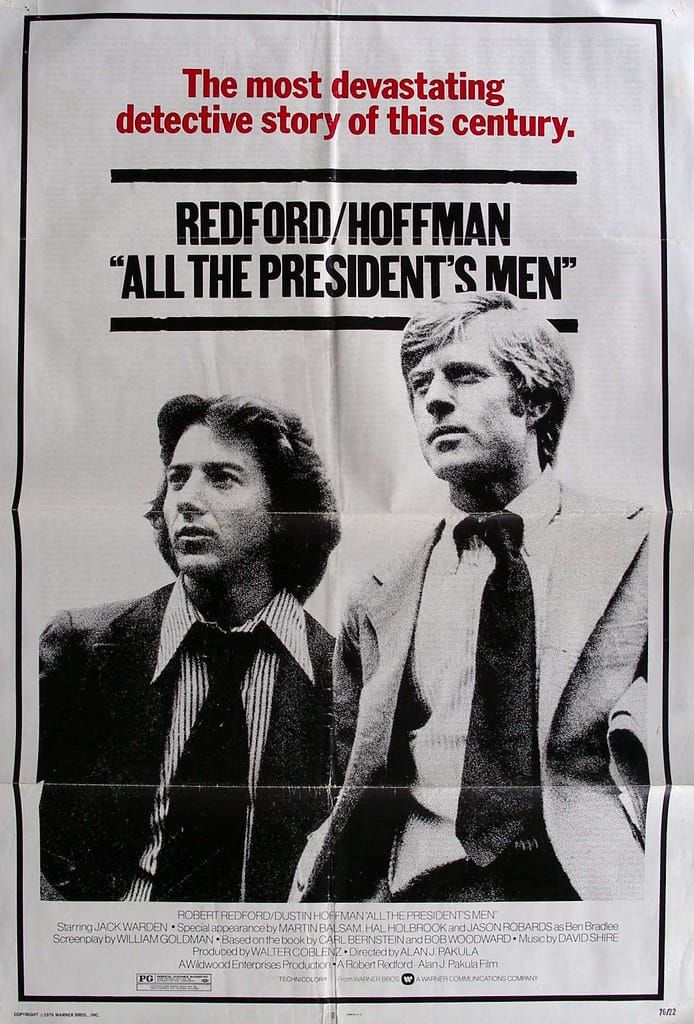
In the summer of 1979, I was working on my master’s thesis in the communication department at UW-Milwaukee. My topic was “All the President’s Men,” written by Carl Bernstein and Bob Woodward, specifically their coverage of the Nixon White House during the Watergate crisis, culminating in a disgraced president resigning in 1974. In 1976, the book became a hit movie, starring Dustin Hoffman and Robert Redford.
The Bernstein-Woodward book reads like a detective mystery. That was my thesis argument. The reporters drew from all the tropes that make detective fiction: revealing a crime, searching for clues, confronting the villains and resolving conflicts. One paperback edition of the book’s cover used several newspaper testimonials: “One of the greatest detective stories ever told” (Denver Post) and “Reads like a first class whodunit” (Cleveland Press).
Detecting and reporting have a lot in common. I noticed this because at the same time I was finishing my master’s thesis, I was also a reporting intern at the Milwaukee Sentinel. One of my jobs was helping a veteran crime reporter by calling city and suburban police stations asking if there was any serious wrongdoing the paper should cover. When I asked the reporter what I should be looking for, he said: “It should be juicy, something that will make a good story.”
Modern crime reporting and detective fiction developed roughly at the same time, in the 1830s and 1840s. The rise of crime stories was partly a result of the rotary press, which made it possible to print thousands of newspapers very quickly and sell them for a penny, making newspapers affordable. Editors discovered that working class people wanted to read about their own communities and not so much about weeks-old political news from Europe. Crime reporting helped U.S. newspapers break away from the early partisan model, when national politics and the businesses of privileged white men dictated content.
Meanwhile, Edgar Allen Poe was inventing the modern detective story. “The Murders in the Rue Morgue,” a Poe short story, was published in 1841. Poe introduced the world to the Parisian sleuth C. Auguste Dupin, whose rational, detached approach to crime became the model for Arthur Conan Doyle's Sherlock Holmes and Agatha Christie's Hercule Poirot and Miss Marple.
Editors and publishers found detachment financially useful. Penny press owners realized that telling good stories, and appearing more neutral and less partisan, would attract a larger audience that crossed over political divides. Working class readers, who could not afford the old six-cent partisan papers, valued news of their towns and neighborhoods over the political views of the wealthy.
The penny papers of Benjamin Day, who founded the New York Sun in 1833, and James Gordon Bennett Sr., who started the New York Herald in 1835, used sensational crime reporting to transform the news business and, ironically, made Bennett a multi-millionaire.
By the mid-1800s, crime reporting became entrenched as a major beat at newspapers. Not only do readers want to know about dangers to their communities, but a good crime story contains many of the elements of a good detective tale. In “Adventure, Mystery and Romance,” the literature scholar John Cawelti studied popular culture narratives like romances and adventure tales. He explained the appeal of the detective genre, arguing that crime stories allow us “to explore in fantasy the boundary between the permitted and the forbidden.” In other words, such narratives – whether in fact or fiction – help us confront the inexplicable, deviance and evil. In classic detective fiction, of course, the rationality of the heroic sleuth wins out over the chaos perpetrated by the bad guys.
P.D. James, the British writer who created the cerebral detective/poet Adam Dalgliesh, once commented on the popularity of the genre and its staying power: “No matter how difficult the problem, there is a solution. All of this is rather comforting in an age of pessimism and anxiety.” She wrote this in 1984.
Our fascination with crime stories, whether in fact or in fiction, endures. In fact, when TV came along, PR consultants advised local news on how to build ratings, arguing that the best way to attract viewers was leading with a crime story. Soon the phrase, “If it bleeds, it leads,” became a mantra, then a cliche. Still, studies from the late 1960s onward show that even today local TV news stations lead with a crime story 30%-40% of the time.
My own fascination with crime stories also continued. For my Ph.D. dissertation (which became a book), I studied the CBS news program “60 Minutes.” I argued that what helped make this news magazine the oldest and most popular program in primetime TV history was the reliance on the familiarity of the detective formula. When I interviewed Don Hewitt in 1989, the program’s creator and long-time executive producer agreed. I asked him the secret to the success of “60 Minutes.” He replied, “Four little words – tell me a story,” the title of his 2001 autobiography.
Many of the program’s signature episodes featured the reporter-as-detective, at times wearing a trench coat, explaining the crime and tracking the evidence. In the program’s climactic moment, the reporter would confront the “villain,” often a sketchy businessman or a government bureaucrat, sometimes shot in a tight, sweaty close-up. It is no coincidence that from 1984-1996 “60 Minutes” provided the lead-in to the fictional detective show “Murder, She Wrote” – together a powerful Sunday evening ratings juggernaut for CBS.
With this familiar narrative strategy firmly established, “60 Minutes” has reigned as the No. 1 TV news program for more than 50 consecutive years.
Although “60 Minutes” debuted in 1968 – six years before “All the President’s Men” – Don Hewitt used the Watergate narrative as a touchstone for his own program. In 1985, he told the “Washington Journalism Review” that “60 Minutes” is about “the adventures of five reporters, more fascinating to the American public being themselves than Robert Redford and Dustin Hoffman were playing Woodward and Bernstein.”
Richard Campbell is professor emeritus and former chair of the Department of Media, Journalism, and Film at Miami University. He is also a co-founder of the Oxford Free Press.