

On My Plate: Winter squash
The English word “squash” derives from the Narragansett word askutasquash, which means “a green thing eaten raw” – presumably summer squash. “Squash,” as a verb (meaning to crush) and as a racquet sport, derives from Romance languages and has no connection with the etymology of the food.
Thinking about baking a pumpkin pie? What could be more “local” than reusing a Halloween decoration for a Thanksgiving pie. You may want to think again. A pumpkin makes a cute seasonal decoration, but I don’t recommend actually baking a pie with it. I tried a few years ago.
Two reasons for this caution. First, preparing a pumpkin for use in a pie is messy and time consuming. The pumpkin must be cut, cleaned and roasted before the flesh can be used in a pie. Second, the effort isn’t worth it, because the resulting taste of the pie is pallid.
Most pumpkin pie bakers reach for a can of Libby’s, which holds more than 90% of the world’s canned pumpkin market. Nestle, which owns Libby’s, contracts with growers (mostly in downstate Illinois) to produce a proprietary variety called Dickinson.
Turns out that the Dickinson variety in Libby’s cans is actually a variety of butternut squash. The U.S. Food and Drug Administration (FDA) says that Libby’s can legally call the Dickinson a pumpkin. The distinction between pumpkin and butternut squash is “murky,” according to the FDA.
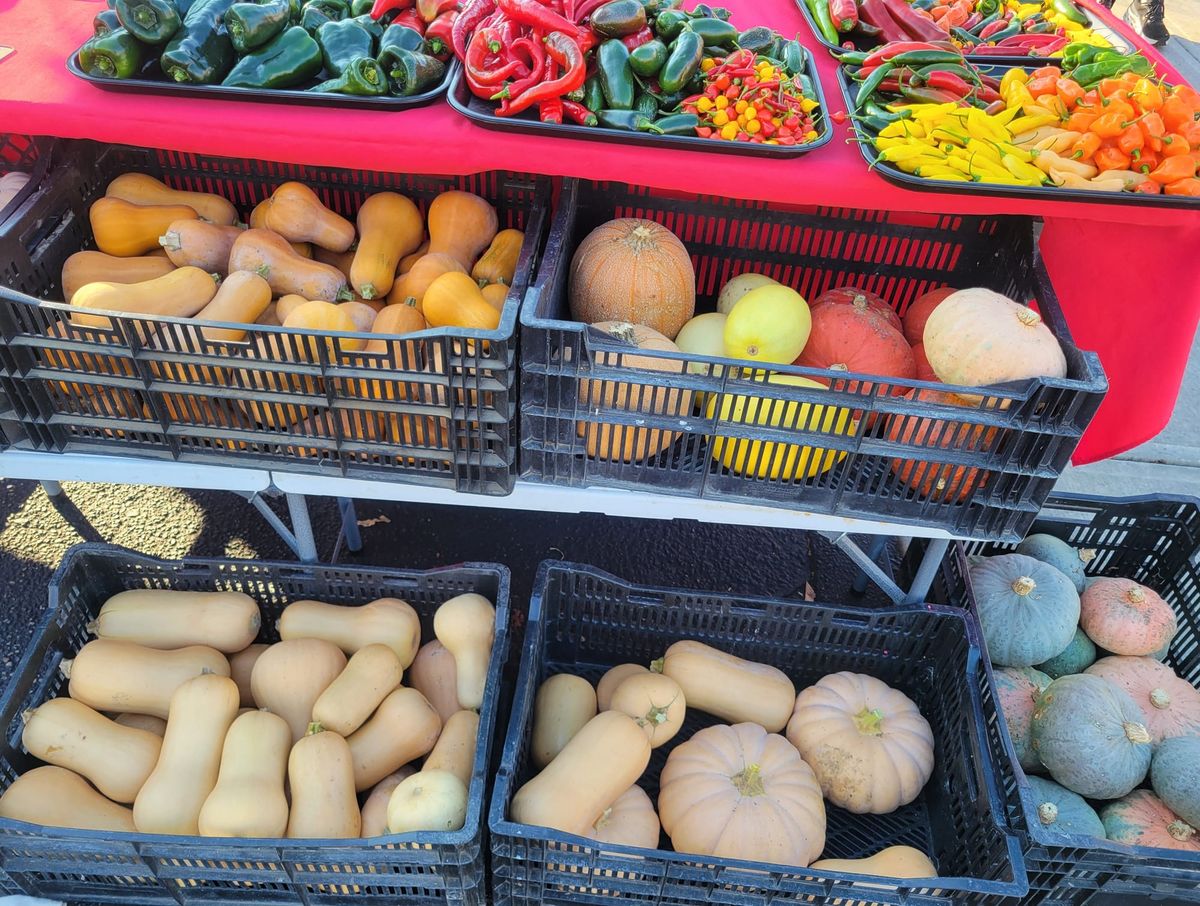
Squash is easier than pumpkin to use in a pie, and the results are more flavorful. Locally grown squash suitable to make a pie can be found this year at the Oxford Farmers Market and MOON Co-op Grocery. Craig and Sharon Harkrider have harvested a large number and variety of squash at their Stoney Hedgerow Farm. A year ago, the Harkriders didn’t have much squash so this year they planted a lot of it.
Squash has been cultivated for more than 10,000 years ago in Central America – possibly the oldest plant cultivated for food in the Western Hemisphere. Winter squash and summer squash are essentially the same botanically. As the name implies, summer squash is harvested in the summer while it still retains a thin skin that is soft enough to eat. Winter squash, like summer squash, is actually grown in the summer, but gets its name because most varieties can be stored safely through our long cold winters thanks to a thick rind.
The English word “squash” derives from the Narragansett word askutasquash, which means “a green thing eaten raw” – presumably summer squash. “Squash,” as a verb (meaning to crush) and as a racquet sport, derives from Romance languages and has no connection with the etymology of the food.
In addition to a pie filling, winter squash can be roasted for a side dish, stuffed for a main dish, or steamed for a soup. The first step in using a winter squash is to cut it open to remove the seeds. If you can’t get a knife through the raw squash, don’t hurt yourself. Microwave the whole squash for a few minutes, then cut it open and chop into pieces if necessary.
Squash is one of the few items that I microwave. A smaller squash can be microwaved as two halves, whereas a larger one needs to be chopped into several pieces. Place the pieces in a baking dish, cut side down and add enough water to just cover the bottom of the dish. Cook covered on high for around eight minutes.
The variety of Stoney Hedgerow squash is a visual delight. I count more than a dozen varieties, in many shapes, ranging in size from tiny to over five pounds, a riot of colors including bright orange, blue, green, pink, tan and striped. Hopefully you will find that trying unfamiliar varieties and recipes can be rewarding during our cold dark winter.
James Rubenstein is president of the Board of Directors for the Oxford Free Press and professor emeritus of geography at Miami University.