
Miami students, faculty deliver petition calling for academic freedom
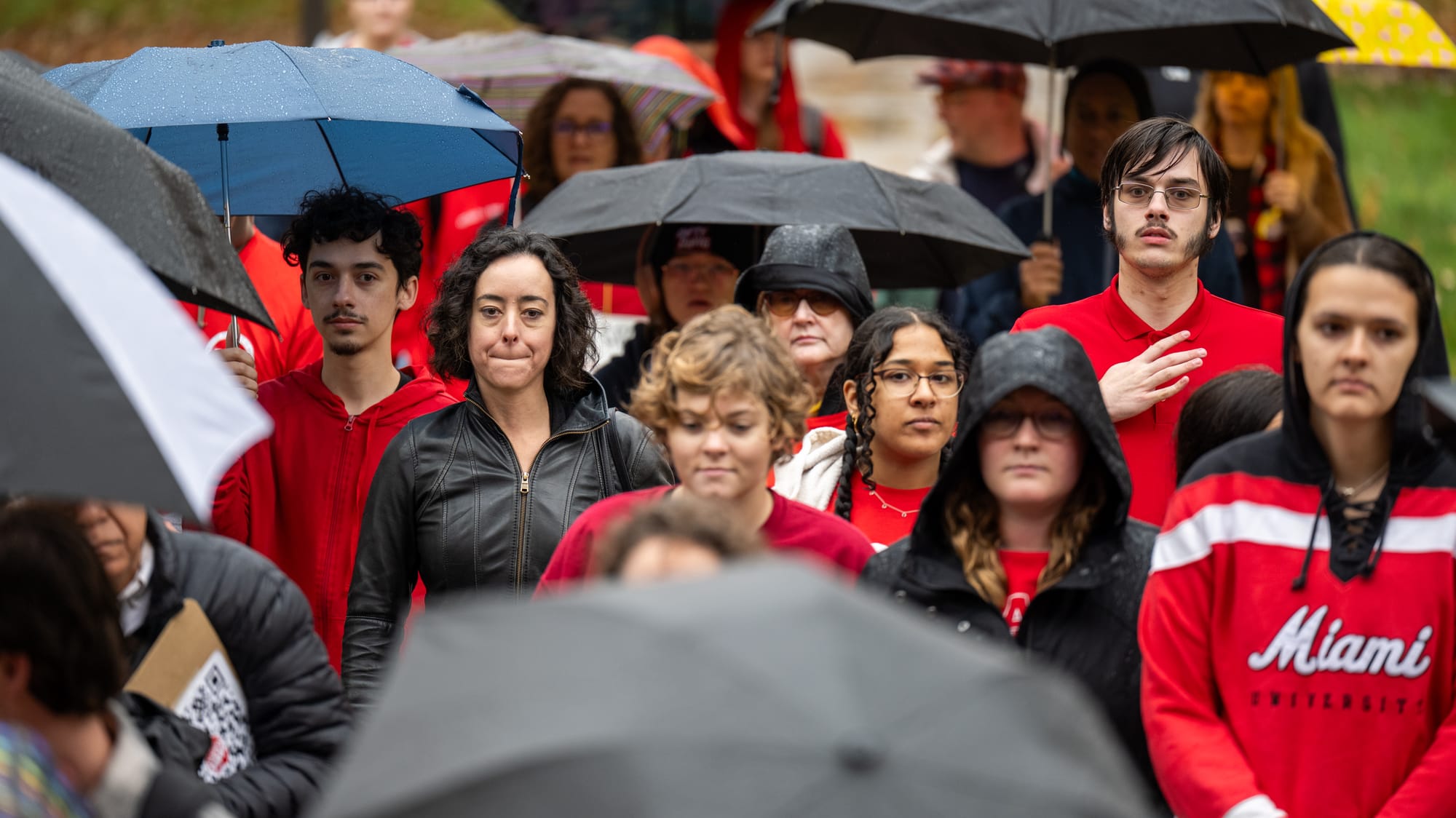
Dozens of Miami University students and faculty, led by members of the Ohio Student Association, delivered a petition to Roudebush Hall on Nov. 7 calling for “academic freedom and institutional integrity.”

While administrators at Miami University still haven’t responded to President Donald Trump’s compact asking colleges across the country to adhere to his administration’s priorities, dozens of students and staff who delivered a petition Friday, Nov. 7, made their position clear – they don’t want it signed.
The compact
The Trump administration originally asked nine institutions of higher education to commit to a 10-point “Compact for Academic Excellence in Higher Education,” according to reporting from Inside Higher Ed.
The initial nine included Brown University, Dartmouth College, Massachusetts Institute of Technology, the University of Arizona, the University of Pennsylvania, the University of Southern California, the University of Texas at Austin, the University of Virginia and Vanderbilt University. But the administration said in mid-October any college could sign, according to reporting from Inside Higher Ed.
As of Oct. 24, Inside Higher Ed reported none of these colleges had yet signed the compact.
In the compact, institutions are asked to ban consideration of race or sex in hiring and admissions processes; freeze tuition for a five-year period; limit international undergraduate enrollment to 15% of students; and require standardized testing in admissions, according to reporting by the Wall Street Journal.
The compact would also require signatories to prohibit employees from speaking on political views; maintain "institutional neutrality;” encourage a “vibrant marketplace of ideas on campus;” abolish departments that “punish,” “belittle” or “spark violence” against conservative ideas; and poll students and staff on compliance.
The petition
Although Miami hasn’t agreed to the pact or publicly indicated it will, the petition to administrators, signed by 388 members of the Miami community, directly asks them to reject loyalty oaths, “defend academic freedom and institutional integrity,” and “visibly protect the safety and belonging of our communities on campus.”
Kali Barcroft, president for the Miami chapter of the Ohio Student Association (OSA), said the petition is also meant to address unique impacts on Miami from the passage of Ohio Senate Bill 1 and censorship on campus as a whole.
“(S.B. 1) severely limits topics that are allowed to be discussed in college classrooms and how professors are allowed to teach certain topics, but it also outright bans DEI (diversity, equity and inclusion) initiatives on campus and does not allow universities to show support for marginalized groups in certain ways,” Barcroft said.
Barcroft pointed to examples of S.B. 1 already taking effect on campus, including the removal of flags in the Armstrong Student Center showing support for LGBTQ+ communities and people of color.
“Our biggest concern with Miami currently is the lack of visible representation following the wake of S.B. 1. We are most heavily focused on requesting that administration visibly protect and represent all identities of groups on campus,” Barcroft said, noting several students have approached OSA with concerns about a lack of community support on campus.
The petition directly asks administrators to hang a banner reading “Love and Honor for All” in replacement of the flags.
Barcroft said there is also a common consensus among students that their voices are not being taken into consideration in university decision-making.
Maddie Andrews, treasurer for the Miami OSA chapter, said signing oaths like the compact “limits freedom.”
“They’ve been pretty silent on the issue,” Andrews said of Miami administrators in response to the compact. “With S.B. 1, too, that passed last year … between that and the compact, that definitely makes the effects worse.”
Andrews referenced an award given by Miami for champions of civil rights named after the Freedom Summer of 1964 or “Mississippi Summer Project” – a voter registration drive with the goal of increasing Black voter registration.
“Miami has such a legacy of being a school for civil rights and social justice, and signing a compact like this would kind of undermine that,” Andrews said. “And so to keep our legacy and keep the school the way it is, that’s why we would ask Miami to not sign – reject any compacts.”
The march
Catherine Conner, a sophomore at Miami and member of the OSA chapter, attended the march to “protect the culture of love and honor” at the university.
“I care a lot about my education and others’ education, and this compact would make it really hard for everyone to get a fair education that they deserve if we’re restricting the things that can be taught and the things that we can talk about,” Conner said.
When asked if Miami’s administration had done anything recently to make her believe it would sign the compact, Conner said its “quick” response to S.B. 1 without listening to student voices made her think they may also comply with the Trump administration’s asks.
“The student body doesn’t want that,” she said. “I think there is a lot to worry about when it comes to higher education and how different administrations are dealing with it. … Now more than ever, everyone needs to be educated. Regardless of which side that you're on, this is something that affects everyone.”
Marley White, another sophomore at Miami and OSA chapter member, said he attended the march “to defend education as we know it.”
White’s parents are educators, which he said made him feel as though it were his duty to attend the march. He said he is “vehemently against” the compact promises of preferential federal funding that are “inherently corrupt.”
Theresa Kulbaga, president of the Faculty Alliance of Miami (FAM), who was also at the march, said FAM posted an open statement on its website urging the university to reject the compact in October.
FAM said of the compact in its statement, “This attempt at coercion is just one of the many examples of intensifying political interference in higher education.”
Cathy Wagner, a FAM member, said “I am really proud of students for caring about higher ed, which is under a lot of threats right now.”
“Our students are really well informed about what's happening across the country,” Wagner said. “They're aware that higher ed nationally is under threat and that it matters for their degrees. It matters for their future.”
Upon delivering the petition to Roudebush Hall, Barcroft and other OSA members were given a contact of a staff member to follow up with.
The Oxford Free Press reached out to Miami for a response, but it did not receive one before press time Wednesday, Nov. 12.