
Observations: The dog theme
My mother never allowed us to have a dog, so I didn’t have one until I was well along in my career.
Dogs have played a part in both my professional and my personal life.
Over the years, as I have taught American history, I frequently touched on the theme of dogs in our past. I spoke about Richard Nixon, candidate for the vice presidency in the election of 1952, when he was accused of having a slush fund for his personal use. He went on nationwide television with his “Checkers” speech, a maudlin effort in which he declared that he had never taken any gifts, except a small cocker spaniel named “Checkers” sent to his daughters by a supporter, that he would never give back. It saved his political neck, and his career continued until its final demise in the Watergate scandal.
Then, there was Lyndon Johnson. He had two beagles, named Him and Her, during his time in the White House. In 1963, he faced a powerful backlash when he lifted Him by the ears while greeting someone at the White House. The public was outraged, and Johnson had to issue a formal apology. This was well before outrage over his escalation of the Vietnam War ended his presidency, but for a time, it was a real story.
Then, much more recently, there was Joe Biden’s dog Commander, who had to be removed from the White House after a number of biting incidents.
But dogs have been even more important to me in my personal life.
My mother never allowed us to have a dog, so I didn’t have one until I was well along in my career. When I was teaching at the University of Oregon, in Eugene, we went to a shelter and brought home a small male terrier we named Paddywack. The kids loved him, though we didn’t really know how to take care of him. He lived out in the backyard, and in the house when we were home, but we seldom walked him or went out of our way to play with him.
He came with me when I moved to Oxford, but died in the next year or so.
My son David was distraught, and we got another dog as soon as we could. My sister had a golden retriever named Guffy, so we got a golden retriever that we named Duffy.
Duffy was a spunky dog. Once, early in my relationship with Sara, Duffy and I went to her home in Richmond to spend the night. We put Duffy in the guest room and closed the door. The next morning, we found that she had chewed a round hole in a lovely woven zebra-striped throw rug Sara had bought in Kenya. Sara was distraught, and I took the rug to Cincinnati, where I found a weaver who repaired the hole, and charged me four times what the original rug had cost. But it was worth it. Sara and I celebrated 34 years of marriage together, and I still have the rug to this day.
After Duffy came Mali. Our friend Sarah Michael persuaded us to get a black lab, and the puppy was impossibly cute. We had to go to a conference a week after we got the dog, and Sarah and Jim Michael kept her for the week we were away. On our return, we found she had already learned to sit, and we went on from there.
My Sara had never had dogs before, but she fell in love with Mali. She took her to her job as science librarian at Earlham College, and Mali stayed in a small crate by Sara’s office door. Students came by to talk to Mali and often took her out of the crate to play with her. It was a terrific time for all.
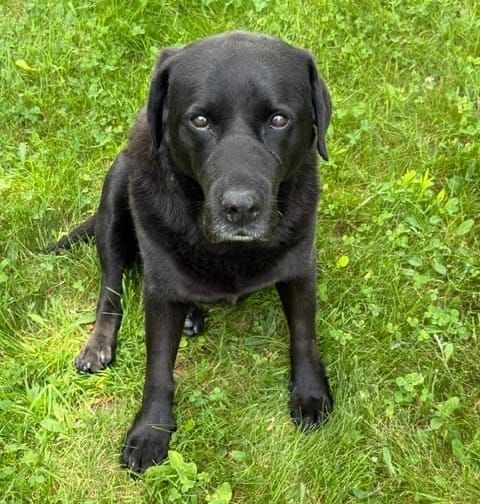
Now, I’ve got Lindi, another black lab who looks like Mali but is not related. We have just arrived in Maine after over 20 hours in the car. This is possible only because Lindi likes to travel in the car. She sleeps in the back of my Honda CRV and almost never complains.
Because of her – actually only partly because of her – I stop every couple of hours or so to walk around and then continue on our way. We stopped in Boston to see a friend, on Cape Cod to see another and then continued on to our rented house in Maine. Here, there are trails to walk, other dogs to play with and a chance for both of us to refresh ourselves before coming home.
Allan M. Winkler is a University Distinguished Professor of History Emeritus at Miami University, where he taught for three decades. He serves on the Board of Directors for the Oxford Free Press.