
Observations: World War II
The war has played a large role in my own life – a role I find myself unable to forget.
Recently, perhaps because we’re involved in another war and perhaps because I’ve been reading Lee Fisher’s good pieces in the Oxford Free Press about veterans in the area, I’ve been thinking about World War II.
The war has played a large role in my own life – a role I find myself unable to forget.
During the war, my father served in the Navy in the South Pacific. His ship was in port, and his commanding officer asked him if he wanted to stay on board or go ashore. My mother, in Cincinnati, was about to give birth to me and he decided to leave the ship to see if there was any news of my arrival. While in town, his ship experienced one of the very first kamikaze attacks of the war, and everyone at his battle station was killed. Family lore said that I had saved his life.
About 25 years later, I was serving as a Peace Corps Volunteer in the Philippines. Unlike in the United States, the war was still very much on people’s minds. At one point, my parents came over to visit, and I took them to a Rotary Club meeting. There, my father and many of the men attending discovered that they had been involved in the same battle, on different sides of the mountain that ran through the island of Leyte, where I lived. They were excited to compare notes. I was fascinated to hear them talk.
When I returned to the United States, and began to become an American historian, I found myself drawn to the war. My first book dealt with American propaganda during the war. Another book dealt with the home front at that time. I also wrote a young adult novel about the experiences of a little girl in the midst of the war. Another book focused on the nuclear age and the Manhattan Project, which created the first atomic bomb, and the explosions that ended the war.
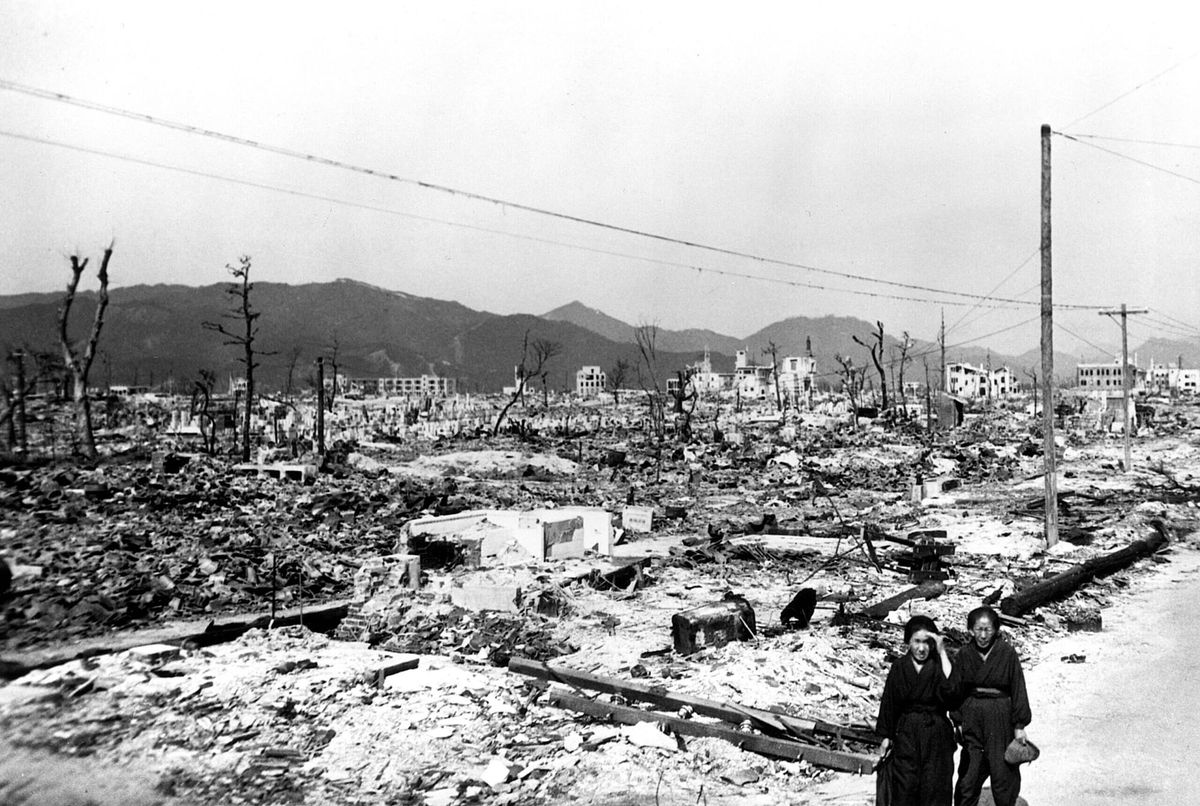
While in the Philippines, I had the chance to travel to Japan, and was able to visit both Hiroshima and Nagasaki. In Hiroshima, there was a marvelous, relatively new museum, with artifacts and photographs of the blast. It was overwhelming to see pictures, to read first-person accounts, to try to make sense of the destruction. Outside the museum was the collection of paper cranes, begun years before by Sadako Sasaki, who hoped that by folding a thousand cranes she might save her life.
The museum at Nagasaki, back in the 1960s, was in a small frame house owned by the Quakers. I spent one afternoon helping the director put on a new roof, then touring the small museum.
Years later, Sara and I were back in Nagasaki, and now there was a full-scale museum, much like the one in Hiroshima.
The war haunts me to this day. Journalist Studs Turkel called it “the good war,” but that may be a misnomer. The war in America saw the incarceration of Japanese Americans – in the greatest violation of civil liberties in American history. It featured a segregated military, where Black people faced discrimination throughout the war. Until the very end, it ignored the plight of the Jews, when some kind of response would have saved lives.
On the other hand, it did defeat the totalitarians and saved democracy. For that, we should all be grateful.
Allan M. Winkler is a University Distinguished Professor of History Emeritus at Miami University, where he taught for three decades. He serves on the Board of Directors for the Oxford Free Press.