

OCAC seeks lease extension as it pursues $10.2M renovation
“We are restoring this building, we are transforming it and then we are just literally saying ‘imagine what we can do next.’”
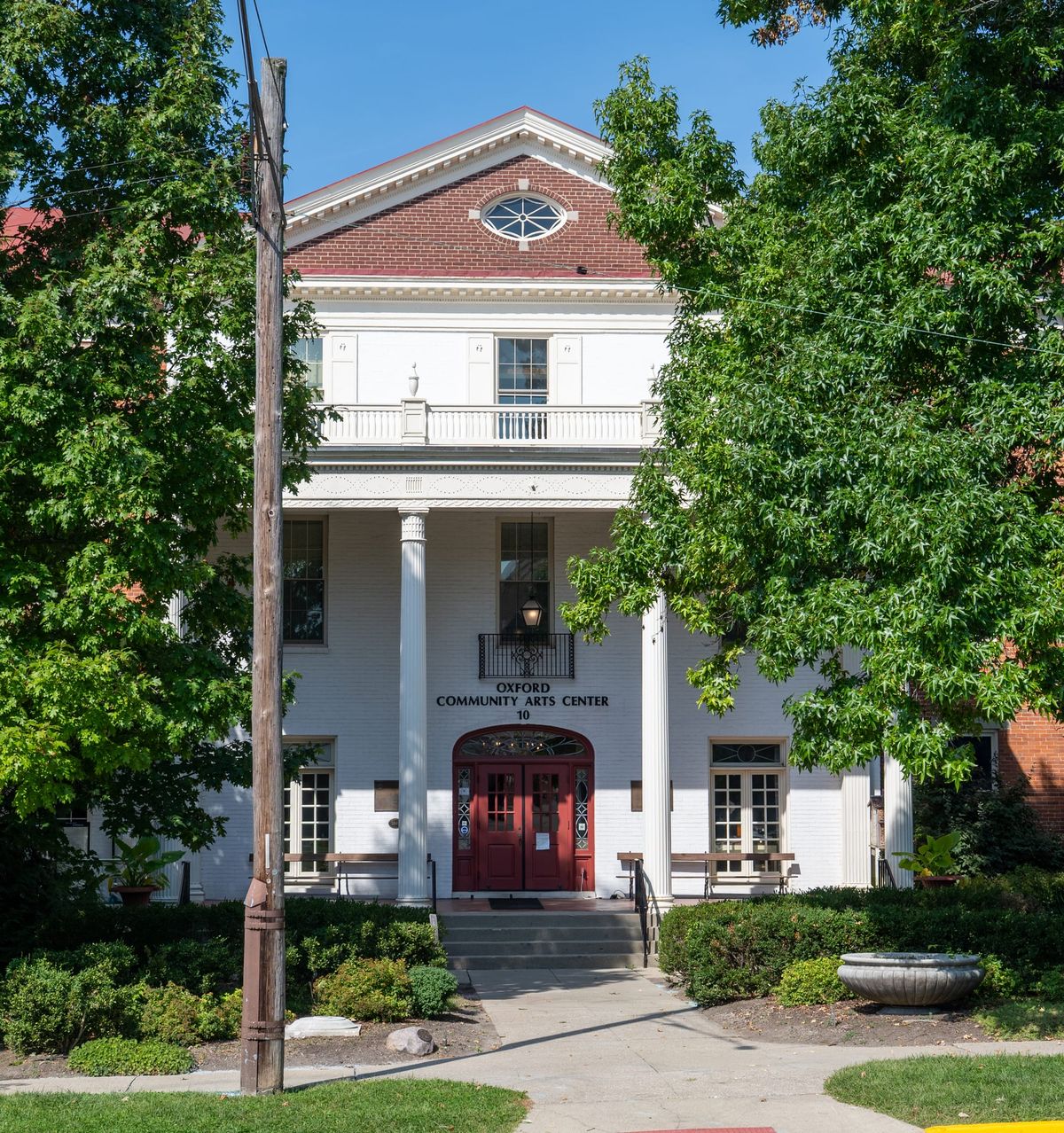
Since 1998, the second floor of the Oxford Community Arts Center (OCAC) has sat largely unusable, limiting how the historic building can serve the Oxford community through arts programming. Now, the arts center is pursuing a $10.2 million renovation that would modernize the whole building.
Twenty-five years ago, a group of “art-minded” citizens, Miami University professors and retirees came together to ask Miami to establish a lease to create a community arts center in the historic building at 10 S. College Ave. – the former site of the Oxford Female Institute – which is still owned by Miami.
The initial lease was signed in 2002 and guaranteed a 50-year commitment with a 25-year renewal option. Thus, the OCAC was created.
Heidi Schiller, executive director for the OCAC, said the building has gone through three renovation projects already, which included adding an elevator, placing new windows, tuckpointing the exterior, building the outdoor pavilion and renovating the catering kitchen.
Schiller said the newest proposed renovation project is the most ambitious one yet.
The $10.2 million capital campaign project, titled ‘Restore. Transform. Imagine.,’ will “significantly bring the building up to some needed modern standards,” Schiller said.
Currently, the second floor of the OCAC, which spans just over 10,000 square feet, is “unusable,” Schiller said. “That dramatically limits how the entire building functions and how many people we can serve.”
The project will completely renovate the second floor. Additionally, the project will add air conditioning throughout the entire building, upgrade the building’s 30-year-old boiler heating system to a steam system and upgrade the building’s Wi-Fi and lighting.
Other improvements include creating three multipurpose spaces, four skill-based art spaces – a technology center, fiber arts studio, pottery studio and a podcast studio – and eight new resident art studios, with three on the first floor and five on the second floor.
“When we call this (project) ‘transform,’ we really mean it,” Schiller said. “We are restoring this building, we are transforming it and then we are just literally saying, ‘Imagine what we can do next.’”
Schiller said the OCAC has secured its construction partner for the project, SHP Architecture and Design, a Cincinnati-based group, along with Messer Construction, which has previously worked with Miami.
Messer informed the OCAC that the work would take between 10-12 months to complete. During the construction, the OCAC could continue to occupy the building.
With this project, staff offices will be moved to the second floor, creating more space for main floor programming, Schiller said.
The main floor will include renovations to the main entrance, the creation of a cafe and possibly a concessionaire. The building’s theater on the main floor will be upgraded. A second ADA-compliant entrance will also be added.
On the financial side of the project, the OCAC is working on raising the $10.2 million.
Schiller said this sum is split into two separate groups. The first group includes $5.2 million in funds coming from individual donors, grants and foundational money. The other group includes $5 million made up of historic tax credits, numerical tax credits and state and city money, according to Schiller.
Historic tax credits, which contribute to around a third of the entire project's funding, make up $3.3 million in total.
Schiller said these historic tax credits work by “offering for-profit entities to buy into … the renovation of a historic project. For seven to 10 years, those for-profit entities will get tax credits.”
That seven- to 10-year period is an IRS requirement, Schiller said, which aims to prove that the lease is longstanding, or “proof-of-intention.”
“It cannot be overstated how important the tax credits qualification is,” Schiller said.
Since the building is owned by Miami, receiving these historic tax credits requires OCAC staff to have a qualifying lease structure.
“That is where we stand now,” Schiller said. “We have done our due diligence with the application process, and we’ve received confirmation that it has successfully met all the standards necessary to pursue the tax credits.”
Since the initial review has been approved for the historic tax credits, OCAC staff are now working to receive a qualifying lease with Miami.
“As we understand it,” Schiller said, “what we need is a 60-year lease between Miami and the OCAC.”
The current lease lasts until 2052, and would need to be amended to run through that 60-year period of time. As part of the lease’s terms, the OCAC is responsible for 100% of maintenance to the grounds and the building, including repairs.
Schiller said she believes this project would be the first in the City of Oxford to utilize state and historic tax credits.
“If we can open the door as the first project to get historic tax credits, there are certainly other buildings and other entities that could also benefit from this program,” Schiller said.
If the OCAC cannot gain the historic tax credits, Schiller said the OCAC will still move forward with the project.
Schiller said that applications for the historic tax credits have two cycles each year, with deadlines in September and March.
While working on getting the amended lease, Schiller acknowledged this step takes time and Miami “has to do their due diligence and protect the university.”
Schiller added that the OCAC doesn’t only serve the City of Oxford, but also beyond and into different communities, and this renovation project is projected to increase traffic in Oxford and the arts center.
“We are a driver of economic tourism, cultural tourism and historic tourism,” Schiller said. “Through this renovation, we are anticipating increasing our participation from 18% to 23%.”
Cody Powell, vice president of facility and planning operations at Miami, spoke to the Oxford Free Press about the requested amendment to the OCAC’s lease.
“These tax credits can be challenging, in particular because they don’t own the facility,” Powell said. “Those tax credits are really intended for owners of facilities that are seeking them.”
Powell said the challenge with amending the lease “amounts to a significant extension … with really no right of termination.”
Powell confirmed Miami has no interest in terminating the lease and plans to continue supporting the OCAC.
“There’s just so many challenges today with higher education, and we don’t know what the future holds,” Powell said.
He added that Miami is actively trying to help the OCAC “be successful with their goals without having to make that commitment from the university.”
Powell said Miami is in a good place in terms of attempting to provide that assistance with the OCAC’s goals.
Schiller said some OCAC board members are planning to speak at the Sept. 25 Miami Board of Trustees meeting in support of the project.