

Oxford City Council discusses Complete Streets Policy, installation of EV charging stations
The Oxford City Council met on March 3 to discuss an upcoming sidewalk project during a work session and approved the installation of new electric vehicle charging stations.
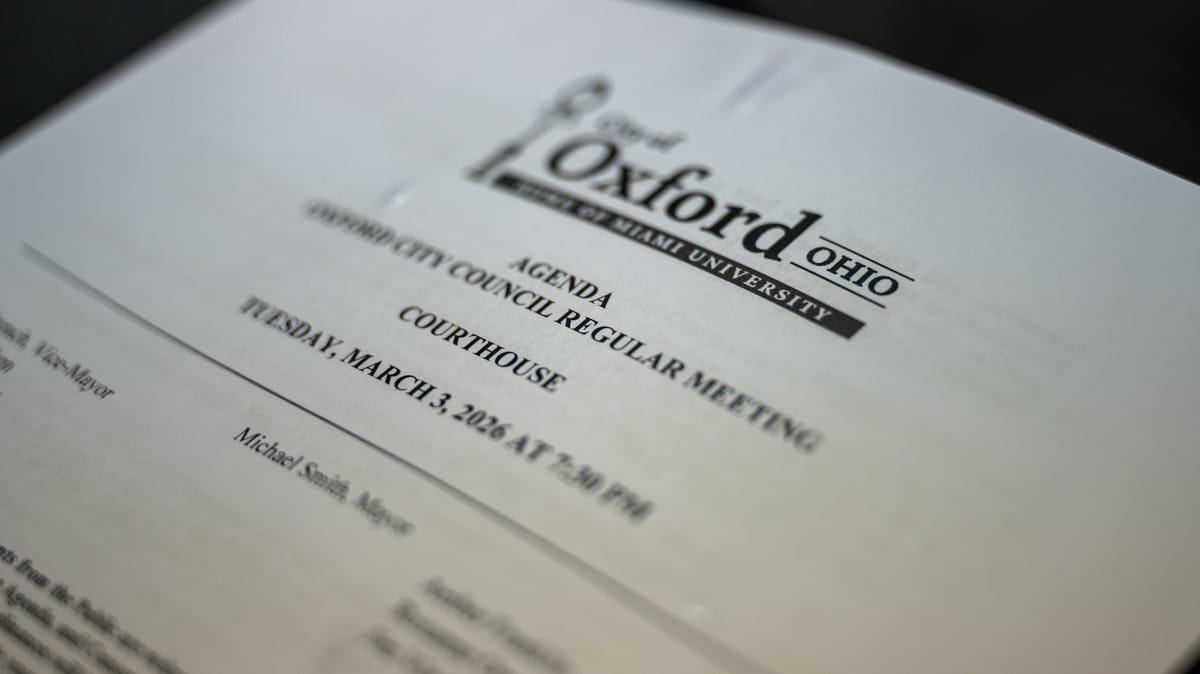
The Oxford City Council met on March 3 to discuss an upcoming sidewalk project during a work session and approved the installation of new electric vehicle charging stations.
Complete Streets Policy
In the work session segment of the meeting, the city council discussed its Complete Streets Policy.
The policy, adopted in 2019, aims to strengthen local infrastructure for transportation, including sidewalks, bike lanes and streets.
According to the presentation, a complete street is a transportation policy and design approach that ensures streets are safe, convenient and accessible for everyone, regardless of age, ability or mode of travel. These streets accommodate pedestrians, bicyclists, motorists and transit riders, prioritizing safety over motor vehicle speed.
The city’s policy states “when doing any project in the right of way – new construction, reconstruction, resurfacing, and rehabilitation – the city shall attempt to make a street ‘complete.’”
According to the presentation, the city council agreed in 2025 that establishing a baseline of funding for Complete Streets Policy improvements was important, but not needed to affirm staff analysis when Complete Streets Policy improvements were found infeasible.
In August 2025, the city council passed a resolution to add a complete streets budgetary
line item that recommended 20% of the resurfacing budget be applied to
complete street improvements.
In 2026, that 20% totaled $124,000, and will contribute to the creation of a $25,000 safety study including a new crosswalk with a rapid flashing beacon on College Corner Pike, a $24,000 curb extension at three intersections on Campus, Poplar and Main streets and $75,000 for undesignated improvements, according to the presentation.
Two new Americans with Disabilities Act (ADA) approved audible crosswalk signals will also be created using roll over funds from the 2025 budget.
Since this resolution was adopted, the city has received a $200,000 grant for a city-wide safety study, according to the presentation.
Olde Farm and Contreras roads project
A resolution passed by the city council on Jan. 20 highlighted the need for a new sidewalk on Olde Farm Road, from Contreras Road to approximately 105 Olde Farm Road, according to previous reporting by the Oxford Free Press.
During the public comment section of a city council meeting on Feb. 17, multiple residents from addresses in or near the nine affected parcels expressed their annoyance and frustration, citing concerns about the potential cutting down of trees, lack of communication from the city and uncertainty around funding.
Mike Dreisbach, service director for the City of Oxford, said the project is estimated to cost $153,000 – an amount that is not currently included in the City of Oxford’s Capital Improvement Plan (CIP).
The proposal recommended the City of Oxford cover 75% of the costs, while home owners would cover 25% of the costs.
Jessica Greene, assistant city manager for the City of Oxford, shared four options to approach the project.
Option one entails the addition of a scoring rubric to create an equitable approach for the Complete Streets Policy.
The rubric would score areas in Oxford where sidewalks would be needed, and if deemed as such, residents would have up to two years to install after street resurfacing.
This option would allow for residents in the proposed areas more time to save funding for the installation of these sidewalks, if its score deemed a sidewalk, according to the presentation.
“This approach will cost both the city and residents more money, possibly significant (money),” Greene said. “We’ve never done this before.”
Option two would utilize the Bike and Pedestrian Master Plan to address gaps in sidewalks instead.
It would also remove “reconstruction, resurfacing and rehabilitation” as a trigger for sidewalks and/or bike lanes in the Complete Streets Policy.
The city would create a plan to close sidewalk gaps and add bike lanes across the entire city by identifying key priority areas, ranking them and creating budgets and implementation plans for each priority area, according to the presentation.
This option stated that it would need to be determined if the city could pay for it or if the city should ask property owners for a portion of the gap closure.
The presentation also suggested a possible investment by the city if the scope of the project is increased.
Greene spoke in favor of the second option, stating that it would “solicit public input as a part of the prioritization.”
According to Mayor Mike Smith, the city council leaned toward option two.
Option three was to repeal the resolution and cancel the project entirely, according to the presentation.
“Complete Streets (Policy) is interpretive,” Greene said. “You can reinterpret and say ‘This gap closure isn’t needed now.’”
Option four would be to proceed as planned, according to the presentation, with the estimated next steps to be taken in the summer.
Councilor William Snavely said he has received multiple comments about the proposed project, mainly focusing on the “exorbitant” cost.
Snavely also added the concern for trees blocking potential sidewalk construction on these routes and suggested another option to remove parking on the side of the street in order to create a curbed bike lane.
He further suggested finding a compromise between the city and the affected residents.
Councilor Jim Vinch said while sidewalks may be a public benefit, they do not necessarily benefit every homeowner.
Due to this, Vinch stated the city should not put a financial burden on residents.
Following the work session, members of the public were invited to share their opinions on the project on Olde Farm Road and Contreras Road.
T.J. Meloy, a local lawyer, explained how both he and his wife are blind, and the lack of sidewalks on the street makes it hard for him to leave the house and travel safely.
“The sidewalk is the ultimate way to assure safe pedestrian travel,” he said. “It creates a clear barrier between the pedestrian and the road.”
Meloy said the biggest obstacle he and his wife have faced while not having a sidewalk is not having a defined curbed cross at Country Club Drive, and added his support for properly finishing the street.
“Finishing that sidewalk, which would be minimally invasive, is essential to any effort to make Old Farm Road a complete street,” he said.
Allison Meloy, vision services program manager for Opportunities for Ohioans with Disabilities, shared with the city council that sidewalks are a key part of mitigating risks for all individuals leaving their houses each day.
“I want to work together to find the best solution here,” she said. “Whatever decision the (city) council decides will benefit everybody.”
She added that implementing this proposed sidewalk will not only help those with disabilities, but will help kids, the elderly and more.
“This is a concept called universal design, designing spaces and systems that work for everybody,” she said.
New EV chargers
The city council approved a resolution authorizing the city manager to enter an agreement with EVunited, an electric vehicle charging and solar solutions company based in Dublin, Ohio.
Previously, the group installed a level two EV charger in the city’s Walnut Street Parking Garage.
The agreement allows for the City of Oxford to install six direct current fast charging stations for electric vehicles at a cost of $904,328 with a contingency of $1,161.
According to the staff report, four charging stations will be installed at the city’s surface parking lots on Main and Church streets near Uptown parks.
The two other stations will be installed at the City of Oxford Municipal Building’s northern parking lot.
“The one negative with the project is the project does not include some expense with Duke Energy to provide very large transformers for both facilities,” Dreisbach said.
The City will be responsible for the costs associated with Duke Energy and the installation of transformers at each charging station site, where costs should not exceed $115,000, according to the staff report.
“Hopefully, we can agree to a 60/40 split on the costs (with Duke),” Dreisbach said.
Dreisbach shared with the city council that the installation will include a five-year service plan for the units as well as a three-year plan for video surveillance of the units.
The Oxford City Council will meet again on March 17 at 7:30 p.m. at the Oxford Courthouse on 118 W. High St.