

Oxford housing restriction draws support, opposition ahead of November election
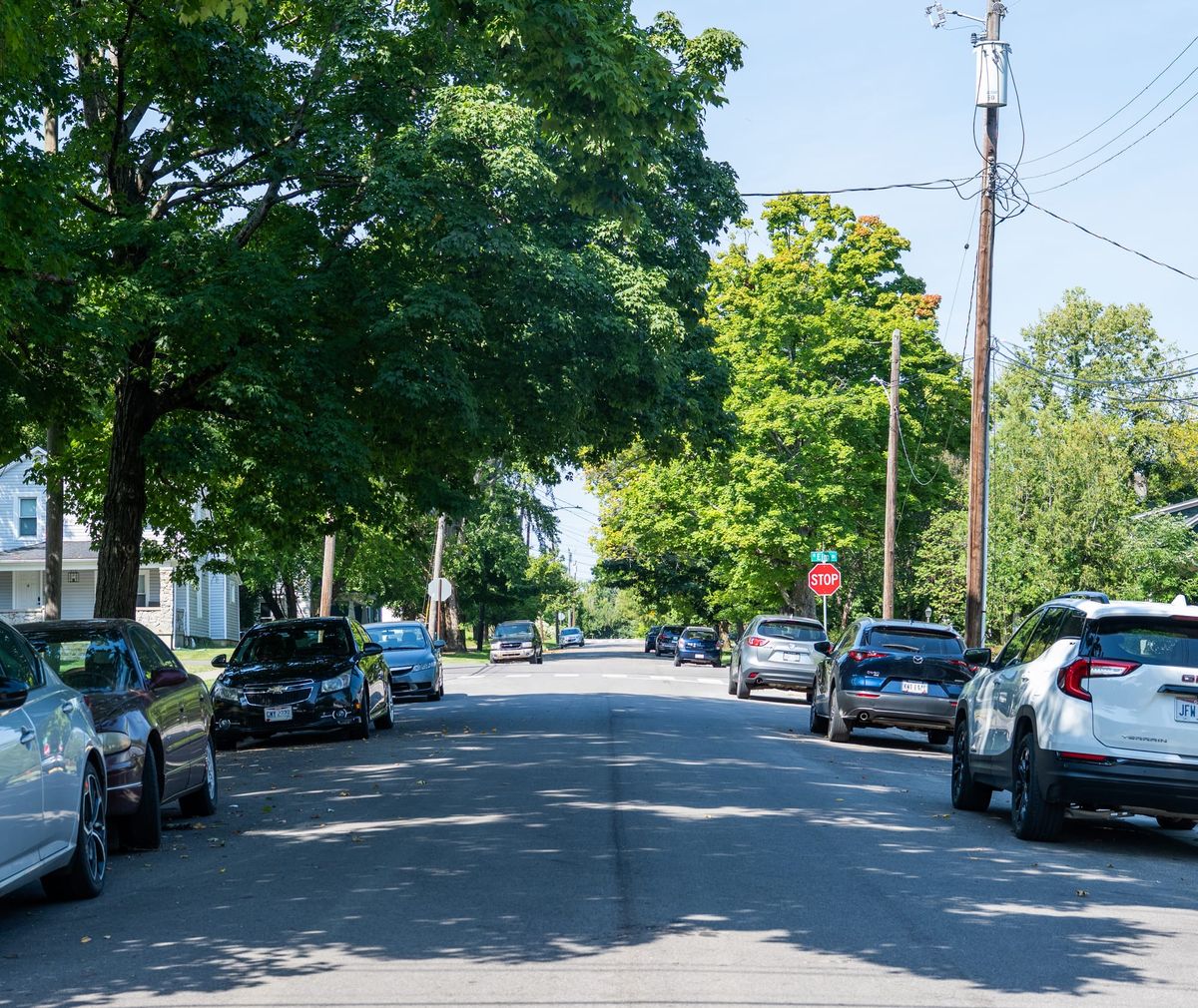
Supporters say removing the restriction could expand housing options, while opponents worry about development, parking and the character of the Mile Square
Oxford voters will decide in November whether to remove a decades-old restriction on housing development in the Mile Square (MS), a proposal that has drawn both support and opposition from city officials and residents.
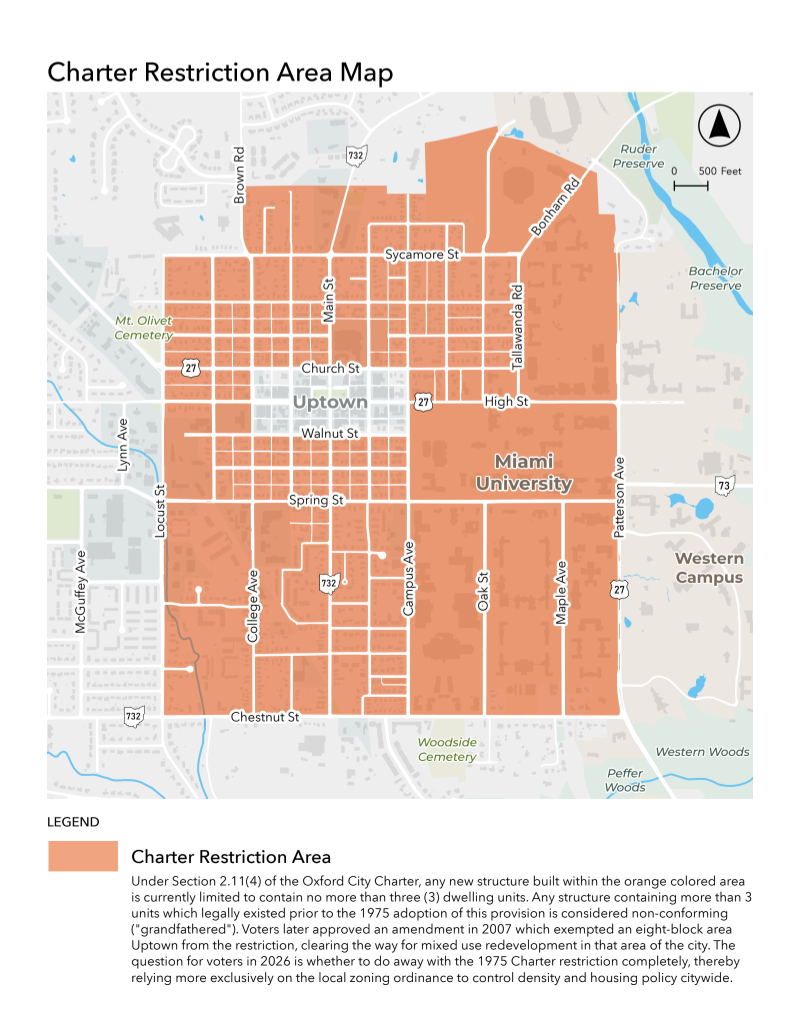
Currently, the city’s charter prohibits the building of new housing that includes more than three dwelling units.
The original MS area, bounded between Locust Street and Patterson Avenue and Chestnut and Sycamore streets, was first platted and founded in 1810, according to Zachary Moore, city planner and GIS coordinator for the City of Oxford.
“Since 1810, Oxford has grown from its original 1 square mile settlement to encompass an overall land area of roughly 7.5 square miles,” Moore wrote in an email to the Oxford Free Press.
Moore added that a portion of the charter restriction area “technically falls outside of the true Mile Square.” This area includes certain parts of the city north of Sycamore Street, such as Lincoln and North Beech streets, Homestead Avenue and more.
According to Doug Elliott, city manager for the City of Oxford, the current restriction was initiated by Oxford locals and adopted by the Oxford City Council in 1975.
Elliott said the city’s zoning code has changed “considerably” over the past 51 years. He said there are many limitations, including the number of dwelling units, number of residents per square foot, setbacks and lot coverage.
“The charter amendment would allow for consideration of apartment projects of more than three dwelling units within the framework of the existing zoning code,” Elliott wrote in an email to the Free Press. “It would provide for some flexibility which does not exist now.”
Elliott said the amendment would allow for the improvement of large, older apartment complexes that were built before the restriction took effect in 1975.
If passed by voters, all wording of the city’s charter for the fourth paragraph after the first sentence would be removed from Section 2.11.
Paragraph four would then only read: “Regulate the use of private real estate in the municipality by establishing zones, limiting the uses in each zone and limiting the height of buildings and the intensity of land use.”
Support for the amendment, potential limitations
Lindsey Myers, co-owner of College Property Management, is the latest in his family to be in the rental business in Oxford. Myers said his grandfather and two business partners started the enterprise.
“We’ve been here a long, long time,” Myers said. “Our family got to a town just outside of Oxford via a land grant from George Washington, so we know Oxford.”
Myers supports the amendment, seeing it as beneficial to potentially diversify housing options in Oxford, adding that he doesn’t see many housing options that include one- or two-bedroom options.
While in support of the amendment, Myers said he doesn’t think its passage would change how his business runs in the city.
“There’s not very many places left in the Mile Square that you can do a large development,” Myers said. “If an area did open up somehow … I think what the city’s hope is, is that somebody would offer some sort of diversified housing.”
Jason Bracken, an Oxford City Councilor, also shared his support of the amendment.
“Approving this amendment, which I strongly support, lifts that prohibition from our charter and places control of the building of greater than 3-dwelling unit housing in the Mile Square onto our zoning rules, rather than the charter, as the rest of our city is regulated,” Bracken wrote in an email to the Free Press.
Bracken added that approval of this charter amendment would “potentially allow for changes to the zoning that could provide for more housing where it makes sense, following approval from the planning commission and city council.”
Bracken said this amendment provides flexibility for the city when considering housing needs in the MS, and each decision related to expanding housing density would be required to go through the city’s planning commission and city council.
While in support of this amendment, Bracken said it could result in more dense housing areas in the MS where housing isn't necessarily needed if city staff, such as those of the planning commission, city council or the city manager’s office, don’t make “good” decisions with future zoning changes.
Bracken said he has faith in the city to make the appropriate changes when needed.
Currently, the majority of single-family housing in the MS is occupied by students, Bracken said.
“Our students need and deserve housing, and they aren’t going anywhere,” Bracken wrote in the email. “Right now, our students are living in homes intended for families. If we can keep those homes and provide students (with) other alternatives where it makes sense, some of those homes can start to open back up again, in addition to helping provide more affordable rental opportunities.”
Bracken said without this amendment’s passage, students and families will continue to be pushed further out of the MS, the local housing market will become even tighter and housing costs will continue to rise.
Sam Perry, community development director for the City of Oxford, said he believes a goal of having this restriction in place in the 1970s was to limit student housing growth in the MS.
Today, Perry said he believes the MS area would give the city more “flexibility” when looking into new investment opportunities in that area.
“I think the timing is really fantastic for the zoning code rewrite that we’re (working) on right now,” Perry said. “The flexibility that council would have is really strategic because council can change the zoning code laws, and if the voters decide to remove that restriction, then it’s (a) quicker response time for making fixes to the local zoning code.”
Perry shared his hope and excitement at the possibility of the restriction being lifted. He said he wishes it to be replaced by something that the city council can make changes to, instead of waiting for a charter review every 10 years, at most.
Part of the city code updates, which Perry and other city staff have worked on for almost two years, will focus on the city council’s goals of economic development, housing diversity and historic preservation.
Perry said the city has been working with a consultant team on the code updates, and training with Oxford’s Historic and Architectural Preservation Commission.
“If this charter restriction is removed, then we’ll still have protections in place for strategic properties,” Perry said. “Then, there’ll be a more streamlined process for what kind of development that we want to see without as many public hearings.”
Perry added that this also allows the city to create more student and non-student housing.
According to Perry, the city conducted a study in 2021 that concluded housing needs for non-students were very high.
Perry said multiple apartment buildings exist in the MS that are “older.”
“You can repaint them, put in new appliances, sinks (and) basic things, but you can’t really gut them and remodel them,” Perry said.
Perry acknowledged there is some risk when leaving these resources to future city councils, but the potential benefit “outweighs” that risk.
While in support of removing the restriction, Perry said there were some cons that could occur if the restriction is lifted, including parking challenges.
“When you add more dwelling units to a geographic area,” Perry said, “there’s likely going to be cars associated with that (growth).”
Perry said residential growth typically costs more for the city and public services, like police and fire departments, because these expenses are paid through the city’s general fund.
“The only way to get more revenue in the general fund is to have more payroll tax,” Perry said, adding that if job growth does not keep pace with residential growth, the city will face higher costs for these services.
Oppositions
Councilor Bill Snavely spoke of his disapproval of the possible amendment to the city’s charter, believing the amendment is “controversial.”
Snavely mentioned the amendment was initially batched with the other amendments approved by the council to include on the November ballot. But it was removed during a July 7 city council meeting, so voters will instead be voting on the housing issue and the other six “batched” items separately.
Snavely mentioned the history of the restriction was important to take into consideration.
“The goal of it, to limit it to three units, was to prevent the Mile Square from just becoming a bunch of apartment buildings,” Snavely said.
Snavely said while he believes the city’s planning commission has many zoning codes in place to prevent this, “that doesn’t always happen.”
Snavely said three years ago, there was a proposal sent to the city that would have taken down all of the buildings along Elm Street, next to Shademakers.
“They wanted to build a big apartment complex,” Snavely said. “I was the one who said ‘Wait a minute, that violates the charter.’”
Snavely added his concern about the permanency of the city’s zoning code.
“Zoning (code) can be changed with a simple vote,” Snavely said. “All the council has to do is (change it) by a majority vote.”
“How much control do we want to have?” Snavely said, adding that the options are to “have a permanent ban by the charter, which would keep the community the way we want it, or … just hope that council is always of the mind that they are now.”
Snavely also said many landlords in Oxford who own multiple properties in the MS could make more money off housing and potential apartment complexes if this restriction is lifted.
“There are landlords who own multiple houses, and they could very easily just tear down those old houses and build a very big and impressive and expensive new complex right in the middle of the Mile Square,” Snavely said.
Janis Dutton, a resident who has lived in the MS since 1977, spoke against the amendment, saying the potential removal of old and historic buildings and homes in the MS would be a “loss.”
Dutton said she hopes the city will “clamp down” on proposed changes to the MS that aim to maximize profit.
“I think it’s too easy to change the code and grant variances to maximize somebody’s profits,” Dutton said.
Dutton said she wants to maintain the neighborhood feel that she and her neighbors have in the MS, adding that a mix between townies and students is good.
“We take care of each other,” Dutton said, “and that’s what a neighborhood (does).”