
Reily locals learn about Myaamia Nation through educational outreach
Residents were given a lecture about the origin and movement of the Native nation over the years as a result of settlers in the region.
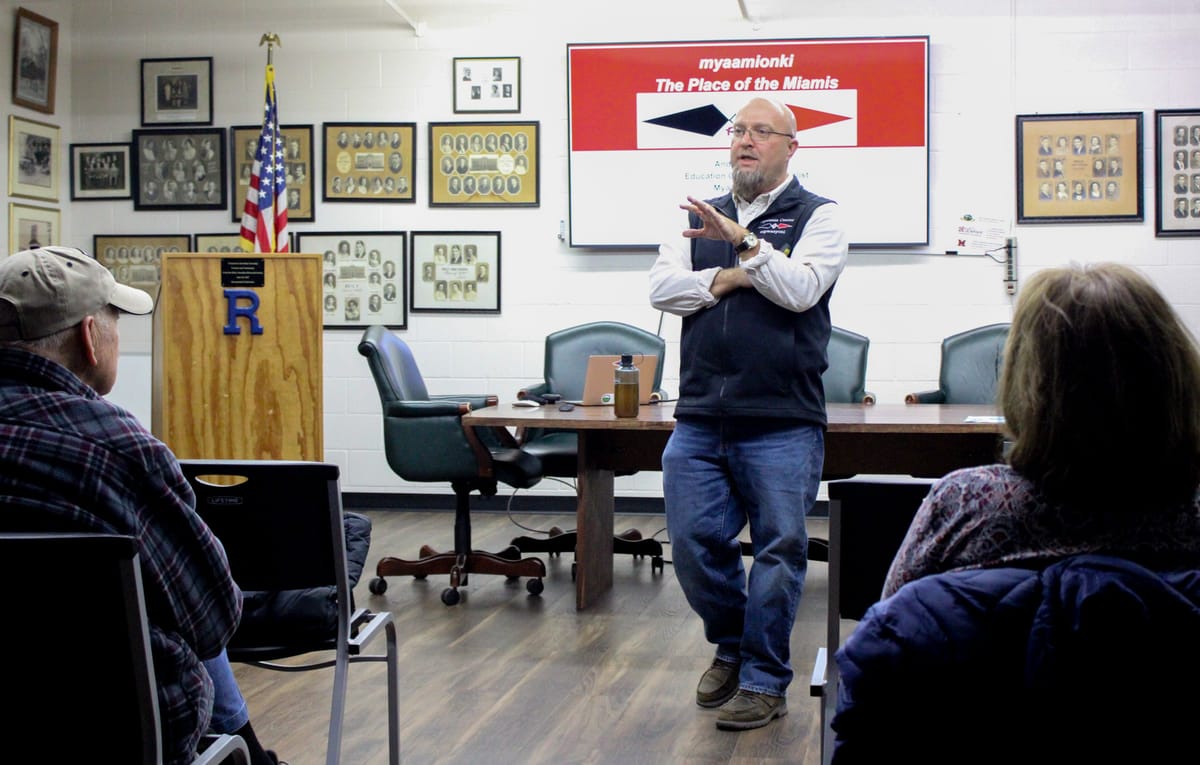
Reily Township residents were given the opportunity to learn more about the Native nation for which Miami University is named during an event at the Reily Township Community Center scheduled by the local historical society earlier this month.
Debbie Gross, archivist for the Reily Township Historical Society and Hammond House Museum, said the group wants to “broaden the horizons” of its members by bringing in other organizations like the Myaamia Center at Miami to give history lessons.
Andrew Sawyer, an education outreach specialist at the Myaamia Center, gave a presentation focusing on the history of the Miami Tribe of Oklahoma, beginning with their history of living in the area, how they were forced to leave, where they went and how they established a relationship with the university.
The Myaamia Center began as an agreement between the Miami Tribe of Oklahoma and the university focused on revitalizing the Myaamia language, although it eventually became a cultural revitalization project, according to Sawyer.
“The biggest piece of this is making sure folks are aware of and appreciate the actual history that’s taken place over the years and especially how the relationship between the tribe and university has grown since the university has carried the tribe’s name,” Sawyer said of the educational outreach he does through the Myaamia Center.
He said, besides teaching his own courses, he also gives public presentations a few times a year, some in Talawanda School District classrooms.
Sawyer said most of the work he does is focused on sharing the work of the Myaamia Center with instructors to help them incorporate it into their classes. He said he hopes telling the story of the Myaamia people, or Myaamiaki, will teach a lesson of “cooperation” and “discussion.”
“For the first 163 years of the university’s history, they had no contact whatsoever with the tribe whose name they carried,” Sawyer said. “But in the last 53-54 years, they’ve not only built a relationship, but they’ve helped the tribal nation recover their language, revitalize their traditional practices and really reengage their tribal community.”
The traditional homelands of the Myaamiaki include the land which is now Illinois, Indiana, the western half of Ohio, lower Wisconsin and lower Michigan. Sawyer said the Myaamiaki considered the lands a “shared landscape” with multiple Native nations, although there were more Myaamiaki exclusively located in the Wabash River valley.
Although the United States originally made it illegal for American citizens to cross the Ohio River onto the Myaamiaki homelands, once Americans began breaking the law in the late 1700s, the United States decided to fight the “Native resistance” to the settlers, according to Sawyer.
After many battles and many failed attempts by the Americans, Sawyer said the Native alliance was eventually defeated in the Battle of Fallen Timbers in 1794. This resulted in treaty negotiations, which would give around two-thirds of what is now Ohio and parts of what is now southern Illinois to the United States, according to Sawyer.
As Americans continually squatted, claimed and restricted resources, and several military incursions forced Native nations to give up their lands, Myaamia leadership agreed to give the last remaining portions of their homelands to the United States in 1840 and move west of the Mississippi River. In 1846, the United States began the process of forced removal for those still there.
The remaining Myaamiaki eventually settled in the territory promised to them, which is now Kansas, although they were forced out again in 1867 to what is now Ottawa County, Oklahoma.
Today, the Miami Tribe of Oklahoma is a federally recognized sovereign nation and has its own police force, government and social services.
In 1972, the president of Miami University wrote to Chief Forest Olds of the Miami Tribe of Oklahoma. As communications with the tribe continued through the years, the Myaamia Project was created in 2001 using all documentation available to revitalize the original Myaamia language.
Miami University has a series of courses designed for students who are members of the Miami Tribe of Oklahoma to learn the language, history and cultural traditions. During the fall 2025 semester, Sawyer said there were 46 students on campus who were members of the tribe.
Anyone wishing to learn more about the Myaamia Center may visit miamioh.edu/centers-institutes/myaamia-center.
Cameron Shriver, an adjunct assistant professor and research associate at the Myaamia Center, will also be visiting the Reily Township Community Center on by request of the historical society on Feb. 3 at 7 p.m. to talk further in depth about the nation’s Mihši-maalhsa Wars, or their wars with the Americans.