
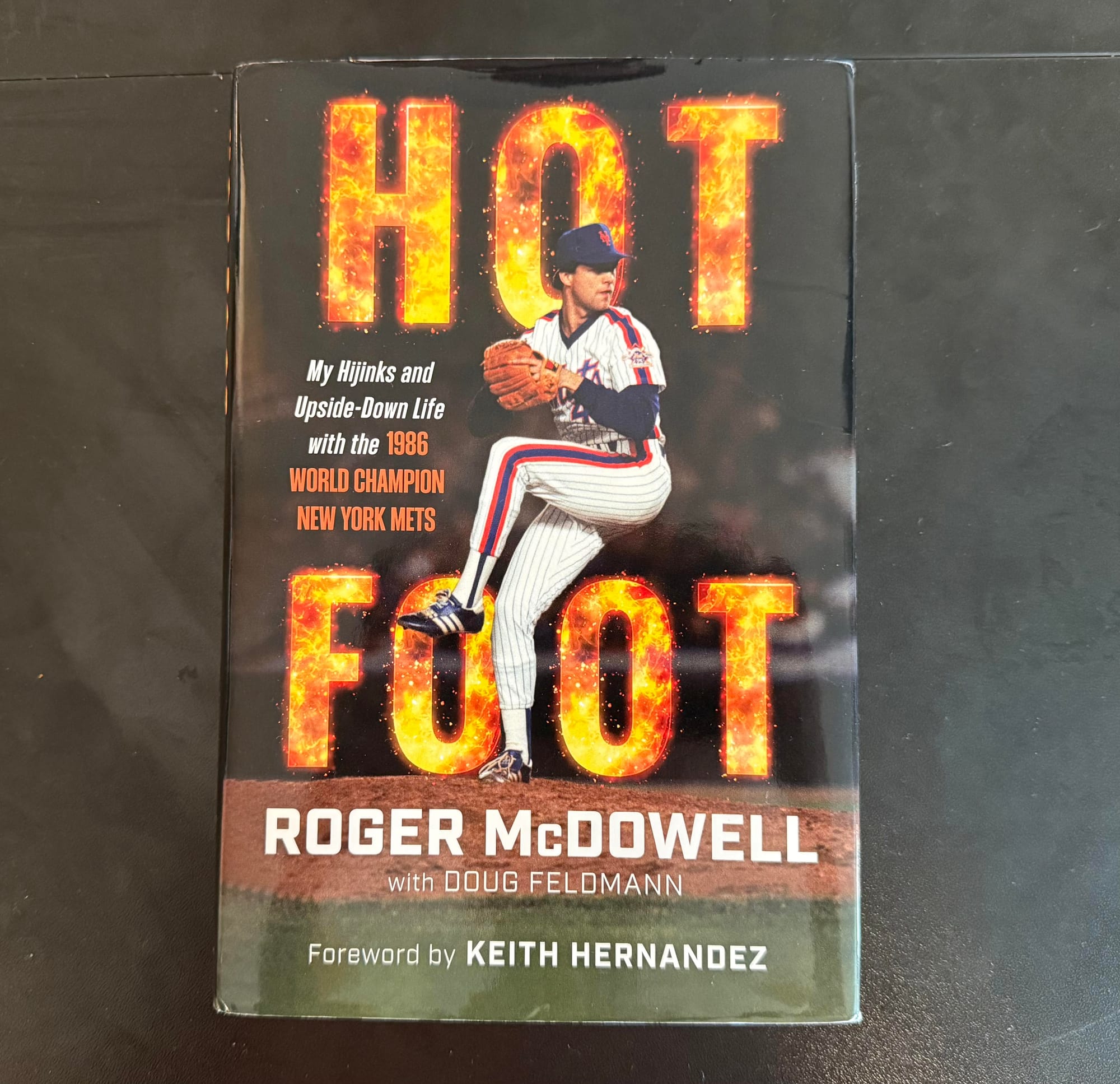
Roger McDowell’s new book ‘Hot Foot’ highlights upbringing in northwest Cincinnati before New York Mets career
The 1986 World Series champion reliever talks his baseball career and growing up in Cincinnati
The 25-year-old stepped on the mound with his head down before roughing up the dirt with the bottom of his spikes. Long brown hair flowed from under his blue cap. He was chewing vigorously. And the clean-shaven face didn’t look up until it was time to throw a pitch.
Before he emerged from the bullpen, the game had been down to its final two outs. But three straight runs in the top of the ninth provided new life. Now, it was his turn to write the narrative.
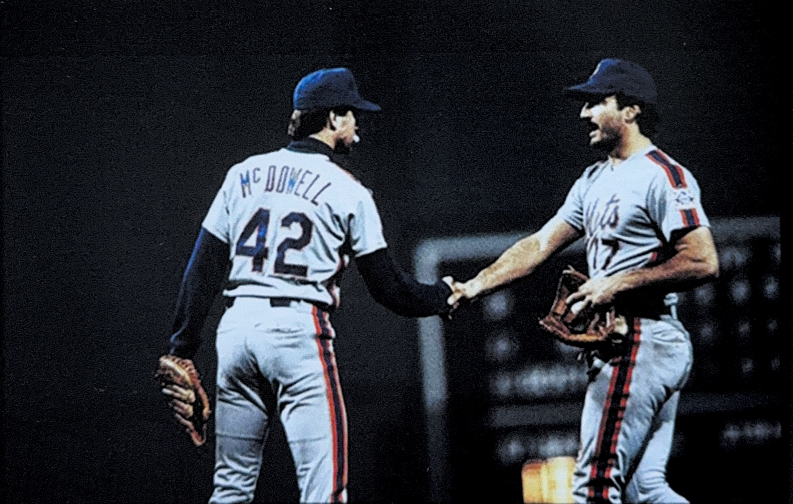
Donning the number 42 on the back of a gray uniform with blue and orange accents down the shoulders and sides of his pants, the second-year right-hander was the enemy. The majority of the 45,718 souls in the Astrodome were rooting against him. His downfall was to be the joy of an entire city and the devastation of another.
A trip to the World Series was on the line. But stone-faced he stood, knowing the object in his hand gave him control and, most importantly, his team needed him.
So he went to work.
Groundout. Groundout. Groundout. Inning over.
Groundout. Strikeout. Groundout. Inning over.
Groundout. Groundout. Groundout. Inning over.
Strikeout. Hit. Caught Stealing. Groundout. Inning over.
After three more outs, the 25-year-old walked off the mound and did not return to the game. He had done what needed to be done over five full innings. But they weren’t just any five innings. They were the bottom of the 9th, 10th, 11th, 12th and 13th in Game 6 of the 1986 National League Championship Series (NLCS) in the Astrodome.
Roger McDowell – a pitcher who wasn’t the most imposing on the mound, didn’t throw the hardest and wasn’t highly touted coming out of college – had just thrown the best and longest relief appearance of his career in the biggest moment.
After almost five hours, the game ended. The New York Mets scored three runs in the top of the 16th and closed out a nerve-wracking bottom half of the inning, punching their ticket to the World Series by a final score of 7-6.
The 1986 Mets were a team of destiny. They finished the regular season 108-54, and while their cast of characters may have been unique, no one could argue because all they did was win.
McDowell pitched in Houston, and three days later pitched in Game 1 of the World Series against the Boston Red Sox. Then, he pitched in Game 3, Game 4, Game 6 and Game 7. He earned his first career postseason decision in that final game and became a World Series champion – a journey that began because of his dad, Cincinnati baseball, a rubber ball and a wall.
And a journey that culminated in a celebration of that World Series title through a new biography called “Hot Foot.”
McDowell was born and raised near Cincinnati. He grew up loving baseball. “The Big Red Machine” put everyone in Ohio into a baseball frenzy. His dad was a fan of former Brooklyn/Los Angeles Dodgers manager, four-time World Series-winning and seven-time National League pennant-winning manager Walter Alston, who played baseball at and graduated from Miami University.
While he was growing up, McDowell sometimes visited the Oxford campus, primarily in high school. He thought it was a beautiful campus, and the baseball program was one of excellent stature. If he was given the chance, it’s where he would have attended.
“Miami and Michigan were the two schools in that Michigan, Ohio, Kentucky and Indiana area that had really good baseball (teams),” McDowell said. “I wasn’t really good enough to go to Miami. That’s where they recruited higher players who had a little bit more ability back when I was in high school. That was the place I wanted to go to and where I wanted to further my baseball career.”
McDowell played on a travel baseball team called Midland Guardian growing up, a program founded in 1966 by Joseph P. Hayden Jr., a 1951 Miami alumnus whose name sits today on the Jay Hayden Baseball Center and McKie Field at Hayden Park on North Quad. The program is also home to alumni such as Barry Larkin and Ken Griffey Jr., among others.
While participating on the Midland team, he also played in high school at Colerain High School, a 33-minute drive from Oxford.
After high school, McDowell went to play college baseball on scholarship in the Mid-American Conference at Bowling Green State University, rejecting an offer from Virginia Military Institute and beginning a new chapter of his life.
“When I graduated high school, I basically left Cincinnati,” McDowell said. “I still had roots in Cincinnati; my parents at the time still lived there, but my two older brothers, one had moved to Florida and one was in the service, and my sister moved to Atlanta, Georgia.”
The right-hander went on to play three seasons with the Falcons, dreaming of making it to the big leagues just as he did when he was a kid. He hated the classes and went only because he needed to be eligible for baseball. His major was initially architectural engineering, but he switched to commercial art after realizing how many math classes he had to take.
McDowell passed all the classes he needed to but didn’t complete his degree. After his junior year, he knew his time at Bowling Green was over. He didn’t care what team drafted him or how much was on the check; professional baseball was up next.
In the third round of the 1982 MLB Amateur Draft, McDowell was selected by the Mets and began his professional career with the Single-A Shelby Mets of the South Atlantic League. From 1982 to 1984, he worked his way from the ground up in the minor leagues, learning from teammates, tweaking his delivery and ultimately improving his patented sinker ball along the way.
On April 11, 1985, at the age of 24, McDowell made his first appearance on a major league mound. In a game against the archrivals of the Mets at the time – the St. Louis Cardinals – the lanky kid from Cincinnati grabbed the baseball and pitched a complete inning without allowing a baserunner. He earned his first career decision that night in a 2-1 victory in the 11th inning.
The 1985 season was about as good a start to a major league career as McDowell could have asked for. He finished sixth in Rookie of the Year voting and was on a team waiting to bloom. In fact, the next season, when the team came out of its shell, so did McDowell.
There are an abundance of stories from the 1986 Mets, and McDowell found himself in the middle of plenty. He was known on the team as a prankster, particularly for the “hot foot” prank (hence the name of his book), in which a player would use gum or specific kinds of tape to stick a book of matches and a cigarette to the back of a teammate’s shoe.
The teammate wouldn’t know until the smell of burning leather hit their nose, signaling something was wrong.
McDowell perfected his hot foot craft with the 1986 Mets, but he was a prankster with variety his entire career. His hijinks extended far beyond the hot foot.
McDowell played pranks all the time. He cut up a teammate’s suit so he had to walk out of the ballpark in it. McDowell wore his uniform upside down (pants on arms and shoes on hands) and walked around the dugout. He put a plate with a hamburger on third base for a larger-built umpire.
He made fun of the MLB crackdown on baseball doctoring by wearing a tool belt in the bullpen. He revealed a teammate on the bullpen toilet to fans during a game and threw firecrackers into the bat slot of teammates who were slumping at the plate.
Former Mets reliever and one of McDowell’s closest confidants, Jesse Orosco, pointed out that McDowell’s pranks helped keep the mood light during the long parts of the season.
“Roger was amazing,” Orosco said in “Hot Foot.” “He was an incredible athlete – he could do anything on the field. But he was also a great teammate, and of course, one of the best practical jokers in all of baseball. Teams need someone like that, because it brings everyone together. It helps to have someone on the club who likes to make people laugh. He was famous for the hot foot, so we didn’t want to sit too close to him on the bench. I also remember him blowing big bubbles with bubble gum right in a guy’s face, and that would get everyone laughing too. He was always looking to do something new.”
McDowell was known all around the league for his pranks and fun-loving attitude, but he was also known by his teammates and team staff as reliable. He was someone who could flip a switch the moment he stepped on the diamond.
“Roger had a great sense of humor,” former Mets PR Director Jay Horwitz said. “He was a practical joker. But when he was on the mound, he was all business. In the days of relievers pitching one inning, he pitched two innings. He had that famous Game 6 against the Astros. He had 14 wins and 20-plus saves. He was an anomaly. He was fun off the mound, but when he stepped on the field, he was all business.”
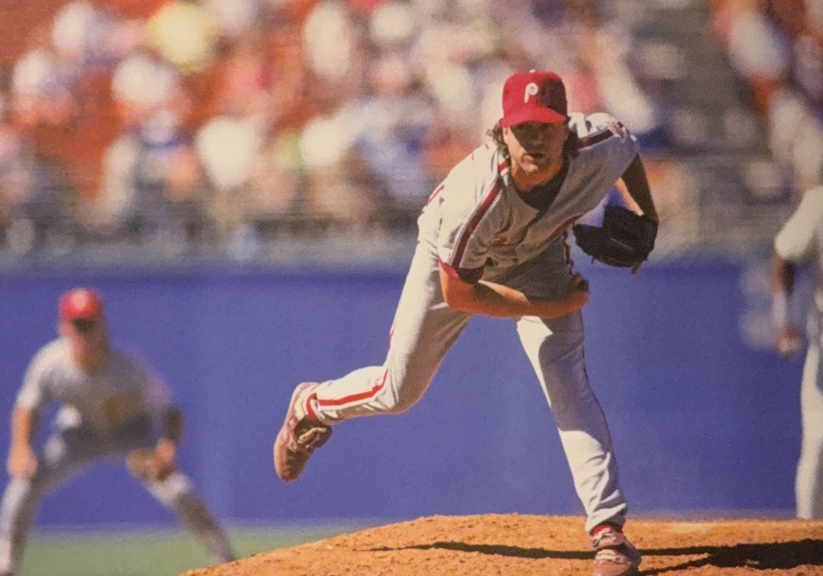
After five years in New York, McDowell was traded to the Philadelphia Phillies in 1989, where he pitched until 1991 before being traded to the Dodgers. Through three years in Los Angeles, McDowell played well enough on and off the field that his stardom continued to grow.
McDowell was not only the guest of honor for MTV’s “Rock n’ Jock” softball games, but he was also in an episode of “Seinfeld” called “The Boyfriend” as the “second spitter.”
But after Los Angeles, McDowell wasn’t sure what was in store for him. However, the Texas Rangers came calling, and he pitched 64 games in Arlington before heading up to Baltimore for his final MLB season in 1996.
McDowell retired and went into the pitching coach line of work starting in 2002. He worked up from single-A to the majors, retiring fully from baseball after working as the Atlanta Braves pitching coach from 2006 to 2016 and the Baltimore Orioles from 2017 until the end of the 2018 season.
Following McDowell’s stint as a pitching coach and his ultimate retirement from baseball, a writer by the name of Doug Feldmann came into his circle.
While writing a book (the 15th of his career) on the 1987 Cardinals, Feldmann had the urge to see the team from their archrival’s view. He was pointed to Horwitz to get in contact with players, and McDowell was one of them.
“(Roger) and I really just hit it off,” Feldmann said. “He’s a great storyteller. I’m a Cincinnati transplant, so Roger and I could talk about Cincinnati, and it occurred to me a short while later that with his colorful and successful career not only as a pitcher but as a pitching coach, he’d make a great candidate for an autobiography. I think at first he was a little reticent, but over time he became more attracted to the idea.”
Reticent was a nice way of putting it. McDowell wanted nothing to do with a book. However, the more he thought about it as a celebration of the people around him than a book about himself, he became a bit more intrigued by the idea.
Finally, he gave in.
“There’s a measure of trust that needs to be built,” Feldmann said. “You’re putting your life story into someone’s hands to write up; it’s a leap to take, no doubt. But we hit it off quite quickly and enjoyed talking about baseball and Cincinnati and Camp Washington chili in Cincinnati, so he just texted me and said, ‘Let’s do it.’”
So they did. They spoke once or twice a week for about a year and worked chronologically from his origins in the Cincinnati area to the World Series to becoming a pitching coach. All of those chats culminated in a 256-page book not just about one person but about those around him who helped shape him.
Through their time working together, Feldmann saw the same thing that McDowell’s teammates saw throughout his major league career: An easy-going personality that could change in an instant when needed. The dedication to his craft and passion for the game are second to none.
“With each story that was told, I had no idea the depths to which Roger had to reach within himself to climb each rung of the ladder,” Feldmann said. “He wasn’t highly recruited out of Colerain. Virginia Military Institute and Bowling Green were his only two scholarship offers. It took him a couple of years to take off at Bowling Green, but (he) did so and became a high draft pick, and then he had to start all over again when he went to the minors and he had to climb the ranks that way.
“But all of it goes back to when he and his three siblings grew up in this small apartment in northwest Cincinnati. It was a cramped situation, so he was always dying to get out of the house, and his dad spray-painted a strike zone on the wall of the apartment building. And not only would Roger practice his pitching, but his dad emphasized that you have to be a good fielder as a pitcher, too. I think that’s what made him one of the best fielding pitchers in memory. But as he climbed each rung in his baseball career, it all went back to the drive to reach that next rung and reach back for the fundamentals that he had learned in a very raw way as a kid.”
The last time McDowell was back in the Cincinnati area was when he was coaching the Orioles: April 20, 2017. But he never forgot the two people who paved the way for him and the places that helped mold him.
“I would always rent a car, and one day I would take a dozen baseballs from the ballpark back to the hotel,” McDowell said. “The next day I would drive out to Brooksville, Kentucky, where my dad is buried and leave 11 baseballs on his gravestone.
“Then, I’d drive maybe 15 minutes from there because my mom loved the (Walcott) Covered Bridge. She loved that covered bridge, and there’s a stream right underneath it, and that’s where she wanted her ashes (spread). So I’d take one baseball, and I’d toss it in the creek for her. Then I’d go back to Cincinnati, and the next day I would go up to my childhood stomping grounds and just take a look at the apartment complex, drive up to my old elementary school and I would stop at Camp Washington Chili.”
McDowell’s story is one of appreciation, but also one of determination. It’s a story of fun times, but also moments of high pressure and intensity.
Through his major league career, both as a player and coach, there was always something new to learn, but it never fazed him. Baseball was his life, and he knew it from the outset.
He made do with the ability he had, and his mindset, drilled into him by his father, coaches and peers, along with his nasty sinker, brought him to the promised land. And with “Hot Foot,” he gets to share his knowledge with the world.