
Talawanda moot court team named state champions 3 years after program starts
This was Talawanda’s first team to win the state competition.
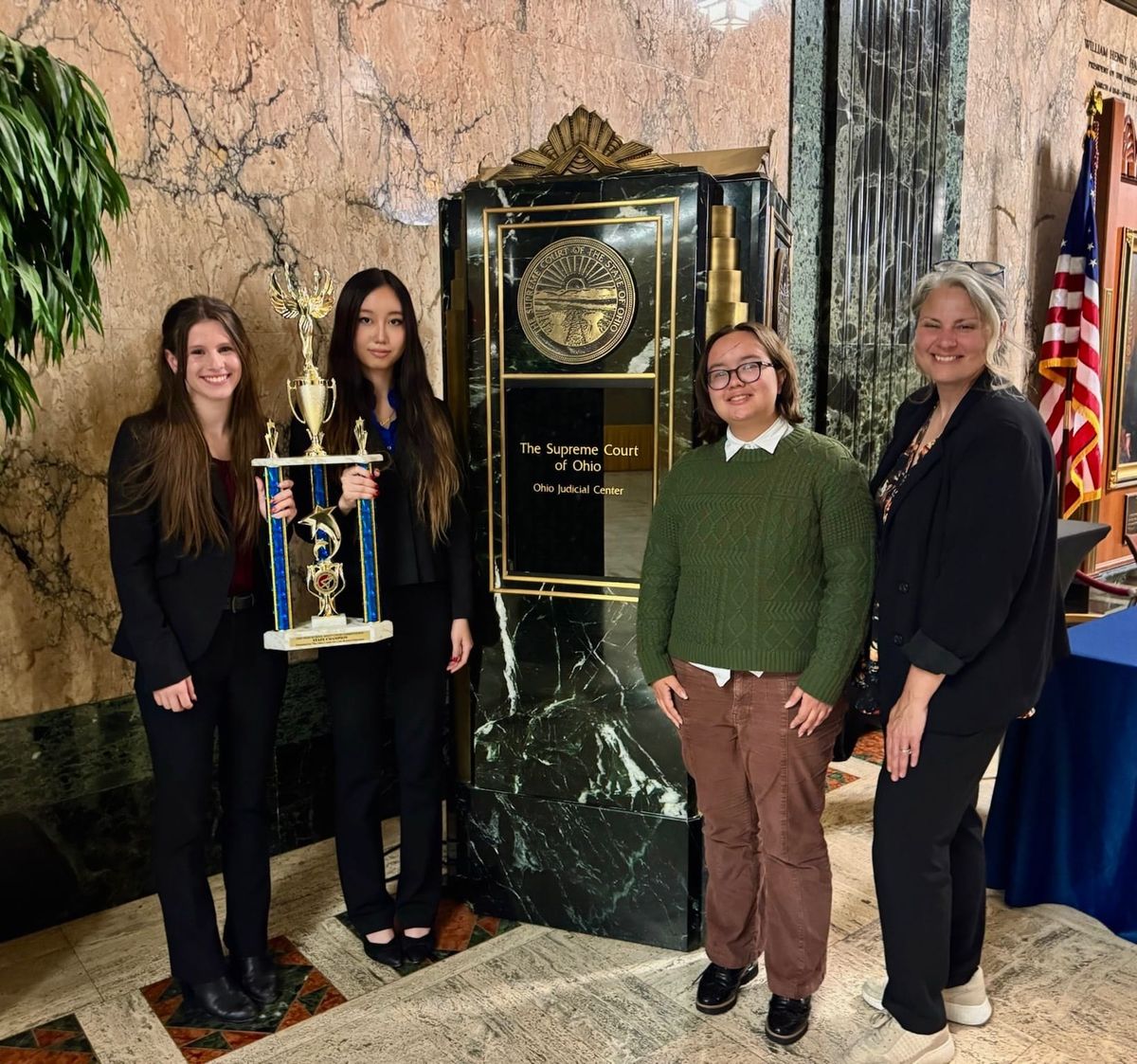
A Talawanda High School moot court team was named the champion of the Ohio Center for Law-Related Education (OCLRE) Moot Court Competition in early May just three years after the program was started at the school.
Melody Miao, a rising senior at Talawanda, and now-alum Katelyn Bulanda won the final round of the OCLRE competition and beat 13 other teams. The team was led by Coach Amanda Weatherwax, an English teacher at the high school, and assisted along the way by their timekeeper, now-alum Shr-Lin Moore.
Weatherwax said she’s been coaching the mock trial program for a long time, but started the moot court program more recently after she realized it was also through the OCLRE. This was Talawanda’s first team to win the state competition.
This year, Miao and Bulanda were the only competing students from Talawanda. Last year, Weatherwax said there were two competing teams and one student who was a timekeeper.
The OCLRE sends participating schools a case file that has been through a fictional court of appeals, including the facts of a case, the lower court’s opinion, case law and precedents of the lower courts. Students then use that information to write a brief, similar to how an appellate attorney would, going through the process all the way to the fictional Supreme Court, set in a fictional state called “Buckeye.”
Students either argue as the petitioner or respondent, writing a brief for either side. During practices, Weatherwax said they’ll brainstorm all the questions the mock panel of Supreme Court justices may ask.
“It's pretty exhilarating, because the students have this roadmap, and they have these major points they need to get out, but the mock Supreme Court justices, they keep interrupting you,” Weatherwax said, “so you have to respectfully answer and engage the court in this conversation, but then also try to get back to the major points that you need to make to try to win for your client.”
This year’s case focused on government jawboning, or the use of speech or implied threats by government officials to influence business or labor leaders. The case was brought against the fictional state’s department of education and workforce and its director for sending a letter to a fictional social media company called “Looped,” asking it to review and potentially take down a school prank video.
In the fictional case, Looped sued, arguing the department violated First Amendment rights by making the request.
The students started practicing in March for the May tournament, which was held at the real Supreme Court of Ohio in Columbus, where real judges and attorneys served as the mock Supreme Court panel. To make it to the final round, Miao and Bulanda had to go through six preliminary rounds, arguing both sides of the case three times each, as well as a semi-final round.
Weatherwax said students should have the opportunity to be in programs like those offered by the OCLRE “so that they experience being a part of something bigger than themselves.” She said participating in a team helps with learning interpersonal skills, like trusting and supporting one another, while being part of a community.
“These two kids just became really good friends,” Weatherwax said of Miao and Bulanda, adding they were also co-counsel on the mock trial team this year.
Although the two didn’t win the regional mock trial competition, Weatherwax said, soon after, the two dedicated themselves to winning the moot court competition.
Weatherwax said of Miao and Bulanda, “(They) are just an absolute joy to work with.”
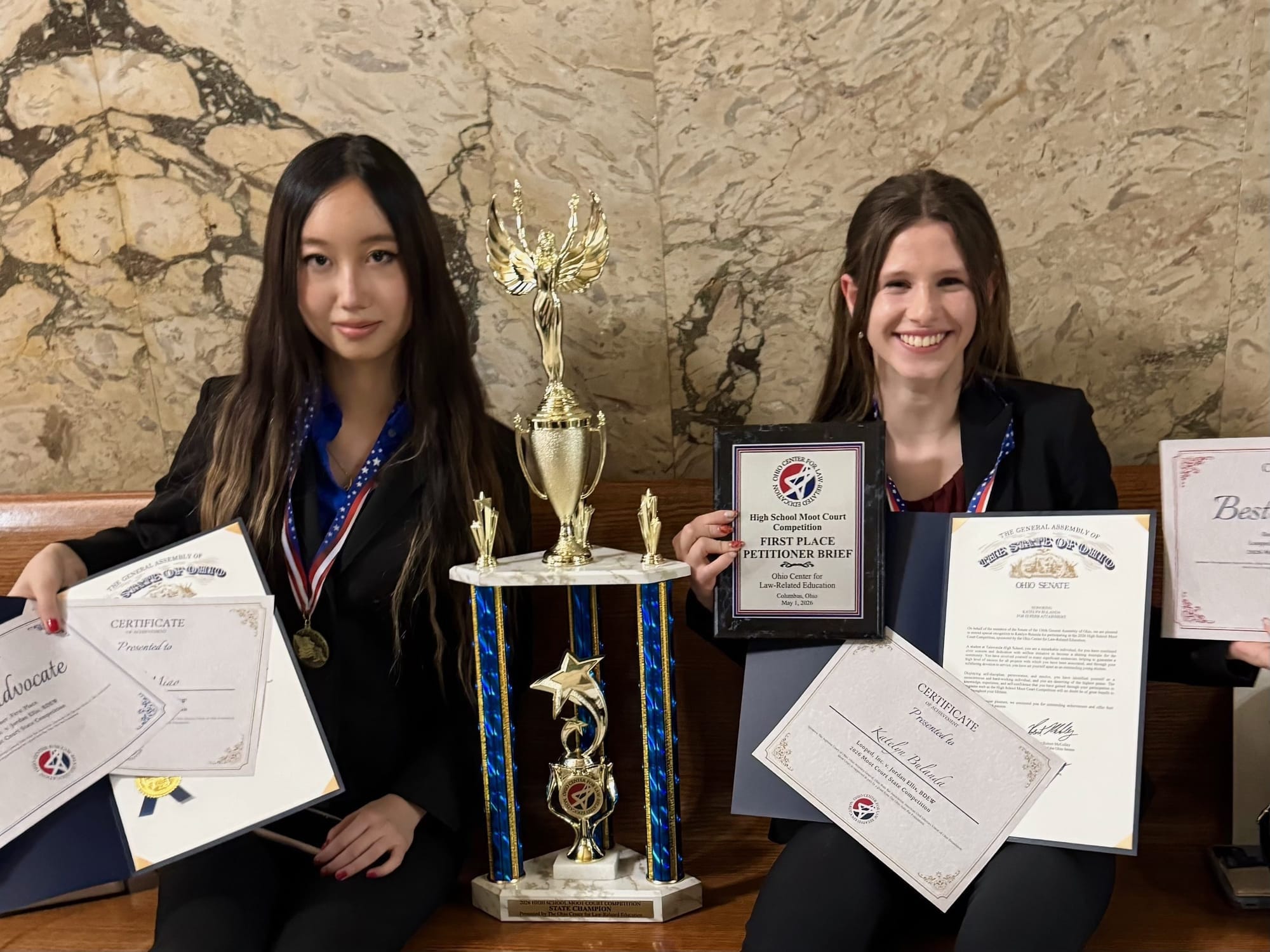
“They're academically gifted, very busy kids,” she said, adding they each took college classes this past year and participated in other extracurriculars. “For them to choose to spend their time doing this… it's just commendable to me. They really are just interested in the law and putting the puzzle pieces together and making a great argument.”
This was Miao’s second year on the team, and she’s also a member of Talawanda’s mock trial team, which is an OCLRE program as well. In the future, she hopes to be an attorney focused on intellectual property, or IP law, and she has a passion for policy.
Miao said she enjoys moot court because of how it combines public speaking with creative argument and working under pressure.
Last year, Miao was paired with Moore, and the two won an award for best petitioner’s brief, and Miao placed in the top three for a respondent advocate award. She said she wants to continue to be on the team as a senior.
Miao said of being named a champion this year, “I was just so proud of my whole team.”
“I feel like this year, we just worked so hard,” she said. “It was a level of commitment that I really haven’t experienced before in any sort of school extracurricular. I think that we all independently were so driven towards our common goal in this competition, and also just studying the law in general, and I was just so proud that our efforts paid off in such a way.”
Bulanda has been in the moot court program at Talawanda since she was a sophomore, but competed for the first time last year, when she and another student earned a first-place petitioners brief award.
Bulanda has also been in the Talawanda mock trial program for the past four years. She said competing in the two programs has helped her with her coursework, adding there’s crossover between the writing, rhetorical, public speaking and presentation skills she’s gained from mock trial and moot court and her performance in the classroom.
She said of being named a champion this year, “It’s very exciting.”
“I've definitely become pretty involved with the different programs (OCLRE has) to offer, and it's been really valuable for me,” Bulanda said. “But this year, to close it out with a state championship is something I've always hoped for, and it was really cool that the last competition I had was the one that we won.”
Miao encourages other students to join the program, saying moot court provides a unique environment with real-world applications, helping to build confidence while practicing quick thinking and polite argumentation.
Bulanda said students who are thinking about joining should know they do not need any prior knowledge of law or court procedure, and "anybody can be good at it.”
“You really just have to kind of show up and be willing to learn it,” she said. “The life skills it provides you with, even if you don’t have an interest in a law-related career, is just beyond valuable.”