
Talawanda student lunch debt at a high
Talawanda School District students are accumulating a lunch debt in the 2025-26 academic year so far that Treasurer Shaunna Tafelski estimates is already higher than previous years.
The lunch debt compiled by all Talawanda School District students is increasing, Superintendent Ed Theroux said during a board of education meeting Thursday, Nov. 20.
Treasurer Shaunna Tafelski told the Oxford Free Press following the meeting she estimates lunch debt is higher so far in the 2025-26 academic year than usual. Although she said she’s still compiling data to figure out the exact amount owed, which could be completed by mid-December, there are many families missing the income cut-off for free and reduced lunch in the school district by just $100 per week.
The National School Lunch Program through the United States Department of Agriculture (USDA) served 1,119 students in the Talawanda School District during Fiscal Year 2025, beginning Oct. 1, 2024, and ending Sept. 30, 2025, according to data from the Ohio Department of Education and Workforce.
Talawanda Schools reported having 2,945 students enrolled for FY 25 according to the state’s data, meaning nearly 38% of students qualified for free or reduced lunch.
Enrollment data provided by Tafelski on Monday, Nov. 24, shows about 40% of students now qualify.
Talawanda is not enrolled in the Community Eligibility Provision (CEP) for free breakfast and lunch for students, although four out of five of its schools are eligible to apply, according to the state department’s annual notification for the 2025-26 school year.
Talawanda High School is the only school in the district marked “near eligible” to apply for CEP, which requires 25% of students to be eligible for free meals based on participation in other federal aid programs like Temporary Assistance for Needy Families (TANF) or Supplemental Nutrition Assistance Program (SNAP).
According to the USDA’s income eligibility guidelines from July 2025, the monthly income of a household of two people must be $39,128 annually for a student to individually qualify for reduced lunch, or $27,495 to qualify for free lunch.
The federal poverty level for a family of two is set at $21,150 annually, according to the USDA. According to the U.S. Census Bureau’s latest recorded data from 2023, 9% of families in the district were in poverty.
Tafelski said, while the school district could participate in CEP, it would not be reimbursed for the cost of school meals for students who would not normally qualify themselves.
“We evaluate this every year, as there is a financial burden that would be put on our general fund,” she said. “The general fund would need to make up the difference to the food service program, and we are not currently in a position to make that happen.”
Theroux said, overall, more students are reaching graduation with compiled lunch debt where there’s been no attempt by their families to pay.
“If you have a family and you don’t qualify for free or reduced (lunch) and you're paying for it, that does not mean that you are not struggling with putting food on your table, paying rent, all that type of stuff,” he said.
This comes after President Donald Trump’s administration passed the One Big Beautiful Bill Act on July 4 with updated work requirements to SNAP and Medicaid that could cause Americans to lose benefits. As some families become ineligible, this could reduce the number of students who factor into a school’s total when deciding if it's eligible for the CEP.
The school district raised the cost of student meals between 10 cents and 25 cents during the previous school year, which Theroux said was a “modest” amount as food costs increased. Although the district was able to provide free lunches to all students during the COVID pandemic through the CARES Act, he said this funding has since dried up.
Breakfast costs $1.75 each day for all students in the district, while elementary lunch costs $3 per day and middle and high school lunches cost $4 per day. With a state minimum of 180 days per school year, families with elementary school students must pay a minimum $855 annually for breakfast and lunch, or $1,035 annually for those with middle and high school students.
As most families in the district are ineligible for free or reduced lunches on their own, Theroux said, “Our people are caught in the middle. And with increasing … food costs, increasing of property taxes, people are making very difficult choices.”
If a student reaches the end of their senior year with a lunch debt, it could prevent them from participating in graduation ceremonies, Theroux said.
Tafelski said groups like the Oxford Community Foundation, Rotary Club and Women’s Giving Circle have donated funds in the past to assist with the debt, but “the pot is dry right now.”
Theroux said, “I think we’re finding tighter times to be honest.”
He said families must fill out an application for free or reduced lunch if they believe they qualify before their student acquires debt, as the district cannot retroactively pay for meals. The form for families to apply is available on the school district website under “departments” and “food services.”
Anyone wishing to assist in paying student lunch debt may reach out to Tafelski by calling the school district at (513) 273-3100.
Other business
In other business, Talawanda High School principal Scott Davie told the board the district’s graduation rate is now at 98.6%, and average daily attendance is up to between 94-96%. Overall, he said chronic absenteeism has reduced from over 30% to about 21% in the past few years.
Since the district’s cell phone ban was implemented at the beginning of the school year in compliance with state law, Davie said 18 THS students have been formally disciplined for cell phone use, with high school enrollment at under 1,000 students.
He also updated the board on the district’s College Credit Plus (CCP) program, “Ohio Transfer 36,” named for the number of college credits offered to high school students which are transferable to any public and nearly all private colleges and universities in Ohio. The program, according to his PowerPoint presentation, is focused on increasing in-house courses and creating more in-state pathways to college.
Davie said offering dual credit courses in-house allows students to have access to more in-person college-level courses, receive feedback on their work and stay in school with other students.
The CCP program has existed for several years, although Theroux told the Oxford Free Press, over the past five years, Talawanda Schools have increased the number of in-house CCP courses, and Davie has worked to ensure more teachers are certified as instructors.
This school year, Davie said more students are taking college credits in-house. He said 1,500 credits are currently being earned at the high school.
Davie said the school district is also saving about $50,000 this academic year by offering more courses in-house instead of sending students off campus.
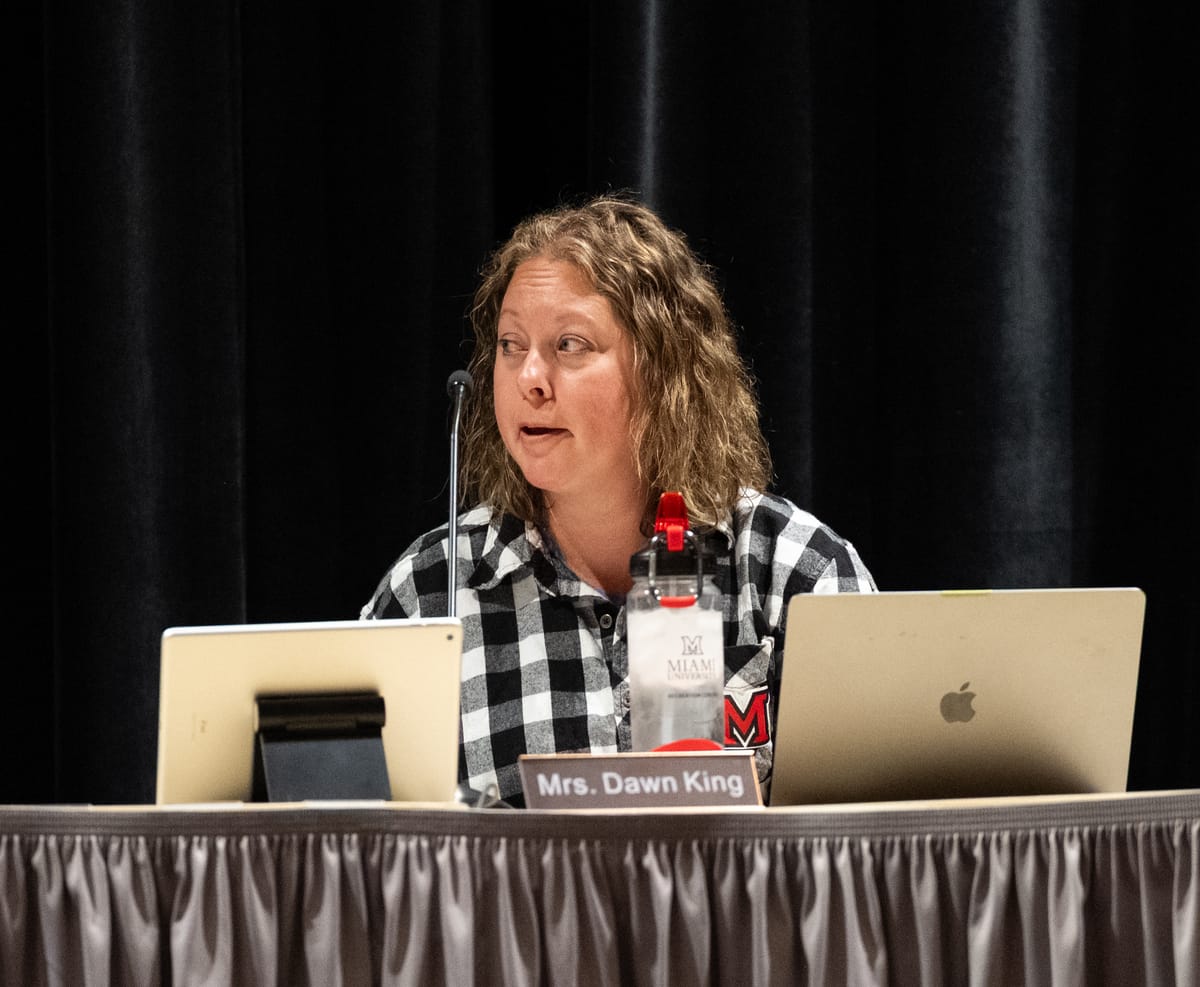
Board member Dawn King asked if CCP courses are replacing Advanced Placement (AP) classes, for which credits are transferable to most colleges in the country.
Davie said some content areas have been shifted from AP to CCP as part of the initiative, although students are still able to take the AP exams at the end of their course. If students pass with a score of three out of five or higher, their credits may be transferable to any institution accepting the AP credit.
“What has happened, too, is now we have consistency in teachers, whereas before, whatever university, whether it’s online or going to (that campus), it may change semester by semester,” Theroux said. “I think we will see many more students passing an AP test … taking the CCP class because of our strong expectations. That does not always occur with a changing faculty that’s teaching classes.”
Davie said the district has already seen that trend. He said AP Calculus was transitioned to a CCP course a couple of years ago, and as students have continued to take the AP exam, “We’ve had some of the highest Calc 1 AP scores that we’ve had in a long time.”
Board member Pat Meade told the board, average daily membership at Butler Tech, the county’s career technical education facility, is the highest it’s ever been, which he attributed to program growth. He said the school’s aviation center, the Advanced Manufacturing Workforce and Innovation Hub in Hamilton and new welding programs are expected to add about 250 spots for Talawanda students interested in those areas.
Chris Brown, superintendent of the Butler County Educational Service Center, also announced he will be stepping down after 10 years in his position in January. He will be replaced by Jeff Brandt.
The center provides programs and services, professional development, leadership, support and staffing for school districts in the county.