

Townships, commissioners proceed with data center research during moratorium
County to consider six-month extension for further exploration
The Butler County Commissioners will consider an extension to the current moratorium, or temporary suspension, on building data centers within the limits of six townships over which the county has zoning control, according to Butler County Administrator Judi Boyko.
The commissioners voted to impose the moratorium on developments in Hanover, Lemon, Madison, Milford, Oxford and Ross townships during a regular meeting on June 16.
The moratorium was in response to all six of the townships agreeing to support the suspension of data center development within their limits in earlier months, although there aren’t currently any plans or requests to build data centers within those townships.
Although most of the proposals sent to the commissioners by townships asked for a pause of 12 months for studies on the implications of any developments, the commissioners originally approved a temporary moratorium on the approval, establishment, construction or issuance of any data or data processing center within the townships for six months.
The moratorium currently in effect is set to expire in December.
Now, Boyko said the county is drafting an extension to the moratorium for another six months, adding that moratoriums generally last for a year. The county intends to submit it to the Board of Commissioners in early December.
“We’ve articulated in the resolution that the purpose is to study, explore, research, understand impacts and methods to potentially mitigate any consequential, negative, detrimental consequences to the properties or property owners or residents on any matter,” Boyko said.
Boyko said it is not an uncommon approach for a community to place a pause on future developments so they can be studied for their impacts and consequences and understood before any businesses or proposals approach a community.
“The initial moratorium is taking an opportunity to explore data centers, what they represent, how they develop, what are the consequences to the development, not only on operating local government but moving people and traffic and goods and impact to the economy in a community,” Boyko said.
Boyko said the impacts of data center development are being studied internally by county staff. Commissioners also approved a resolution in June to request that Prosecuting Attorney Michael T. Gmoser file a motion with the Court of Common Pleas to appoint outside counsel to assist in representation regarding best practices for governmental policy, negotiations and standards related to data centers and their impacts.
There have been two meetings with leaders of the six townships so far, Boyko said, including a high-level overview about data centers with anecdotal information from a national perspective and to look at the existing conditions of properties in the townships, current zoning and land use.
“None of the communities are saying, ‘We want data centers,’” Boyko said. “This is all part of this moratorium exploration.”
The meetings, Boyko said, are meant to educate township trustees on current studies and trends, which they can take back to their boards and have public discussions.
Points to consider in any development would be whether there is available property that’s conducive to the development and if there are ample roadways in and out of the construction, as well as utilities.
“We are simply being the facilitator to provide knowledge and information to the township trustees, so they can go back to their communities and make their own decisions,” Boyko said. “I think communities at every level – cities, townships, counties – have that tool (placing moratoriums) when used responsibly to really look at land use and make the right decision for those communities through facts.”
This comes at a time when a data center developer has filed a complaint with the U.S. District Court for the Southern District of Ohio Western Division against the City of Trenton in response to a city charter amendment voted on by the majority of Trenton residents during the Nov. 3 general election to prohibit the construction of data centers with aggregate monthly demand or peak load of 25 megawatts or more.
During a meeting on March 30, the Trenton Planning Commission approved a site for a data center to be constructed by Prologis at 3000 Arnold Brown Industrial Drive.
According to the complaint, Prologis has already spent $42.3 million to commence construction of the site. The “Trenton Data Center Campus LLC” is arguing the amendment is “unconstitutional” and cannot be applied to Prologis’s already permitted and “substantially constructed project.”
In the complaint, the company asks to complete the project in accordance with the permits already issued by the city and that the court declares the amendment unlawful and unenforceable to the project under constitutional law, enters injunctions prohibiting the city from enforcing the amendment against the project and awards financial relief.
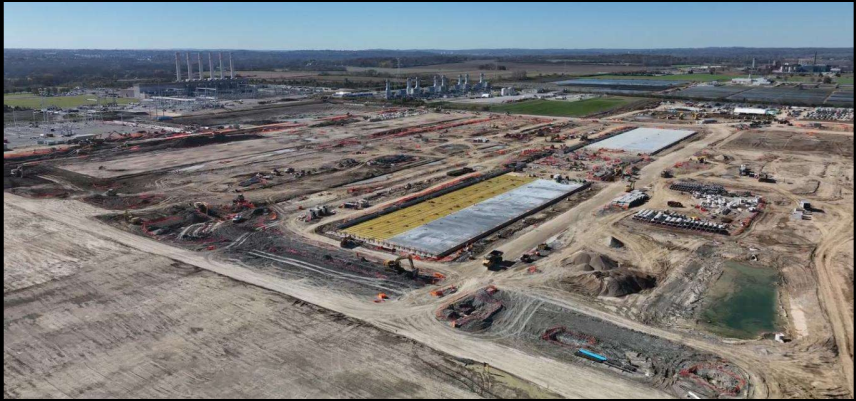
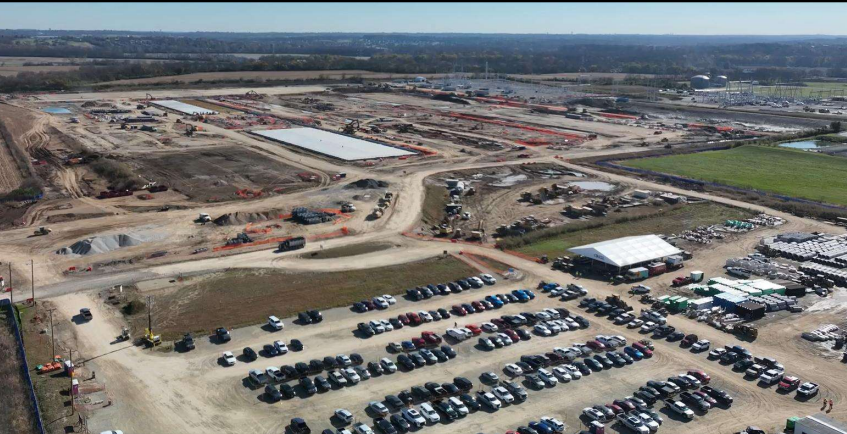
Aerial views of construction currently at 3000 Arnold Brown Industrial Drive in Trenton for the Prologis’ data center project included in a legal complaint filed against the City of Trenton in the U.S. District Court for the Southern District of Ohio Western Division on Nov. 12, 2026. Photo courtesy of legal representation for Trenton Data Center Campus LLC.
Hanover Township trustees already spoke with residents about what they learned from the meetings with commissioners during a meeting on Nov. 18.
Hanover Trustee Diana Ramsey said the purpose of the conversation was to try to ease residents’ minds by talking openly so they know where the trustees stand on data centers.
“With the whole Trenton issue, I think there are a lot of people that wonder if it’s a possibility for a data center to come here into Hanover Township and for them to know where we stand on it,” Ramsey told the Oxford Free Press.
She called the meetings with the commissioners “very informative,” saying the first was about the differences in data centers and the pros and cons. She said the second meeting was more about the zoning currently in the townships.
Ramsey said the trustees learned “that you don’t just have to fold to these big corporations’ hands, that you can mandate or negotiate for certain things for infrastructure.”
Hanover currently only has a half of an acre that is zoned for industrial use, which wouldn’t be large enough for a data center development regardless.
“They’re trying still … to provide us with information on how we can protect ourselves from data centers and what information (in the zoning code) needs to be updated to do that,” Ramsey said, adding the county believes simply saying “no” to all future developments isn’t the best policy, as these companies typically have significant financial resources to combat townships in court.
Ramsey said she believes what the county is currently doing for the six townships in educating them and opening up discussions “could have possibly helped prevent” the legal situation the City of Trenton is currently in.
“They're (the county is) going to be going through each township and updating our land use plan that we currently have, so that the properties that we currently have zoned in a particular way, we want to make sure that they're all updated and all of our data and information in those plans are described in the best way possible,” Ramsey said. “Things like that provide better protection.”
Butler County Commissioner T.C. Rogers told the Oxford Free Press he felt the townships were “enlightened” as the result of the discussions about many different factors that go into the decision to begin any development.
In reference to the development in Trenton, Rogers said, “We’ve always been able to work with them and the other jurisdictions within the county, but we had no indication at all that they were looking into a project like that.”
Rogers said the commissioners had “no input” even though the development could be affected by the county’s sewer arrangements. He added that the county won’t accept the cost of any damage to roads or maintenance required as a result.
“Somebody should have talked to us,” Rogers said, “but that was their deal.”