
Union Miami faculty win new tentative contract with higher raises
FAM files unfair labor practice charge against university
More than nine months since the Faculty Alliance of Miami (FAM) union began negotiating with Miami University, a new contract yielding higher raises was finally settled on for members during a bargaining session on Nov. 19.
The tentative agreement still needs to be ratified by FAM through a vote and approved by the Miami University Board of Trustees (BOT) during a public meeting. The next regular BOT meetings are scheduled to be at the Marcum Hotel and Conference Center on Dec. 10-11.
Bargaining over a new contract to replace the one in effect from 2023 through 2026 began in March, with FAM asking for higher raises and fighting for language regarding academic freedom, artificial intelligence, shared governance and evaluations.
During a special meeting on Aug. 5, the BOT approved a bargaining agreement with union librarians in FAM, which now covers all librarians at Miami, to last through June 30, 2029, including higher raises, promotional bumps and increased professional development funds.
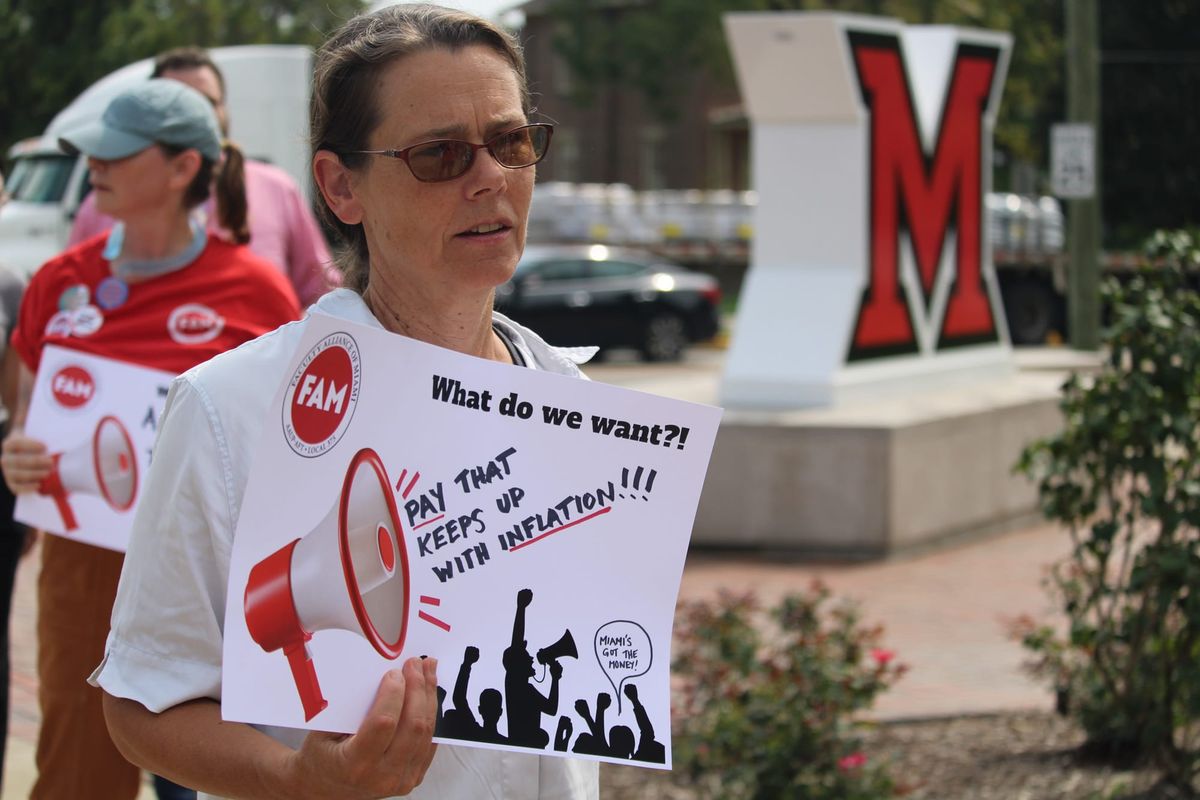
Since the beginning of bargaining, FAM has hosted several rallies around campus to push their message about wanting higher raises among other requests and grievances for university administration.
On Nov. 18, the day before the final bargaining meeting, FAM members marched into Roudebush Hall to deliver a stack of handwritten Thanksgiving-themed postcards to Miami President Gregory Crawford demanding raises. Accompanied by librarians and student allies, faculty moved from the Shriver Center patio to the administrative offices chanting, “Crawford, Crawford, you got paid. Crawford, Crawford, where’s our raise?”
The language was in reference to the Miami BOT’s recent approval of a 3% raise with a 30% Fiscal Year 2026 bonus for Crawford. His new salary sits at $607,190 per year, with a bonus of $176,851 for FY26.
According to salary data of all FAM faculty, which represents all full-time continuing faculty, Crawford’s bonus alone is higher than the annual salary of 92% of union faculty members. Additionally, the university’s original raise pitch for FAM faculty members was just 1.25%.
The tentative contract includes raises that are higher than the first contract settled by FAM in 2023, adding up to a raise of 9.8% including compounding over the period of the contract with full retroactive pay going back to June when the first contract expired. The contract also includes a $500 ratification bonus within 45 days and $250 in professional funds for 2026-27.
Although this is still less than FAM’s original request of a 15% raise over three years, FAM President Theresa Kulbaga told the Oxford Free Press, “That is the way that negotiations go.”
“We set the initial demand high. Management sets their initial proposals low, and we end up meeting somewhere in the middle,” Kulbaga said. “We did push management to higher raises than we won in the first contract, and they were definitely higher raises than the university wanted to give us, which is why it was such a hard fight.”
In the 10 years before faculty and librarians unionized at Miami, Kulbaga said faculty raises were on average 1.8% each year. In the first contract won by FAM faculty – a year-and-a-half-long endeavor – raises were 3% each year to their base salary.
“I think it was such a fight because we’re challenging the norm, the historical norm at Miami,” Kulbaga said. “We have historically low raises, and we’re finally pushing the university to admit that we deserve more.”
The new contract, if ratified and approved by the BOT, also includes caps on health insurance cost increases, which affects everyone employed at Miami under the university’s plan.
“Even though we’re only bargaining on behalf of our own members, the university doesn’t have separate health insurance plans for different categories of employees at the university, so whatever we worked out at the table for faculty was going to be what applied to all employees at the university,” Kulbaga said.
“Whatever wins we got in that (benefits) article, they are significant wins. They’re wins for everyone at the university. … Unions tend to increase job security and economic security for all employees, and not just the ones that are actually in the bargaining unit.”
The new contract also includes eligibility for teaching, clinical professors and lecturers (TCPL) to go on faculty improvement leaves, essentially sabbaticals, which is a first at Miami. Other articles include defined pay schedules for summer teaching and priority for summer and winter teaching over non-union faculty, increases in minimum salaries, promotion raises, minimum per-credit-hour rate for overload teaching and regional per-course caps.
Additionally, the contract preserves the current wording for the grievance and arbitration article, which Kulbaga said management tried unsuccessfully to add 750 words to that “would limit when we could file a grievance, how we could file a grievance, who could file a grievance, what we could be awarded if we filed a grievance, what an arbitrator could decide if we ended up in arbitration and other really unacceptable weakening(s) of our ability to enforce the contract.”
“We fought that very hard,” Kulbaga said. “We got them to drop all of it … in our settlement discussions so that now we can enforce the contract and protect our members when management violates the contract.”
While the contract also includes previous language around academic freedom, intellectual property and artificial intelligence (AI) from the first contract, Kulbaga said the union had to drop previously requested language to agree not to replace faculty members with AI or evaluate members using AI.
“I still think that was a bad decision on (Miami’s) part, and we’re going to be watching very vigilantly to make sure that they don’t start doing those things,” Kulbaga said.
This comes at a time when Miami is making strides in integrating AI into the university, including requiring departments to add AI teachings into their curricula and hiring AI provost fellows to lead the charge, creating a Miami Center for Artificial Intelligence, introducing a bachelor’s program in AI, ensuring access to Gemini and other types of assistance for all students, building a data center in Hoyt Hall and encouraging research projects having to do with expanding AI access to students and staff.
Kulbaga said she is also disappointed that FAM was unable to win language in their contract about what happens if U.S. Immigration Customs Enforcement (ICE) agents come to campus, including procedures on notifying students and staff of their rights and identifying contacts for anyone approached by ICE.
“We’re very concerned about the presence of ICE on campuses and the way that that’s been ramping up in Ohio,” Kulbaga said. “And management did not agree to that (language), and I think that was a real opportunity for both of us to protect our students and our colleagues, and they just did not see that as an opportunity.”
Regardless, Kulbaga said the wins in the contract helped to secure wins for everyone at the university – not just through the benefits article – but by setting a precedent for compensation.
While previous raises were lower university-wide, Miami BOT members passed a 3% raise for all non-bargaining employees at a meeting in June.
“The university has been forced to offer more than that to other employees, so that it doesn't look like we're winning such higher raises than everybody else,” Kulbaga said. “So we're lifting the boats of everybody.”
Miami consistently promotes being ranked a top-tier public university in several categories, and Kulbaga said it’s all because of the faculty who dedicate their time to teaching students.
“We are excellent at our jobs, and we deserve to be rewarded for that,” Kulbaga said. “Anything that doesn't put us closer to catching up with inflation and the cost of living and the expense of everything is not adequate.”
The new contract would be in effect from 2026 through June 2029.
English professor Cathy Wagner, who previously told the Oxford Free Press the university’s first proposals for compensation in the contract were “extremely insulting,” said on Nov. 21 she was “delighted” with the new tentative contract.
“I'm just sort of blown away,” she said of the result of FAM’s bargaining.
Still, she said the order of faculty raises, in which they’ll receive a 3% compounding raise in 2026 and 2027 and 3.5% in 2028 was “disappoint(ing).”
“I am disappointed with the decision on the administration's part to put our largest raise in the third year, but I do understand why they did it,” Wagner said, adding she believes it was so non-union members wouldn’t think bargaining members had a “win.” “Given the situation (with) all the inflation that has been going on, I do wish that we had our largest raise front-loaded.”
She said it’s also disappointing to not have won on FAM’s requested AI language, but feels like the union may have another chance to discuss a memorandum of understanding (MOU) in the future.
Overall, Wagner said she’s happy with the benefits article and the opportunity for TCPL to apply for faculty improvement leaves, which she said often contributes to departments in the long term.
“The university law firms will all tell them to take as long as they can because it means that you know ideally from their perspective, faculty and workers and librarians will get ground down and will take a less-good deal than we might have otherwise,” Wagner said. “We are lucky in having faculty at Miami … that seem to understand those gains and aren't going back down.”
Labor Day
FAM is also in the midst of arguing an unfair labor practice charge against the university, which it submitted to the State Employment Relations Board (SERB) in late September, according to Kulbaga.
The charge is for Miami’s forbiddance of a planned event scheduled by FAM on Sept. 2 in relation to Labor Day, in which the university cited the union’s collective bargaining agreement and Ohio Senate Bill (SB) 1.
The event was a “Teach-OUT” organized by FAM that encouraged members to host their classes outside for a portion of the day to demonstrate their work.
At the time, executive vice president of FAM and history professor Elena Jackson Albarrán told the Oxford Free Press the purpose of the event was to celebrate labor by making their classes visible, but letters from Miami’s legal representation likened the event to an unlawful strike.
Kulbaga said FAM has charged the university with targeting legally protected union activity and submitted a folder in October of evidence to support its claims.
“Our case was basically that the university was specifically targeting the union in its activity of teaching outside, and not targeting teaching outside in general,” Kulbaga said.
Kulbaga said she’s unsure of the timeline for SERB to make a decision, but FAM didn’t ask for compensatory damages, only that the university agrees to not prevent legally protected union activity and set a precedent for other universities which might attempt to use SB 1 to do so.