
Veterans Among Us: Ron Schloemer
After graduating from St. Louis University in 1963, Ron’s Air Force career put him in many different places and many different air planes.
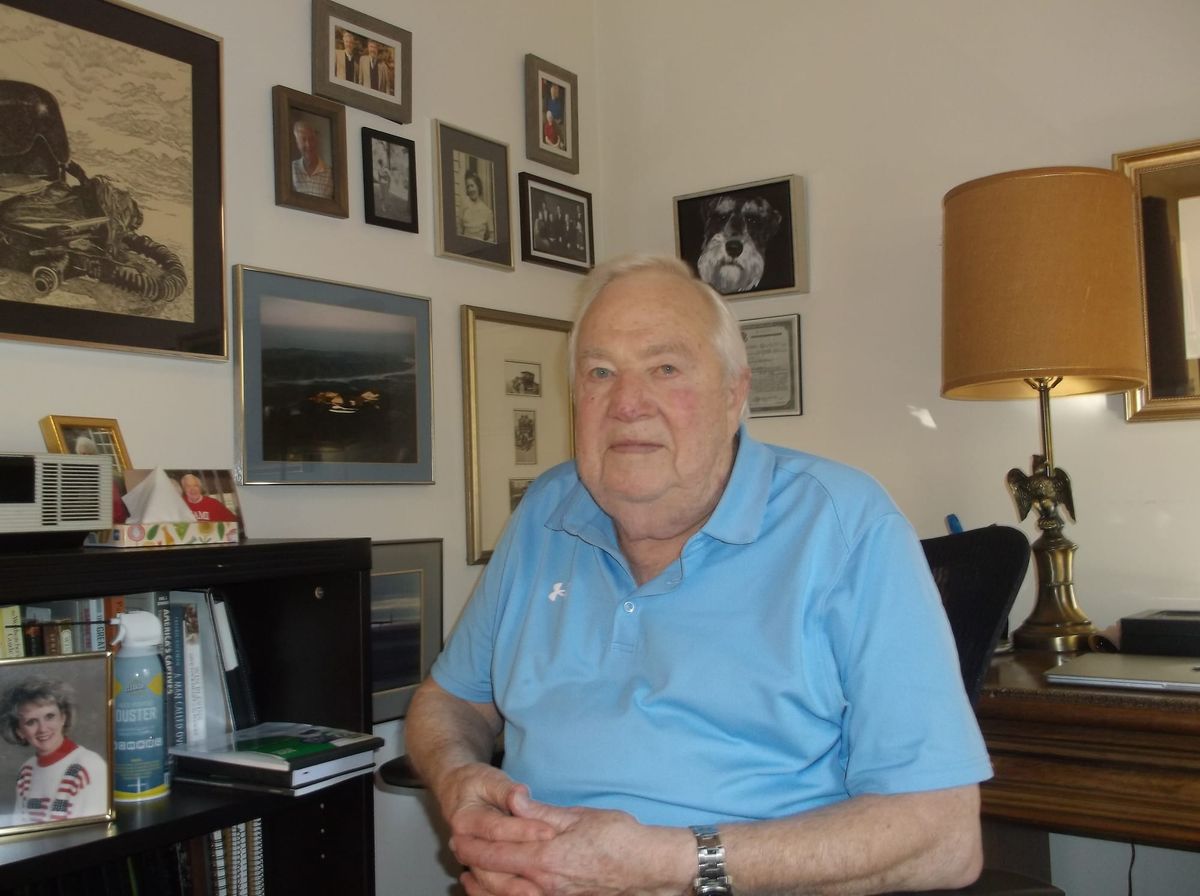
Retired Air Force Colonel Ron Schloemer shared that his older brother, Ozzie, bought him his first model airplane when he was eight or nine. Once this happened, he had model airplanes of his own construction hanging from every part of the ceiling in his room.
Ron was born of German immigrant parents in Elgin, Illinois. He described Elgin as the city of churches, trees and taverns. It was from Elgin’s streets that he remembers seeing victory formations of aircraft flying over the city – probably from the Glenview Naval Air Station just outside of Chicago – signalling the end of World War Two.
Ron credits his older sister, Rita, with being the person who inspired him to think about higher education. Going to college was somewhat financially difficult for a large family, but Rita earned a scholarship to go off to college, setting an example for Ron that it could be done. After high school graduation, Ron was off to St. Louis University, where he was able to combine his interest in academics and his fascination with airplanes by becoming a cadet in the Air Force ROTC program.
After graduating from St. Louis University in 1963, Ron’s Air Force career put him in many different places and many different air planes. Along with all of this activity over a number of years, he earned two masters degrees and was a distinguished graduate of the Air Command and Staff College and the Air War College.
Out of flight school, Ron was first in the T-37 airplane in 1964 at Craig Air Force Base in Selma, Alabama. It was at Craig AFB that Ron had to request his next airplane of his choice. He chose the F-105, but getting his choice depended on the availability of that airplane and his class standing. The F-105 allotments were being taken up by the air war in Vietnam. Instead, Ron was assigned to the F-4 D Phantom II airplane and went to Tucson, Arizona for six months of advanced training in the F-4. From Tucson, Ron was transferred to the 25th Fighter Squadron at Eglin Air Force Base in Florida for three years. The 25th was deployed to Urbon, Thailand in 1968. It was from Ubon that his F-4 participated in 200 combat missions over Laos and North Vietnam. These missions were a part of Operation Igloo White, an idea formulated by then-Defense Secretary Robert McNamara. Using highly classified electronic sensors, F-4 pilots dropped these sensors throughout Laos and North Vietnam to trace enemy movements along the Ho Chi Minh Trail, a labyrinth of trails that carried enemy supplies and combatants.
In historical perspective, this entire operation has been referred to as McNamara’s Line. For his actions in Vietnam, Ron was awarded the Distinguished Flying Cross for Heroism and multiple Air Medals and battle ribbons.
Ron left Vietnam in 1969 and became a F-4 instructor pilot at George Air Force Base in California. From George AFB, Ron was assigned to the Air Force Academy in Colorado Springs, Colorado as a military studies instructor for three years. It was then on to Maxwell Air Force Base in Montgomery, Alabama. This was followed by a two year assignment to Luke Air Force Base as an instructor pilot. From Luke AFB, Ron and his family spent 1978-1980 in Seoul, Korea. Ron was a lieutenant colonel when he was next assigned to Holloman Air Force Base in Alamogordo, New Mexico in 1980. He served as an instructor pilot and flight safety officer at Holloman AFB. It was on this assignment that he was part of the accident team that investigated the 1982 crash of the Air Force Thunderbird Team in Nevada. Ron said that this assignment gave him a lot of visibility to the rest of the Air Force Command.
For the first time in his career he was also picked to be a maintenance officer at Holloman AFB. This assignment was key in getting him promoted to Colonel.
As a Colonel, he was back in California at George AFB from 1985-1987 as assistant deputy commander for operations. At George, Ron flew the F-4G, also known as the Wild Weasel. While at George AFB, Ron decided to put in a request to become an Air Force ROTC instructor. Ron said that he had always loved academics and that heading a ROTC unit somewhere would help satisfy the yearning to continue to teach. He headed Miami’s AF ROTC Detachment 640 from 198701989. He was also a lecturer in Miami’s Farmer School of Business. After his time at Miami, he wasn’t ready to retire, so he took an unaccompanied assignment to Camp Red Cloud, Korea as a liaison officer to the US Army from 1989-1991.
After this assignment, Ron was back in Oxford and commuted to Wright Patterson Air Force Institute of Technology. He worked at Wright Pat as a plans officer from 1991-1993. He officially retired from the Air Force in 1993.
Ron accumulated over 4000 flying hours in his career, 2500 of these hours were in the F-4 Phantom II. When I asked him what all of these hours flying and all of the hours teaching meant to him in service to the country, he said without hesitation, “It fulfilled a childhood dream. I could fly an airplane, and I could find a way to teach.”
Airforce Brigadier General Robin Olds described a fighter pilot in this way: “A fighter pilot is a man in love with flying. A fighter pilot sees not a cloud but beauty; not the ground but something remote from him; something he doesn’t belong to as long as he is airborne. He’s a man who wants to be second best to no one.” I think Olds was describing Ron and thousands like him who dared to go ‘off into the wild blue yonder.”
We should be thankful for all of those who lived and those who never returned to land and fly again.
Lee Fisher is a Miami graduate, resident of Oxford, Ohio and a Vietnam War veteran.