
Downing Fruit Farm Fall Festival
The popular image of Johnny Appleseed as a scatterbrain hippie randomly throwing about apple seeds is inaccurate.
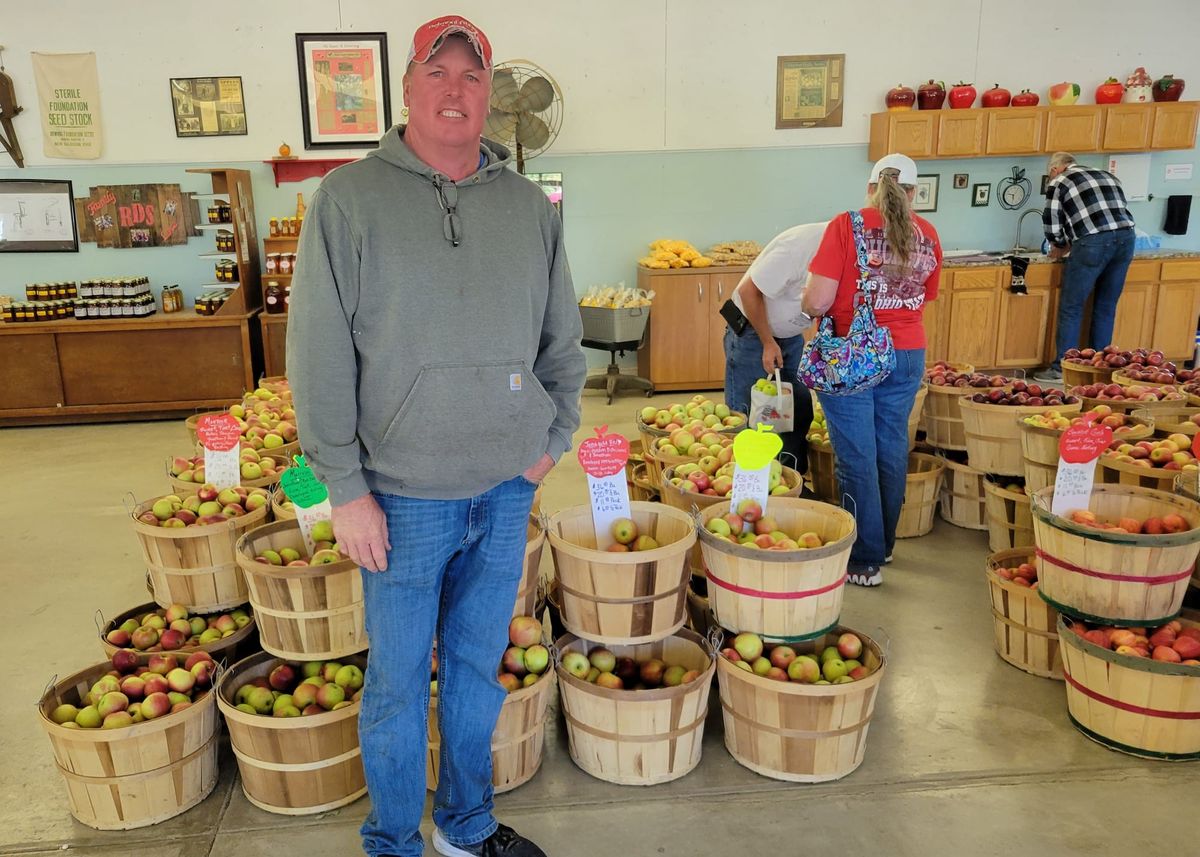
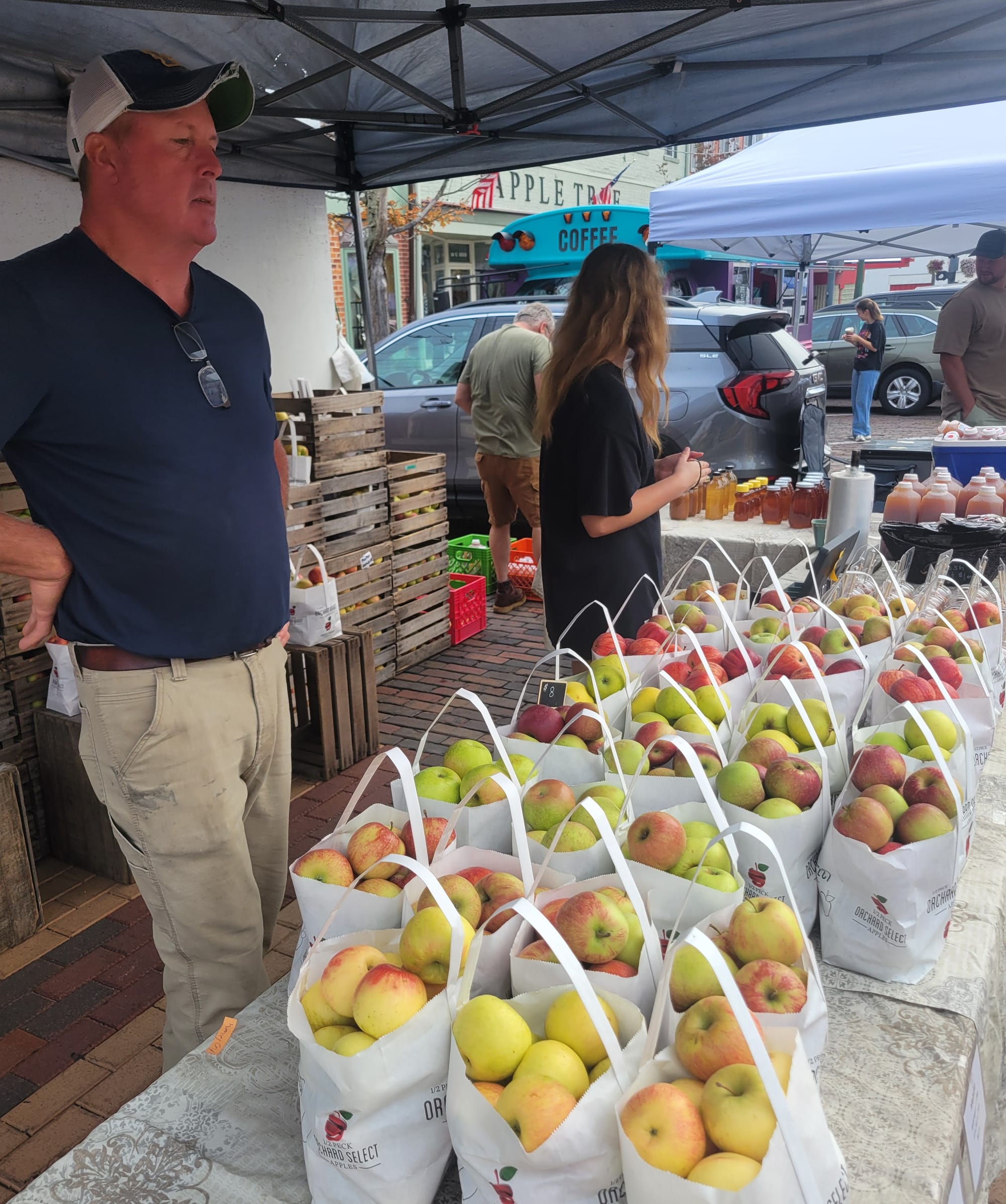
Scott Downing is a well-known fixture at the Oxford Farmers Market. Next week, you can see where all the fruit comes from, because Scott and his family are hosting the annual Downing Fruit Farm Fall Festival at their farm on Saturday, Oct. 3 and Sunday Oct. 4, from 9a.m., to 5p.m. each day.
Scott’s great-great-great-great grandfather John Downing started the farm in 1838. He arrived in western Ohio around the same time as Johnny Appleseed (whose real name was John Chapman), but they didn’t know each other, due to each taking different routes. Chapman migrated to Ohio from Massachusetts as a teenager, whereas John Downing headed west at age 37 from Rock Hill, South Carolina.
John Downing died here in 1870 at age 93, and Scott found his grave back at Fishing Creek Presbyterian Church in Rock Hill, along with other family members, including John’s father (also named John) who emigrated to the American colonies from Ireland and fought in the Revolutionary War.
A statue of Johnny Appleseed by Dayton artist Robert Koepnick stands in Cincinnati’s Spring Grove Cemetery, where some websites incorrectly assert that he is buried. He is depicted as barefoot, with a bag slung over a shoulder, unnaturally tall, looking up to the heavens, holding an apple sapling held high in the air like the Olympic torch.
The popular image of Johnny Appleseed as a scatterbrain hippie randomly throwing about apple seeds is inaccurate. He was actually a clever entrepreneur and financier. Chapman bought thousands of acres of land in Ohio, planted apple seeds, maintained apple tree nurseries, built fences to protect the saplings from livestock and either sold the land for a profit or arranged with neighbors to care for the nurseries in exchange for a share of sales receipts. He was constantly on the go, traveling between his many nurseries. When he died in 1845, Chapman owned more than 1,200 acres, not counting all the land he had bought and then sold.
Chapman focused on apples for two practical reasons.
First, out here on the frontier in the early nineteenth century, the law allowed settlers to lay claim to land through development of a permanent homestead. Chapman realized that a quick and easy way for a homesteader to lay a successful claim was to plant 50 apple trees.
Second, the apples he grew were used mainly for hard cider. Michael Pollan wrote that Chapman was “our American Dionysus,” because he brought “the gift of alcohol to the frontier.”
The last known tree planted by Chapman stands in Nova, Ohio, in Ashland County. It produces tart green apples. In the nineteenth century, in fact, all apples were tart, but when the cider market disappeared during the 1920s Prohibition, most growers switched to apples suitable for eating.
Downing Fruit Farm has 50 acres of orchard with 2,500 fruit trees. Walk through the orchard and pick your own apples, or see the farm in a horse-drawn carriage. Downing Fruit Farm has 75 varieties of apples, so it is interesting to walk through the different rows of the orchard. Some rows contain all one variety, whereas other rows have a mix. Why the difference? Scott Downing explains that some varieties of apples (such as Fuji and Golden Delicious) self-pollinate, whereas other varieties (such as Honeycrisp) pollinate only through proximity with other varieties (such as Fuji and Golden Delicious).
Downing Fruit Farm’s address is 2468 Harrison Road, New Madison, Ohio 45346. It takes about an hour to drive there from Oxford.
James Rubenstein is president of the Board of Directors for the Oxford Free Press and professor emeritus of geography at Miami University.