

Hanna House among Spring Street properties to be deconstructed
The Miami University Board of Trustees heard several updates on various construction projects and the viability of a proposed multi-purpose arena during a finance and audit committee meeting Dec. 11.
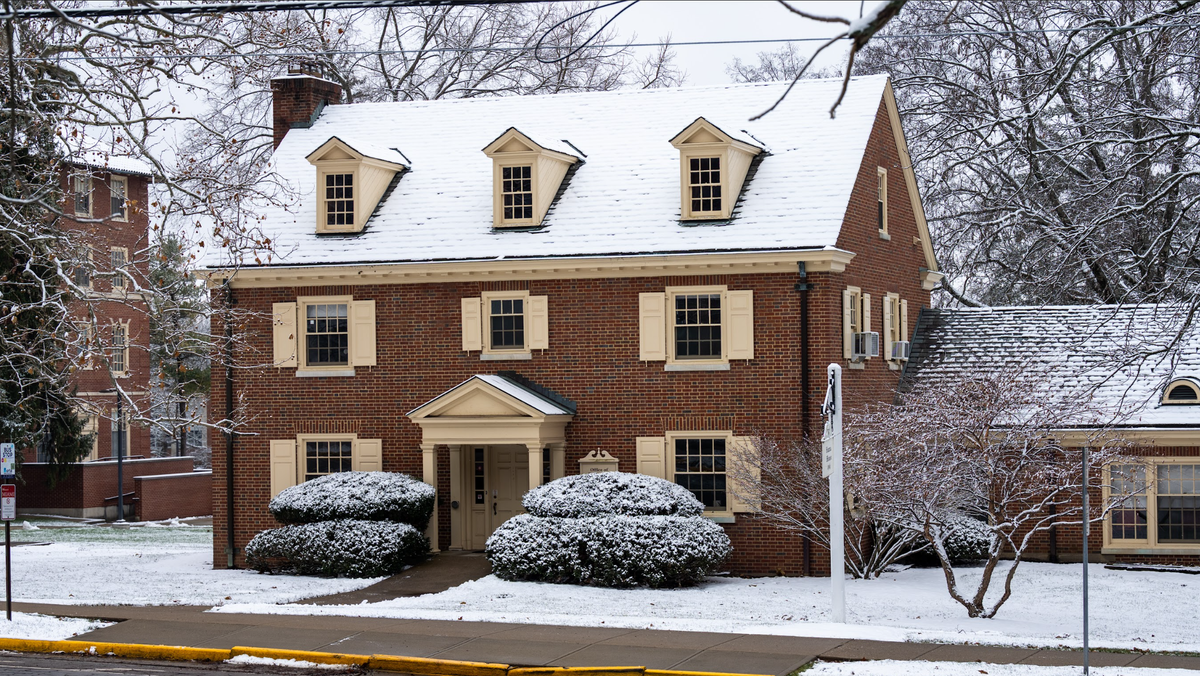
Hanna House was added to the list of several Spring Street properties in Oxford for which the Miami University Board of Trustees approved their deconstruction during a meeting on Dec. 12.
Hanna House, located at 219 E. Spring St., was built in 1963 and dedicated as a home management facility for the university in 1964, according to an Ohio Historic Inventory form for the property through the Ohio Historic Preservation Office. According to the form, an attached one-story wing served as a nursery school.
The building was named in honor of Martha Jane Hanna, who was a member of the Miami faculty from 1915 to 1957 and the first professor of the Department of Home Economics, according to the form.
Cody Powell, associate vice president for facilities planning and operations, told the board’s finance and audit committee during a meeting on Dec. 11 the building was constructed specifically for home economics instruction.
According to an executive summary of the deconstruction project presented to the board, Hanna House is a small structure that has become “inefficient” to maintain. Powell said it has not been used for its original purpose for several years, and although it had a few occupants this semester, it will be vacated over the winter.
As a result, Hanna House will soon be deconstructed alongside three other Oxford campus buildings, including Williams Hall, Wells Hall and Joyner House, which Powell told the Oxford Free Press the university was considering demolishing in September.
Powell told the Oxford Free Press previously the university determined it would not be financially viable to renovate the three properties for various reasons, citing inefficiency and a lack of ADA-compliant facilities.
According to the executive summary, the sites of the properties will be “re-designed considering the potential for future buildings.”
The work will also include renovation of the hardscape in the area where the campus sundial is located and the conversion of Warfield Hall, MacMillan Hall and the Armstrong Student Center from off-campus steam to hot water loops.
Powell told the committee the open area created by demolishing these buildings came up as a potential site for the university’s multi-purpose arena, although it was ultimately “determined that this would be a better site for future academic building growth.”
He said the Cleveland Clinic Health Sciences and Wellness facility on campus was designed with the intent of expansion, and as the university invests more in its health science programs, the area could be considered as a future buildable site for a health district.
The estimated total budget for the project is $7 million, according to the executive summary, and it is expected to be completed in the summer of 2026.
In regards to the historic nature of the buildings being demolished, Powell said, “We try to find a way to save the structure if we can do it in a cost effective way and have it meet the needs of students because we know that history is important, and we know these issues can be controversial.”
“This is not the path we choose,” he said.
Multi-purpose arena updates
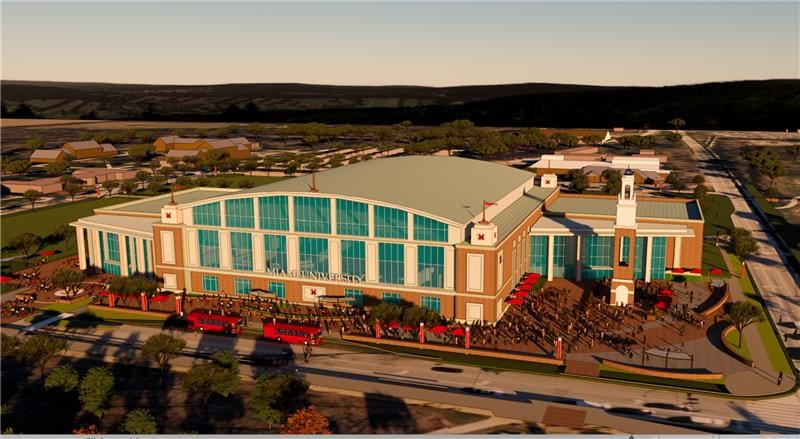
In other business, Powell presented to the board a new rendering of the proposed multi-purpose arena, more recently known as the “event district,” which would replace Millett Hall and be located in the Cook Field open recreation area.
The back portion of the building behind the Pulley Bell Tower would house the volleyball arena, which would hold around 1,300 seats. The main arena would be in the middle of the building, and two practice basketball courts and athletic offices would be on the left-hand side near the Farmer School of Business.
Powell said the university is proposing a site for a land lease for a hotel developer in the upper left portion of the property and a surface lot in the upper right portion along State Route 73 with under 500 spaces.
Additionally, Powell said the university is still evaluating where to move the recreation fields currently located on Cook Field. He said the university’s ROTC program is also currently in the basement of Millett Hall and will need to be relocated.
David Creamer, senior vice president for finance and business services and treasurer at Miami, told the committee the arena the university is planning will require borrowing to be executed.
Creamer said borrowing on projects similar to the multi-purpose arena is typically for a period of 25 years, although most organizations take as long as 35 years to pay debt for a similar facility.
Creamer said the university has the debt capacity to take on the project in a $200-$250 million range if the board chooses to proceed.
He said there will be a more complete presentation for the arena at the board’s meetings on Feb. 26 and Feb. 27, when a formal decision can be made on whether to move forward with the project and possibly have the arena available for the 2028-29 basketball season.
“We had a very good year in Fiscal Year 2025. We are expecting for the current year to see, again, a growth in the amount of net tuition, which is a positive trend,” he said of the university’s financial situation, adding the fall 2025 cohort of students did not bring net tuition growth above what it was in the spring.
Applications data presented during the board meetings showed an overall decline across Miami’s campuses for Fall 2026.
Still, he said as incoming classes pay more than those before them who are graduating, the university can expect more revenue from tuition, especially as discounted rates resulting from the COVID pandemic are declining. He said the university is also hoping to see increased enrollment in its regional campuses after they transition to a polytechnic-centered education by fall 2026.
Other construction updates
Powell gave additional updates on other construction projects the university has taken on, including the Western Geothermal Solar Field on the western campus, which he said are near completion.
Powell said the work on the solar panels is complete, although the university is waiting on final approval from Duke Energy for a received interconnection agreement.
Powell said work has begun on the Sharon and Graham Mitchell Sustainability Park, which is planned to open in the spring of 2026 on the western campus. According to a university news release from 2024, the park will encompass the Western Geothermal Solar Field, walking paths and connections to nearby trails in Miami’s Natural Areas.
The Advanced Manufacturing Workforce and Innovation Hub at the Hamilton campus in partnership with Butler Tech is also at completion, Powell said.
Butler Tech was meant to begin moving in furniture and major equipment the week of Monday, Dec. 15. A ribbon-cutting for the facility is scheduled from 10 a.m. to noon on Feb. 2, although classes will begin for Butler Tech students on Jan. 5 and for Miami students the week of Feb. 26.
Renovations on Bachelor Hall, which Miami is reshaping as a “hub for the humanities,” according to a news release from 2024, remain ahead of schedule, even with the original plan for its opening for classes to occur in the 2026 fall semester. Construction on the exterior space is largely complete, Powell said.
Powell said Miami has completed drilling all of its geothermal wells in front of Millett Hall, although the front lawn is not currently being restored as university officials contemplate where to relocate the recreation space currently at Cook Field.