
Local Legends: The calm and the chaos
In 2025, the Oxford Fire Department responded to 3,442 calls, many of which were EMS runs, the legacy of Shoemaker’s creation of the first life squad and the 271 calls it was responding to by the time of his retirement.
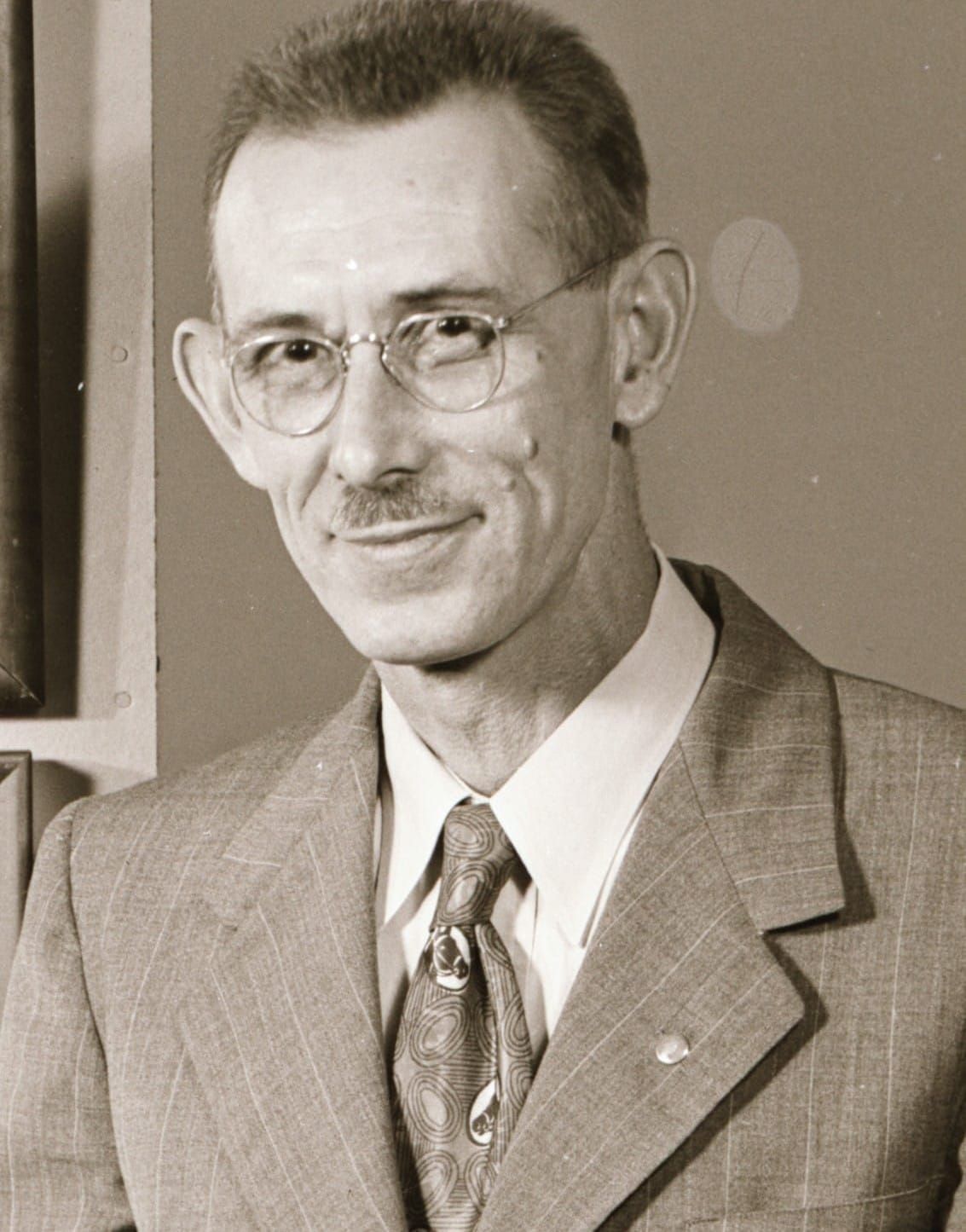
Though he loved the calm of the outdoors, Charles Kent “Kent” Shoemaker modernized the Oxford Fire Department and positioned it to best handle the chaos of fire and medical runs, including creating the department’s first life squad.
Born on July 17, 1908 in Brimfield, Illinois, Shoemaker was the son of Rev. Charles Drake “C.D.” Shoemaker, later a minister of the Morning Sun Presbyterian Church, and Edith Julia (Grimwood) Shoemaker. The family moved around during his youth and Shoemaker eventually graduated from Waverly High School in Waverly, Illinois with the class of 1926.
Desiring to continue his education, Shoemaker came to Oxford to attend Miami University, but the onset of the Great Depression forced him to drop out for financial reasons in 1929. Trying to find his way in life, he sold insurance for a year and then ran a grocery and gas station in Morning Sun, Ohio.
Shoemaker married Mary (Duerr) Shoemaker in Newport, Kentucky on July 30, 1931 and returning to Oxford went to work for the local Kroger, managing the store’s meat department. His and Mary’s only child, Dorothy (Shoemaker) Marks, was born in 1933.
Earning an appointment as a substitute letter carrier on Oct. 1, 1935, Shoemaker began a 32 -year career with the United States Post Office. Within three years, he was a full-time letter carrier under postmaster R.W. Schoke. When the new post office, now the Oxford Courthouse, was built in 1938, Shoemaker won the contract to unpack and move all the furniture for the new building.
A lifelong outdoors enthusiast, Shoemaker also became the president of Oxford’s Sportsman’s Club in 1938. He remained with the club for a year before leaving to become the first president and a charter member of the Tallawanda Chapter of the Izaak Walton League. He enjoyed bass fishing and trap shooting, and for many years helped organize events in the local woods and streams.
Shoemaker was also a conservationist, and as early as 1939 was protesting dumping in Four Mile Creek, leading discussions on fish kills downstream from the Oxford disposal plant, and hosting state conservation and game officials.
Along with continuing to serve on the local chapter of the Izaak Walton League, Shoemaker served the organization at the state level. He took the lead on planning annual picnics for Butler County Izaak Walton chapters, was appointed to a state committee to work on distributing funds generated through the Pittman-Robertson Wildlife Restoration Act of 1937 and garnered the support of the Izaak Walton League for the creation of Hueston Woods State Park through presenting the proposal to their board of directors.
In 1952, Shoemaker became the president of the Ohio Izaak Walton League. Along with Izaak Walton, he also helped form and became the first president of the McGuffey High School Boosters Club and was an executive for the Fort Hamilton Council of the Boy Scouts of America.
He also later served on the Izaak Walton League of America’s national board, during which time he made a proposal that the league’s national headquarters be moved to Oxford. Although the proposal was being seriously considered by the board, Oxford lost out when larger cities entered the running and offered free land and buildings.
Wartime rationing required Shoemaker to get special permission to purchase new tires for his mail truck, which was later stolen by a joyriding juvenile and left abandoned north of town. In 1947, he took on a new role at the post office as the postal clerk in charge of the office’s directory section.
When the Oxford Fire Department became embroiled in a bitter battle over the make of a new fire apparatus for the village in 1951, Chief Paul Flanagan resigned along with the entire volunteer department. Chief Frank M. Reardon replaced him as a full-time fire chief and Shoemaker was one of the 11 new firefighters appointed as replacements for the resignees.
Shoemaker was immediately elected captain of the department and when Reardon became ill and unable to do his job a year later he was Mayor M.D. Worley made an emergency appointment that led to Shoemaker serving as the acting chief on a part-time basis.
He remained acting chief until Reardon’s death later that year. In promoting him to chief, Worley cited Shoemaker’s adept handling of the department, “He has done an excellent job both as a fireman and as an acting chief since Mr. Reardon left last summer…all the men in the department like him and work well with him.”
Over the course of his 24 year firefighting career, Shoemaker responded to a plethora of runs, encountering everything from a bus fire to a major grass fire near Cook Place to mattress fires to a burning telephone truck with dynamite caps used for removing tree stumps on board.
Evidence shows that at one point Shoemaker actually did have to send a ladder truck to rescue a cat from a tree on High Street.
As chief, he also investigated the cause of fires, carried out inspections and was there for critical incidents, some of which were horrific. This included conducting a 1955 recovery operation for the remains of Mollie Dilyerd Reece and her five year old son Tommy Allen Smith who drowned in Four Mile Creek and investigating the cause of the Masonic Lodge Fire that killed Hamilton Fire Department Deputy Chief Stanley Meyer and injured three other firefighters in 1971.
Shoemaker nearly resigned in 1953 due to increased duties at the post office, but city officials intervened and mediated with his boss, allowing him to continue on with both jobs. In February the following year, Shoemaker and members of the fire department bought a used panel van and transformed it into Oxford’s first life squad. They donated it to the village as a surprise gift to the city council and placed it in service to supplement regular ambulance services, which were at the time mostly provided through local funeral homes.
At the very beginning of the trend that would eventually lead to a massive expansion of paramedicine at a national level, Oxford was ahead of the curve with the implementation of a life squad unit. The life square had the advantage of carrying a state-of-the-art resuscitator machine and Shoemaker responded with it to emergencies from his home, with his wife answering the radio calls.
Education and training were greatly improved under Shoemaker’s administration as chief. In 1954, he attended the Federal Civil Defense Administration Staff College in Olney, Maryland. With 18 other Butler County trainees, learning how to properly respond to an atomic bombing. He also brought in instructors to train his firefighters, he himself later became a certified firefighter instructor, resulting in the first certifications being issued to members of the department.
Outside of being Chief, Shoemaker was also a board member for the Hamilton Chapter of the American Red Cross, Butler County Fireman’s Association, Butler County Democratic Party Central Committee and the Butler County Board of Elections, as well as being a HAM radio operator and the choir director for the Seminary Presbyterian Church. He was named an Oxford Citizen of the Years in 1966 and retired the following year as an assistant postmaster.
Shoemaker’s fire service career ended in 1976 with his resignation following a dispute with City Manager Lee Davis. Davis had given Shoemaker a list of a dozen directives that he expected to be followed by the fire department, many of which Shoemaker disagreed with. He submitted his resignation rather than meet the demands.
A hallmark of his career had been working to increase cooperation, in regards to emergency services between the village and township culminating in Oxford Township donating a second life squad to Oxford Fire Department. In 1975, Shoemaker was elected Oxford Township clerk. Leaving the post in 1980, the township trustees thanked him for his service, “The trustees are particularly appreciative of his wise counsel on several matters and in particular his expert opinions on fire and emergency coverage of the Township.”
The retired chief died at age 75 on March 7, 1984 and was buried at Oxford Cemetery. Mary passed on March 2, 1991.
In 2025, the Oxford Fire Department responded to 3,442 calls, many of which were EMS runs, the legacy of Shoemaker’s creation of the first life squad and the 271 calls it was responding to by the time of his retirement.
Brad Spurlock is the manager of the Smith Library of Regional History and Cummins Local History Room, Lane Libraries. A certified archivist, Brad has over a decade of experience working with local history, maintaining archival collections and collaborating on community history projects. He also serves as a board member for Historic Hamilton Inc. and the Butler County Historical Society.