
Miami cites state law in prohibition of union faculty teaching outside for planned Labor Day-related event
Now, FAM says it’s exploring legal options
Miami University forbade union faculty from participating in a planned event on Sept. 2 in relation to Labor Day, citing their collective bargaining agreement and Ohio Senate Bill (SB) 1.
Now, Faculty Alliance of Miami (FAM) President Theresa Kulbaga said the union is exploring legal options.
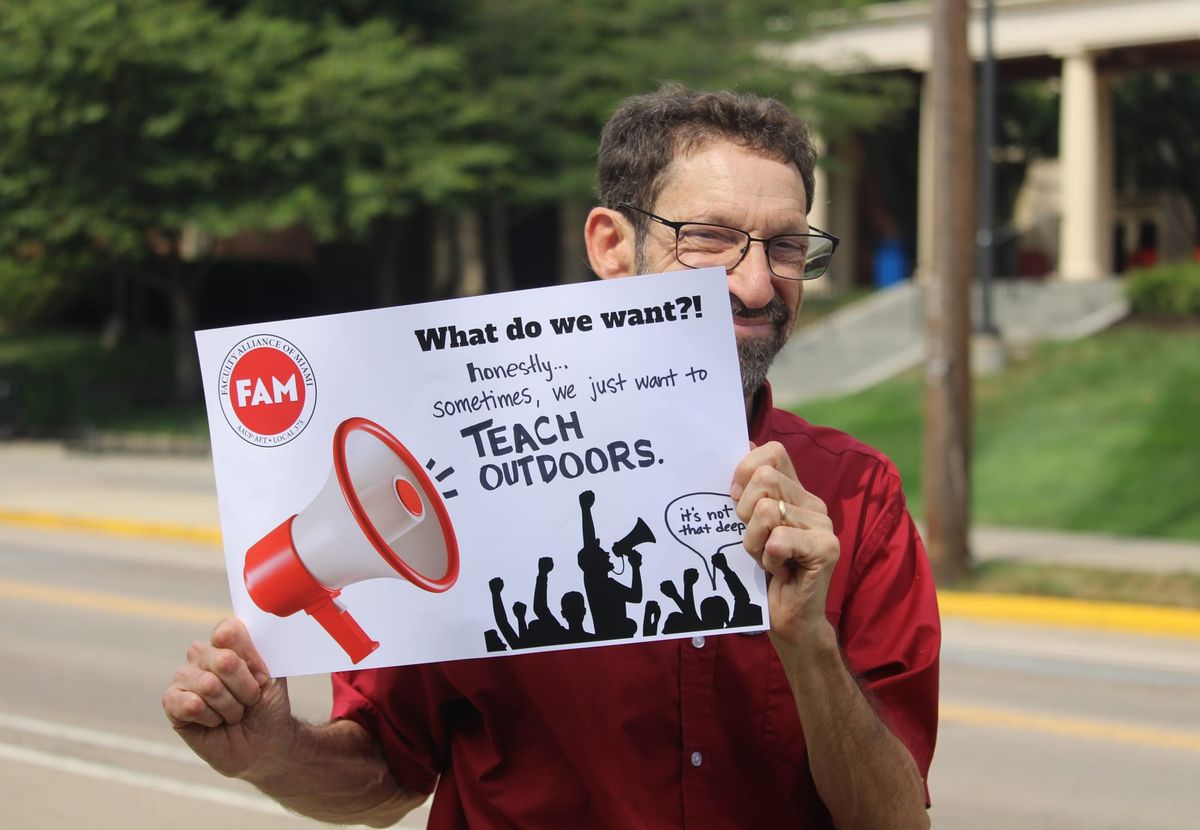
The “Teach-OUT” organized by FAM encouraged union members to host their classes outside for a portion of the day in demonstration of their work.
Elena Jackson Albarrán, executive vice president of FAM and history professor, said although she didn’t have a class to teach on Sept. 2, she helped plan the event and was going to sit at a resource table presenting information about the history of Labor Day and giving out water bottles.
“We thought, how can we celebrate Labor Day and the work that labor has made to secure certain protections and rights for workers across all sectors, while still keeping the business of the university running?” Albarrán said. “I think, often, administrators make policies about classroom education, but they don't really ever see us in the classroom doing what we do.”
But leaders of the union were sent a legal notice from Miami’s representation on Aug. 30 saying the Teach-OUT was “not permissible.”
According to a letter from Jazmyn Barrow Legal, Miami’s representation, to FAM leadership, the issue with the event was not FAM’s message or the ability of members to engage in “lawful union or expressive activity.” Instead, Barrow said the issue was in using scheduled instruction as a “vehicle for a coordinated labor action.”
Barrow’s letter cited SB 1, passed in June 2025, which states that full-time faculty members of any state institution of higher education shall not strike.
“Their claim is that our Labor Day celebration, in which we were going to have faculty show what we do every day … constitutes a strike,” Kulbaga said. “In other words, they think that's us walking off the job. Do you understand how absurd that is?”
Barrow’s letter also cited Article 28 of FAM’s collective bargaining agreement, which she said prohibits planned interference with assigned instruction and university operations. More specifically, Sections 1 and 2 state that differences are to be resolved without interruption of university operations, and FAM is prohibited from condoning strikes and the interference of university operations.
Section 3 requires FAM to cooperate with Miami in continuing operations and discourage violations of the bargaining agreement. The letter also points to Article 8 of the agreement, which gives Miami full rights to direct and supervise bargaining unit faculty and authority over class methods and facilities.
Barrow wrote in the letter, “Nothing in the Agreement gives FAM authority to designate an alternative instructional location or to direct faculty to disregard the instructional arrangements established by the University.”
Barrow’s letter also pointed out Miami reserves the right to discipline faculty members in violation of the agreement.
A follow-up legal notice from Barrow sent on Aug. 31 to FAM’s attorney additionally pointed to Miami’s Class Attendance Policy, which states that, “All classes are to meet at the time and location listed in the official university course schedule unless changed with the consent of the entire class.”
“Faculty may, in the ordinary course of instruction, engage in policy-compliant pedagogical activities outside an assigned classroom,” Barrow wrote in the letter. “That does not give FAM contractual authority to convert such flexibility into a coordinated labor action or to direct bargaining-unit faculty to alter assigned instruction for the purpose of advancing a labor-relations objective.”
Another letter from the Miami Academic Affairs Office of the Provost to all faculty sent on Aug. 31 said all classes must meet at their assigned locations unless a change has been approved by the department chair for “a legitimate instructional reason.”
“These expectations concern the performance of assigned University responsibilities, not faculty members’ viewpoints, union membership, or participation in lawful union or expressive activity,” the office wrote in the letter. “Our purpose is to ensure continuity of instruction and equal access for students while respecting lawful employee expression.”
Seth Bauguess, Senior Director of Communications at Miami, said in an emailed statement to the Oxford Free Press on Sept. 15, “The basic principle is that student learning should come first; it is important to distinguish between holding a class outdoors and involving students in a labor dispute.”
But Kulbaga said the use of the language in the collective bargaining agreement by Barrow to say faculty cannot take their classes outside was “unprecedented in the history of Miami in recent memory.” She said, in the past 20 years she’s taught, she tries to take her students outdoors to learn “regularly.”
FAM leadership wrote to union faculty on Aug. 31, saying Barrow portrays a “gross mischaracterization” of the event, which was not a strike, ideological or required for members.
“We are confident, after consulting with our attorney today, that this action in no way constitutes a violation of any aspect of our CBA (collective bargaining agreement),” FAM wrote in the letter.
The letter ended with FAM encouraging members to “not be intimidated by this show of pettiness,” and telling them, if they’d still like to teach outside, FAM would back them up legally.
But FAM cancelled the event on Sept. 2, telling faculty not to take their students outside and instead to meet for a pre-planned faculty assembly in the Shriver Center to ask Miami leaders “pointed questions.”
“We wouldn’t want to violate any hastily-composed University mandate, especially one that contradicts decades of practice,” FAM wrote in a letter to faculty. “We certainly wouldn’t want to engage in the kinds of hands-on experiential learning that Miami is clearly against, such as writing outside with your students, taking your Bio students outside to look at actual plants, or engage in field research about campus-area business with your students.”
Albarrán said there was no expectation for all union members to engage, and some professors even initially declined, saying their classes would not be adaptable for an outdoor setting. She said she wished the university had approached FAM leaders about the nature of the event before resorting to the legal notice.
“It was certainly not a demonstration or a protest. There was no programming involved in the event,” Albarrán said. “Participation was likely to be very low given how hot it was, and so we were prepared for it to kind of be a non-event, but the university felt really threatened by it to an extent that, in many ways, was alarming.”
Albarrán often takes her history students outside to study the native gardens around campus, visit libraries or host discussions outdoors where there is more space. But she said Miami has “anticipated the worst” in the past when it comes to FAM’s events, sometimes bringing in campus security.
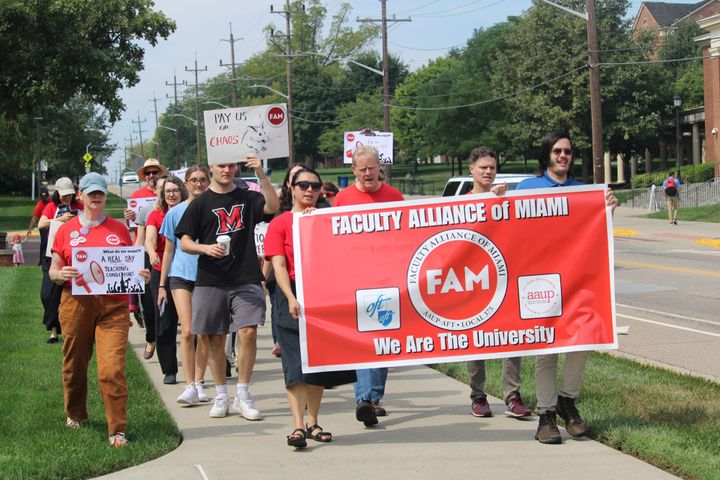
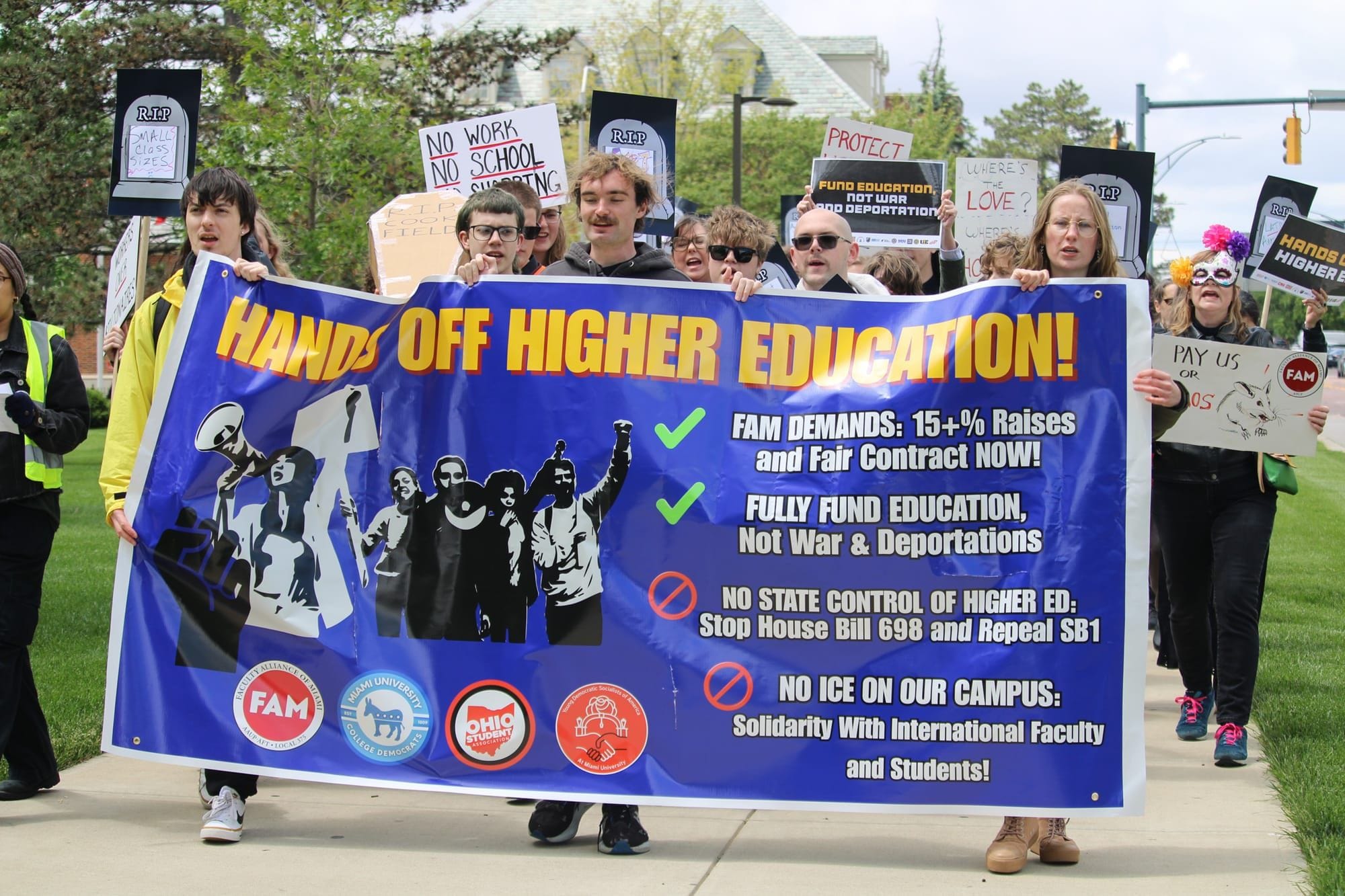
FAM members have participated in several protests on the Miami campus over the past year, which occurred on instructional days, including a “funeral” for the Cook Field green space on May 1 and a march to deliver a petition calling for academic freedom on Nov. 7, 2025. FAM members again rallied for higher compensation during an event on Sept. 16.
Albarrán said of the Teach-OUT, “I think they were worried that it was somehow going to turn into a protest or a march where we were bringing students in on something that was not part of our course of instruction, which we would not do.”
“The other is the timing right now of our contract negotiations,” Albarrán said. “I think people are starting to get restless and concerned about working off contract at this point, and the university is aware that we don't have that piece of our labor management in place right now, and so everything is kind of a little bit more tense.”
Kulbaga said there were ultimately no faculty who taught outside Sept. 2 and later asked FAM for support, although the faculty assembly was “interesting.”
“I think one of the faculty who asked a question summarized the meeting best. … ‘Why do you think there’s such a disconnect between the optimism about Miami University spoken about by all the administrators in the room today and the worry and concern among the faculty in the audience?’” Kulbaga quoted.
FAM’s legal representative declined to comment to the Oxford Free Press on the current and future response to Miami’s shutting down of the Sept. 2 event.
Bargaining progress
Since March, FAM representatives have been meeting with Miami representatives to settle updated contracts for both union faculty and librarians. On Aug. 5, the Miami University Board of Trustees approved an updated collective bargaining agreement for union librarians only – the second agreement since librarians joined FAM in 2023.
FAM’s current faculty contract expired on June 30. Until a new one is settled, the former contract remains the status quo. During this time, raises for all union faculty cannot be given.
As of press time Sept. 16, the university still had not reached a new collective bargaining agreement for union faculty members.
According to the FAM website, as of July 31, the groups were still discussing topics such as compensation and benefits, leave, faculty evaluations, promotions, artificial intelligence, grievances and arbitration, among other points.
“We’re trying to close the second contract, and the university is trying to stall, delay, intimidate faculty in that process,” Kulbaga said. “We think what the university did last week just makes us dig in our heels to our position even more.”
Kulbaga said she felt Miami chose to interpret the Teach-OUT as a strike because “they are attempting to shut down our ability to put pressure on them to win the contract, and they are trying to intimidate faculty from participating in legal union activity.”
“It’s union busting,” Kulbaga said. “They’re trying to prevent the union from doing anything, and in this case, they’re using SB 1 to do it.”
As of Sept. 11, Kulbaga said progress on the new contract depended on how much Miami was willing to budge on raises. She added that FAM has given up requested language to agree not to replace faculty members with AI, although it’s still pushing to include language that protects faculty from evaluations created by AI.
“Negotiations are a give and take … and both sides have to give something up,” Kulbaga said. “If we’re going to give up our language on AI or something else like that, then we expect to see compensation increase accordingly.”
Kulbaga said negotiations are down to the “top priorities only,” with three to four items left in disagreement, adding her hope is that discussions will wrap up within another month or two. She said if FAM cannot reach an agreement with Miami, it has the option of moving onto fact-finding at the state level, or a formal resolution process, although she said FAM hopes it won’t come to that.
Albarrán said the “biggest issue” with ensuring a contract is secured at the moment is not knowing what the education climate will look like after the general election in November.
“A lot of things in the upcoming election will determine the shape of higher education at the state level,” Albarrán said. “So whatever protections we can secure in this next contract cycle, which will run for three years, are really going to be important because of the uncertainty of what changes may or may not happen.”
Bauguess wrote in his email to the Oxford Free Press, “The university remains committed to engaging in good faith negotiations and reaching a successor contract agreement with FAM.”