
Observations: Ken Kesey
I heard Kesey read some of his poetry at a Eugene gathering, but members of the English Department of the University of Oregon had no use for Kesey, whom they viewed as a crazy countercultural character.
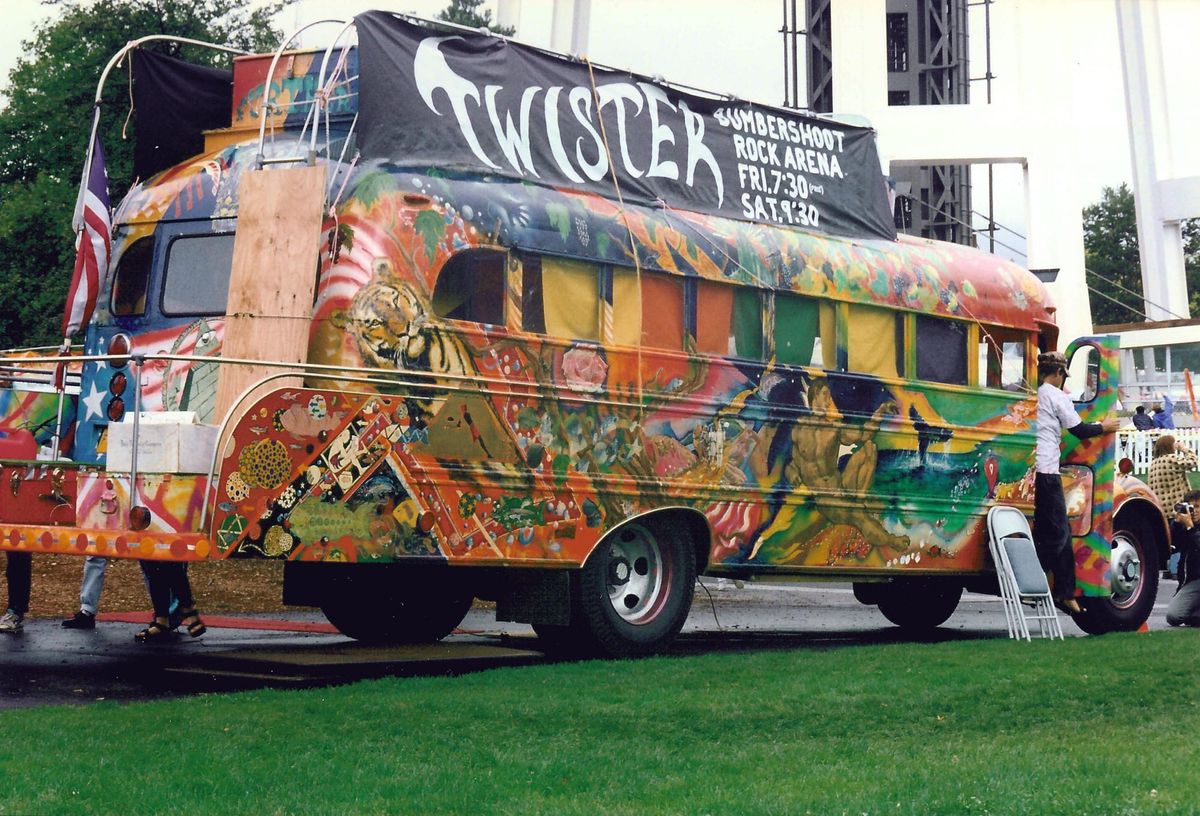
I recently read in a newspaper that novelist Ken Kesey’s legendary psychedelic school bus, Furthur, had left its home in Oregon to be part of a major countercultural exhibition in San Francisco. That prompted me to recall my own association with Kesey during my teaching days at the University of Oregon.
Kesey, born in Colorado in 1935, graduated from the University of Oregon and went to Stanford University to study in the creative writing program run by Wallace Stegner, one of my favorite authors. There, he began writing “One Flew over the Cuckoo’s Nest,” published a couple of years later to both critical and commercial success. Made into a popular film starring Jack Nicholson, it dealt graphically with the craziness of a mental institution.
Kesey then wrote the successful “Sometimes a Great Notion,” which is about a logging family in Oregon.
Also, Kesey was hired by the CIA for experiments with hallucinogenic drugs, including LSD and mescaline, which could be used to get people to divulge secrets and sparked his interest in the drug culture.
Now living in La Honda, California, Kesey began to host “happenings” with a host of countercultural figures, including some from his Stanford days. Documented by author Tom Wolfe in his book “The Electric Kool-Aid Acid Test,” they featured the use of drugs in the midst of multimedia performances.
Then, the group, now known as the Merry Pranksters, bought a 1939 International Harvester yellow school bus, which they painted in day-glo, psychedelic colors and filled with LSD and other drugs, to drive across the country to meet with countercultural guru Timothy Leary.
Eventually the trip came to an end, Kesey returned to Oregon and Further sat out in a field on his farm near Eugene.
I heard Kesey read some of his poetry at a Eugene gathering, but members of the English Department of the University of Oregon had no use for Kesey, whom they viewed as a crazy countercultural character.
At about that time, I was co-teaching with a colleague an American studies course for 700 students. Our subject for one week was the West. I lectured on Monday and my colleague was scheduled for Wednesday, but became ill, and I realized I had nothing more to say. Thinking about what to do, I decided to see if Kesey would come in as a guest. I called his home number and spoke to his wife, who told me he was driving a friend to the airport in Portland. I called back at 3 a.m. and Kesey agreed to come into my class 6 hours later.
He arrived, dressed in black jeans and a black turtle neck. A third of the class knew who he was and was really excited. Another third didn’t recognize him, but saw that something special was happening. The other third was clueless.
Kesey sat on a table in the front of the room, talked casually about the John Wayne film Red River, about his own association with the West and about a host of other things. It was mesmerizing. I realized then how pleased he was to be able to be a guest at the university, his alma mater, English Department be damned.
For me, it was one of the best experiences of my teaching career. For the students, it was one of their best times in my classroom.
Allan M. Winkler is a University Distinguished Professor of History Emeritus at Miami University, where he taught for three decades. He serves on the Board of Directors for the Oxford Free Press.