
On My Plate: Thanksgiving
An Oxford club is a sandwich composed entirely of locally produced ingredients from the Oxford Farmers Market and MOON Co-op, including lettuce, tomato and bacon.
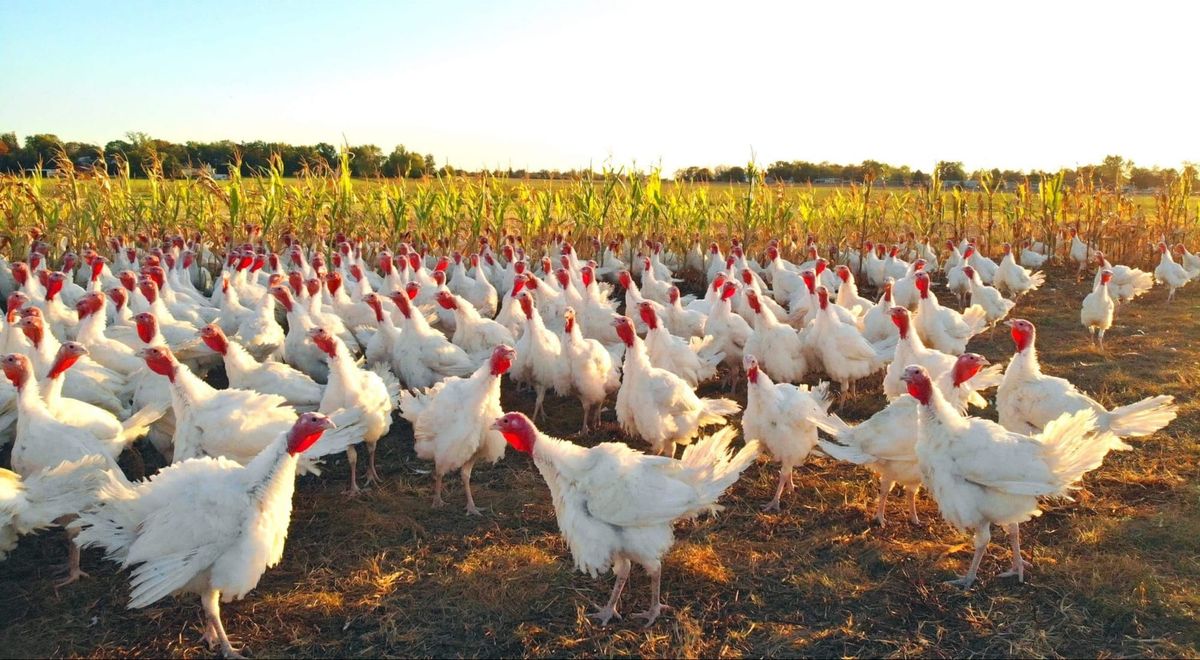
Locally raised turkeys can be ordered from MOON Co-op Grocery, as well as from several farmers at Oxford Farmers Market. Bowman & Landes Farm, which supplies MOON Co-op Grocery, raises free-range turkeys that are fed organic grain.
Four principal decisions need to be made concerning your Thanksgiving turkey: what type of turkey to buy, how to cook it, how to serve it and what to do with the leftovers.
Bowman & Landes offers both whole and boneless turkeys. A whole turkey is more handsome than a boneless roast, but it requires more care in cooking and serving. Because we are never home for Thanksgiving dinner, we buy a small boneless roast so that we have leftovers.
To cook a locally raised free-range turkey, ignore the complex recipes in the national media. Simply bake the turkey at 325 degrees for 20 minutes per pound. If you use a meat thermometer, the turkey is done when the thermometer reads 170 degrees. It’s the timing that needs care planning. Work backwards from when you want to serve the turkey. Remove it from the fridge one hour before cooking and remove it from the oven 90 minutes before serving.
The third decision is how to serve the cooked turkey. Norman Rockwell’s iconic 1943 painting “The Thanksgiving Picture,” also known as “Freedom from Want,” depicts a woman placing on the dining table a whole turkey neatly positioned on a platter, while a man wearing a suit is standing by with a carving knife near his right hand. With all due respect to Mr. Rockwell, I don’t think anyone can carve an entire turkey at the dinner table without creating a mess.
Start carving the turkey in the privacy of the kitchen one hour after removing it from the oven and at least 30 minutes before serving it. If carving commences immediately after removing the turkey from the oven, the meat will shred. Start by cutting off the two wings and two drumsticks. Next, cut the turkey in half along the backbone. Each half separates with a few cuts into large thigh and breast pieces. Decent-looking slices of dark meat and white meat can then be sliced and arranged attractively on a platter.
For the leftovers, I suggest triaging into white meat, dark meat and bones. Because of its intense flavor and moistness, the dark meat stands up well to strong flavorings, such as curry.
For the white meat, I suggest an Oxford club sandwich. Haven’t heard of it? An Oxford club is a sandwich composed entirely of locally produced ingredients from the Oxford Farmers Market and MOON Co-op, including lettuce, tomato and bacon.
I learned to eat turkey bones from my father, who could reduce a two-pound wing or drumstick to a couple of toothpicks. I think he was a member of the U.S. Olympic Turkey Bone-Eating Team. Gnawing on the bones is the best feature of leftovers, but it does not appeal to the next generations of my family (sorry, Dad), so I get to take the bones home for private post-Thanksgiving lunches.
Many years ago, we shared a Thanksgiving meal with Prue and Steve Dana. As the table was cleared, Prue created their next-day meal by placing into a single casserole all of the hot leftovers, including turkey, potatoes, green vegetables, stuffing and gravy.
“The best meal of the year is the day after Thanksgiving,” says my buddy, John Hofmann. “The day after Thanksgiving meal is fabulous. Everything is already cooked, so no commotion, no complicated prep – just reheating.”
James Rubenstein is president of the Board of Directors for the Oxford Free Press and professor emeritus of geography at Miami University.