
Observations: The automobile and me
I can’t say that having my license made much difference at all in my social life, but at least it held the possibility of something really good.
As a child with a January birthday, I was the youngest kid in my class. That wasn’t a problem until high school, when I desperately wanted to get my driver’s license. The driving age was 17 in New Jersey, and by the time I reached that point, virtually all of my classmates were driving.
Eventually, my birthday arrived and my father took me to the license bureau, where I mercifully passed my driver’s test.
Now, I could go on dates by myself, with no chaperone or friend who might make things awkward. I can’t say that having my license made much difference at all in my social life, but at least it held the possibility of something really good.
Soon after I graduated from high school, while my parents were away for a weekend, my friend Steve and I took my car – a 1954 Plymouth – on a road trip to Washington, DC. I drove the first leg, then Steve took over. As we approached Washington, the car faltered and came to a halt. It had run dry of oil and the engine was toast. We didn’t realize that a small hose had broken. With no other option, we bought gallons of oil, continually refilled the engine and limped home at 20 mph for most of the day. Lesson learned: take care of your car.
I was proud of that car – It was a stripped-down model with no radio and only one side-view mirror, on the driver’s side. My father thought that saved money, but when I got to college, I went to a junkyard and found both a radio and a mirror. I installed them myself.
Many years later, my wife Sara and I were in Kenya in our used Nissan Sunny. We drove down to Lake Nakuru, site of a gazillion pink flamingos.
“Let’s get closer to the lake,” Sara said. I did. “Closer.” I did. Then we realized that the car wouldn’t move at all. It was stuck in the sand and no one was anywhere around. And so we walked half a mile, past an elephant and a cape buffalo, and finally found people who helped us get the car out of the sand.
I heard a new Swahili word: “mjinga.” When I looked it up in the dictionary, I found it meant “crazy” or “stupid.”
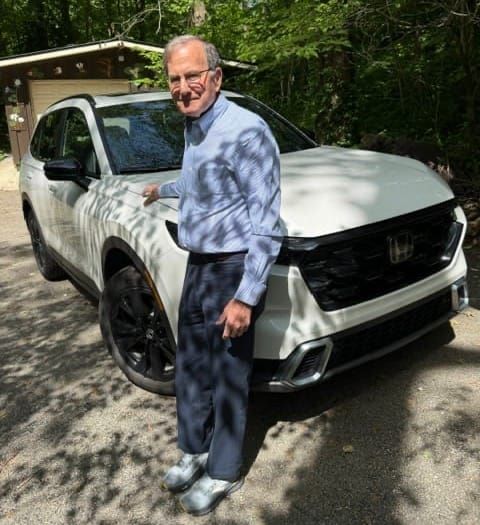
Six months ago, I finally bought a new car – a hybrid Honda CRV. I love it, but I guess I’m still getting used to it. On a recent trip, I parked it at an airport lot and when I went to drive home and pushed the start button, I heard nothing at all. A man from the lot brought over a portable charger, but the battery was fine. Finally, we realized that the electric motor was so quiet that the car was running the whole time.
I felt stupid, but the attendant gracefully told me that this had happened before. And still feeling stupid, I drove home having learned a lesson.
My son David has a Tesla, his second, which he loves, even though he can’t stand the owner of the company. I’m still a little anxious when he lets the car drive itself, but he knows what he’s doing, even if I’m not ready to do that myself.
And so I drive on, happy with my own wheels, taking me wherever I want to go.
Allan M. Winkler is a University Distinguished Professor of History Emeritus at Miami University, where he taught for three decades. He serves on the Board of Directors for the Oxford Free Press.