
Observations: This running life
"I became intrigued with track as a toddler. My father had been a pretty good quarter-miler in high school and college."
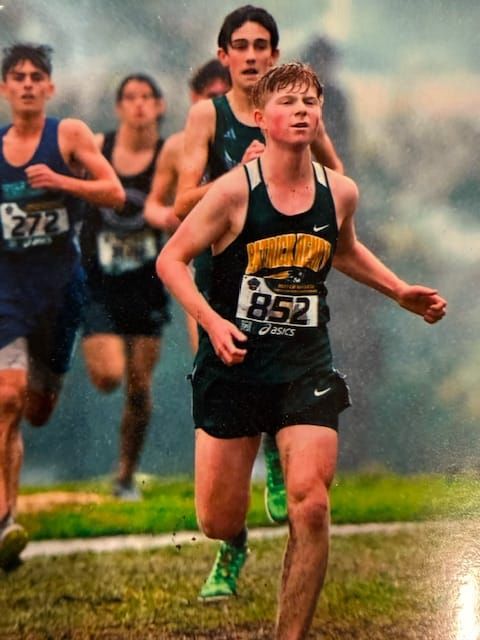
Last week, I traveled to San Diego to see our children and grandchildren. I wanted to see everyone, of course, but I was particularly interested in seeing my 17-year-old grandson Jacob run. I had been a runner for more than 60 years, and when Jacob became interested in cross country and track, I was eager to see him compete for the first time.
I became intrigued with track as a toddler. My father had been a pretty good quarter-miler in high school and college. His time of 49.4 seconds would still be considered respectable today. As a University of Cincinnati student, he competed in meets with the great Jesse Owens of Ohio State. When he was a young faculty member at Rutgers University, he volunteered as a timer at duel meets and brought me with him to the track.
In my freshman year in high school, I heard an announcement asking anyone interested in winter track to come to the athletic office. Not knowing anything about what to do, I went to the office and was told to go outside and run. There were just three of us. We ran and it hurt.
After a few weeks, the coach took two of us to a meet in New York. There were about 40 heats of the half mile, which I was slated to run. I waited for hours for my chance, dreaming of glory. I finished dead last.
Over the years, things got better. By my senior year, I was a pretty good runner, if I say so myself. My crowning moment of glory came in a 2-mile relay in my senior year. I was the anchor – the last runner – and took the baton 30 yards behind the leader. Halfway through the race, I caught him and finished first, as we won the state championship as well.
Later in life, I lived in Eugene, Oregon – the track capital of the world. Teaching at the University of Oregon, I became part of a running group that ran at noon. Sometimes, at the Hayward Field track, where most of the Olympic Trials were held, we would schmooze as we did intervals with Bill Bowerman, the legendary track coach responsible for starting the running boom. I ran shorter road races and marathons and flirted with three hours, which made me a pretty good runner at the time.
And now I was in California, watching Jacob, and a whole lot of kids, run on the track. Back in my day, a dual meet took a couple of hours and was then over. Here, there were both varsity and JV races; Now, there were girls competing.
Back in the dark ages of my youth, there were far too few opportunities for girls to compete. In basketball, there were three people in the front court, three in the back, and they could only dribble three times. It was a far cry of what I saw a few weeks ago in the women’s games during March Madness.
In my own school, when a young woman began to run with her boyfriend to compete, the New York Times ran a feature on what she was doing.
Jacob did decently in the three races that I saw. He didn’t manage personal records in either the 1600- or 3200-meter races, but he ran respectably well and his coach was pleased. For me, it was a real treat to watch the racing, even if I can’t run any more.
Allan M. Winkler is a University Distinguished Professor of History Emeritus at Miami University, where he taught for three decades. He serves on the Board of Directors for the Oxford Free Press.