
Observations: Trump and anticommunism
The Red Scare, in the aftermath of World War I, was a sorry episode in American society.
In our divided society, President Donald Trump’s anticommunist rhetoric has made a bad situation even worse. In an effort to mobilize support in the upcoming midterm elections, he has chosen to remind us of some of the worst episodes in the past century.
“(Communism) is the exact opposite of life, liberty and the pursuit of happiness,” Trump declared in his address at Mount Rushmore for the nation’s 250th birthday. And immigrants, in that assessment, are responsible for the anticommunist plague.
Unfortunately, anticommunism has been a recurring theme in American life. It is worth remembering the damage it has done to the fabric of our society.
Americans were fearful of radical activism as early as the mid-19th century. Revolutions in Europe in 1848 frightened them, as did the publication of “The Communist Manifesto,” written by Karl Marx and Friedrich Engels that same year.
“Workers of the world unite,” it proclaimed, as it called for an inevitable class revolution and a society where the needs of all would be met.
The Red Scare, in the aftermath of World War I, was a sorry episode in American society. A few years prior, The Bolshevik Revolution in Russia horrified Americans and led them to condemn radicalism wherever they saw it.
Sparked by a number of anarchist bombings, the American government, led by United States Attorney General A. Mitchell Palmer, took drastic measures, leading to the arrest of thousands without proper legal procedures, and the deportation of some of them.
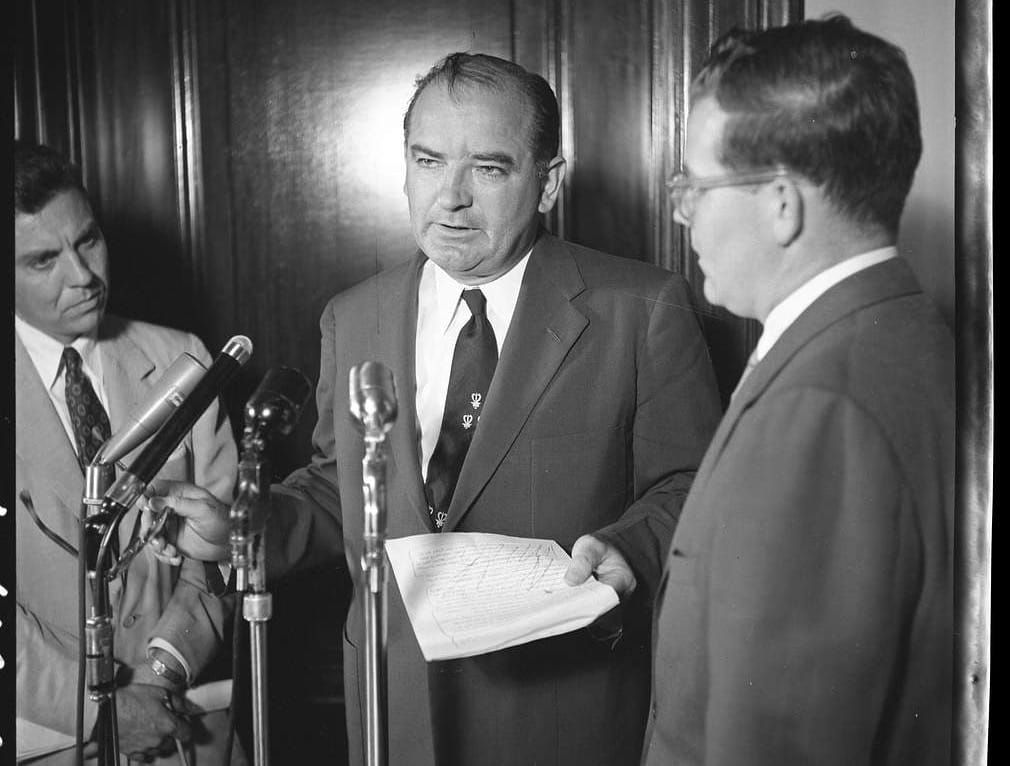
The activities of United States Senator Joseph McCarthy in the 1950s were even worse. He claimed that the American government was infested by Communists and demanded actions to deal with this alleged disaster. The entire country was wracked with fear. Universities demanded loyalty oaths and people accused, not convicted, of radical activities lost their jobs.
McCarthy was a practitioner of both the Big Lie and the Multiple Untruth, in journalist Richard Rovere’s analysis. If a lie was big enough, it was hard to refute. And if there were enough charges, some of them, but not all, might be countered, leaving the others to cause havoc.
Republicans in both The House of Representatives and the U.S. Senate supported and encouraged McCarthy, and gave his movement the power that plagued American society for a number of years.
Today, President Trump seems to be taking a page from those miserable episodes in our past. In his recent speech, reported in the New York Times, he declared that communism has reared “its ugly head right back here in America.” He added that “it’s like a cancer, you got to cut it out, you got to cut it out fast.”
Furthermore, he added that “The Stars and Stripes cast the hammer and sickle into oblivion before, and we will do it again if necessary.”
There are radical activists in the United States today. Indeed, the Democratic Party is engaged in a debate about whether radicals or more traditional politicians should dominate the party.
The charges of Communist involvement, playing upon a national fear of Russian President Vladimir Putin, are both misplaced and dead wrong. But, President Trump perceives this as a political advantage.
We can only hope that most Americans will ignore these comments and make decisions that will better help our nation.
Allan M. Winkler is a University Distinguished Professor of History Emeritus at Miami University, where he taught for three decades. He serves on the Board of Directors for the Oxford Free Press.