
On My Plate: Beets
As a child, I was not a picky eater, but I never cared for beets. When I arrived alone in London as a teenager, for my first meal I ordered chicken salad.
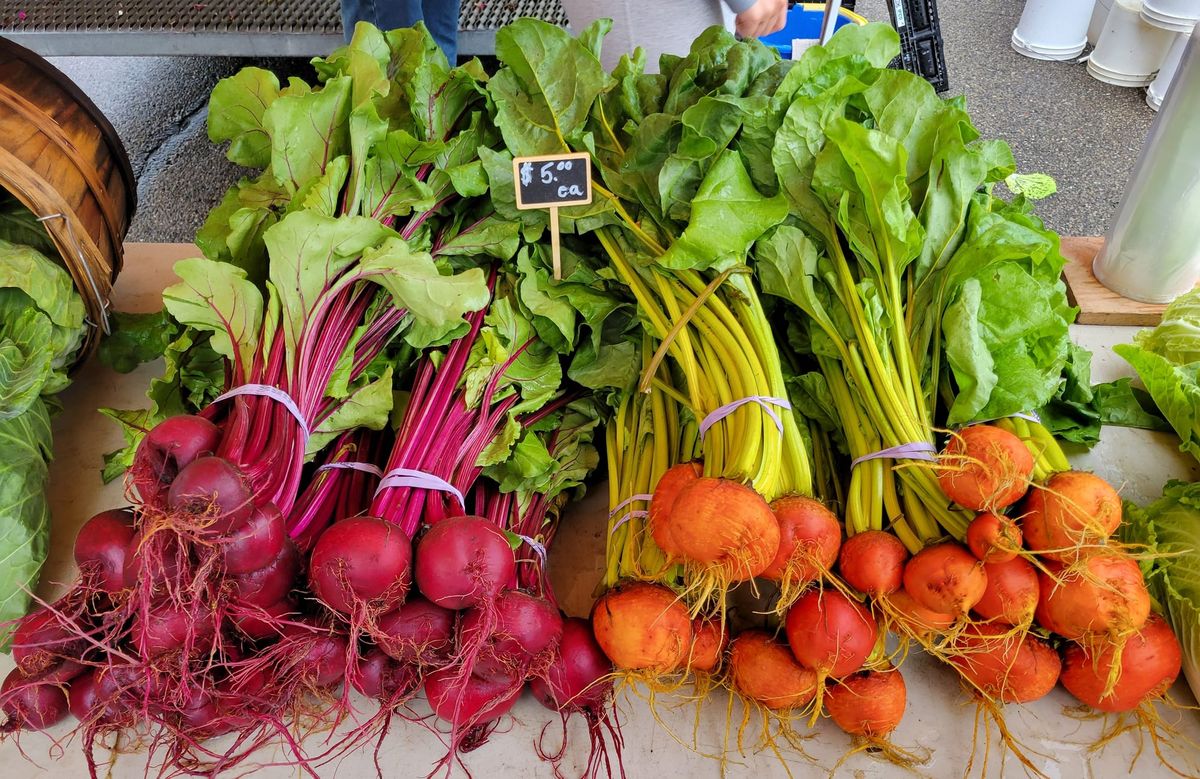
Beets are featured in this week’s column out of affection for our local growers, rather than my desire to consume them. Local beets have been the showiest produce at Oxford’s Farmers Market recently, so making peace with them seems a good idea.
Our local growers offer both red and yellow beets. Scott Downing prefers the red ones, which he says are more flavorful. For someone like me with limited affinity for beets, the milder yellow ones are a better choice.
Two important pieces of advice regarding beets: First, recipes for red beets typically carry a warning about staining cutting boards, fingers and clothing. I recommend preparing red beets while wearing a bright red Miami t-shirt. Or opt for the yellow ones.
Second, retain the leaves that are attached to the beet roots sold by our local growers. The leaves are actually more nutritious than the roots, and they can be cooked the same way as other greens, such as chard and spinach.
When you bring the beets home from the farmers market, immediately cut the leaves away from the beet root. To cook the leaves, chop them into small pieces and add them to a large pan containing a small amount of boiling water. As the leaves wild, move them frequently and vigorously in the boiling water with tongs, for two or three minutes. Turn off the heat, drain the water and keep the greens in the hot pan until ready to serve.
Recipes most frequently recommend boiling whole beet roots, but I prefer to slice them and place them on the grill. Scrubbing the roots rather than peeling them is suggested in order to lock in the nutrients, but I prefer to peel our “earthy” local beets.
The beet root can be eaten raw as a salad. Jamie Oliver of “The Naked Chef” recommends cutting them into matchsticks, doing the same with apples or pears, crumbling in feta cheese and sunflower seeds or nuts and tossing with an oil and vinegar dressing.
Jo Robinson writes in “Eating on the Wild Side” that the leaves, not the roots, of wild beets were consumed in ancient times. However, by the time of the Roman Empire, farmers cultivated larger and sweeter roots, which gradually replaced the leaves as the principal food.
Robinson provides extensive detail concerning the use of beets as an aphrodisiac in ancient Rome. I’ll spare the details here. She notes that the buildings buried in Pompei from the eruption of Mount Vesuvius in 79 C.E. included brothels with paintings of beets on the walls.
Robinson also documents that a University of Exeter experiment had people working out on treadmills drink a glass of either beet juice or a placebo. Those drinking the beet juice could run 15% longer.
As a child, I was not a picky eater, but I never cared for beets. When I arrived alone in London as a teenager, for my first meal I ordered chicken salad. Instead of chopped chicken in mayonnaise, the plate contained a hunk of bony chicken pieces and a mountain of pickled beets.
Like many descendants of survivors of the Great Depression and World War II, I was taught to eat everything on my plate, because “children were starving in Europe.” Would leaving a beet mountain on my plate get me deported, I wondered? That first day in London, I gagged down the beets, but since then I have rarely eaten them.
James Rubenstein is president of the Board of Directors for the Oxford Free Press and professor emeritus of geography at Miami University.