

On My Plate: Bell peppers
“Whenever I have a batch of these delicious red and green roasted peppers ready at hand, I feel secure, as though my larder were somehow complete.”
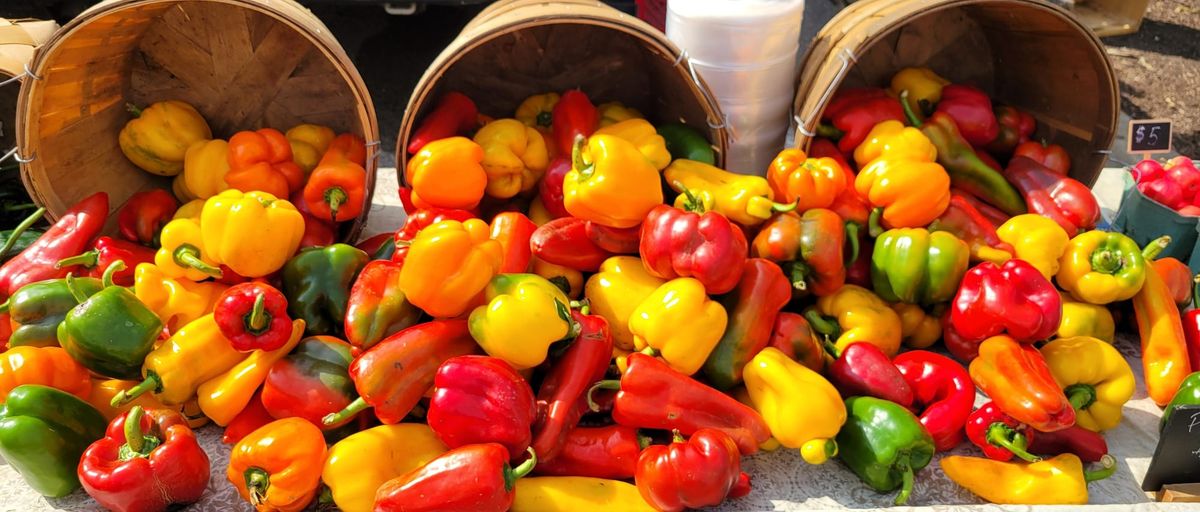
Sweet bell peppers are the current peacocks of our local produce displays at Oxford Farmers Market and MOON Co-op. Brightly colored red, yellow, purple, green and orange peppers are first to catch our eye.
All bell peppers start green. Colored ones have ripened longer so are sweeter. The mostly yellow and red taper-shaped varieties, which are widely available locally, are sweeter than the bell-shaped varieties.
Sweet and hot peppers are part of the same Capsicum genus. The difference: Hot peppers contain the chemical capsaicin, whereas sweet peppers do not. We’ll discuss hot peppers some other time.
The bell pepper, which is a type of sweet pepper, most likely originated in Mexico, according to Oxford resident and long-time eminent Miami Botany professor Hardy Eshbaugh, an international authority on its origin. Most other Capsicum originated in Bolivia.
A bell pepper is not really a pepper. Christopher Columbus sailed from Europe in part to find peppercorns – highly prized in Europe at the time and known to grow in India. Thinking he had reached India, Columbus brought back to Europe what he thought were peppercorns, but they were actually bell peppers. Europeans kept the name “pepper” for the Capsicum despite the confusion.
Patricia Wells, food critic and author of 12 books about food in France and Italy, devotes several pages in “Trattoria” to the handling of bell peppers.
“Whenever I have a batch of these delicious red and green roasted peppers ready at hand,” she writes, “I feel secure, as though my larder were somehow complete.” Bell peppers are the principal ingredient in the second and third recipes in the book’s first chapter “Antipasti, Starters and Salads.”
For grilling bell peppers, Wells advises placing them whole on the grill without piercing or trimming them. Turn them often using tongs to avoid burning the skin and puncturing the flesh. As the peppers cook, flavorful juices will form in the interior that you don’t want to lose. Once their skins shrink and start to peel away, the peppers should be removed from the grill and placed in a paper bag or in a covered bowl until cool. Carefully remove the charred skin and slice the peppers lengthwise into strips.
My Romanian heritage in-laws, who will be visiting us later this month, welcome stuffed peppers.
“Poftă Bună,” the Romanian cookbook I inherited, has two recipes for ardei umpluţi (stuffed peppers), one of which has an asterisk indicating the family’s preference. Green bell peppers (not brightly colored ones) are stuffed with a mix of ground meat and rice, covered with a multi-ingredient tomato-based sauce and cooked in the oven for a long time.
The authentic Romanian recipe is a bit heavy for a summer meal. Instead, a recipe in Trattoria works well for us. Cut a bell pepper into pieces, discard the seeds and cook the pieces in a covered skillet over very low heat. The Trattoria recipe suggests cutting the pepper into quarters, but we have found that small pieces work better on our induction cooktop. Wells warns not to increase the heat or peppers will scorch and toughen.
Instead of the usual olive oil, Wells recommends sautéing the peppers in red wine or balsamic vinegar. We are using Pomegranate vinegar obtained from Evie Semertzides at Oxford Farmers Market. After the peppers have simmered for a half-hour, remove them, heat the skillet with more vinegar plus some olive oil, pour over the peppers, cool for a half-hour and serve at room temperature.
James Rubenstein is president of the Board of Directors for the Oxford Free Press and professor emeritus of geography at Miami University.