
On My Plate: Chili peppers
Salsa, which means “sauce” in Spanish, refers to both Mexican food (more precisely, Mexican-American food) and a style of dance. A core ingredient of most salsas is chili peppers, which are grown locally at Craig and Sharon Harkrider’s Stoney Hedgerow Farm.
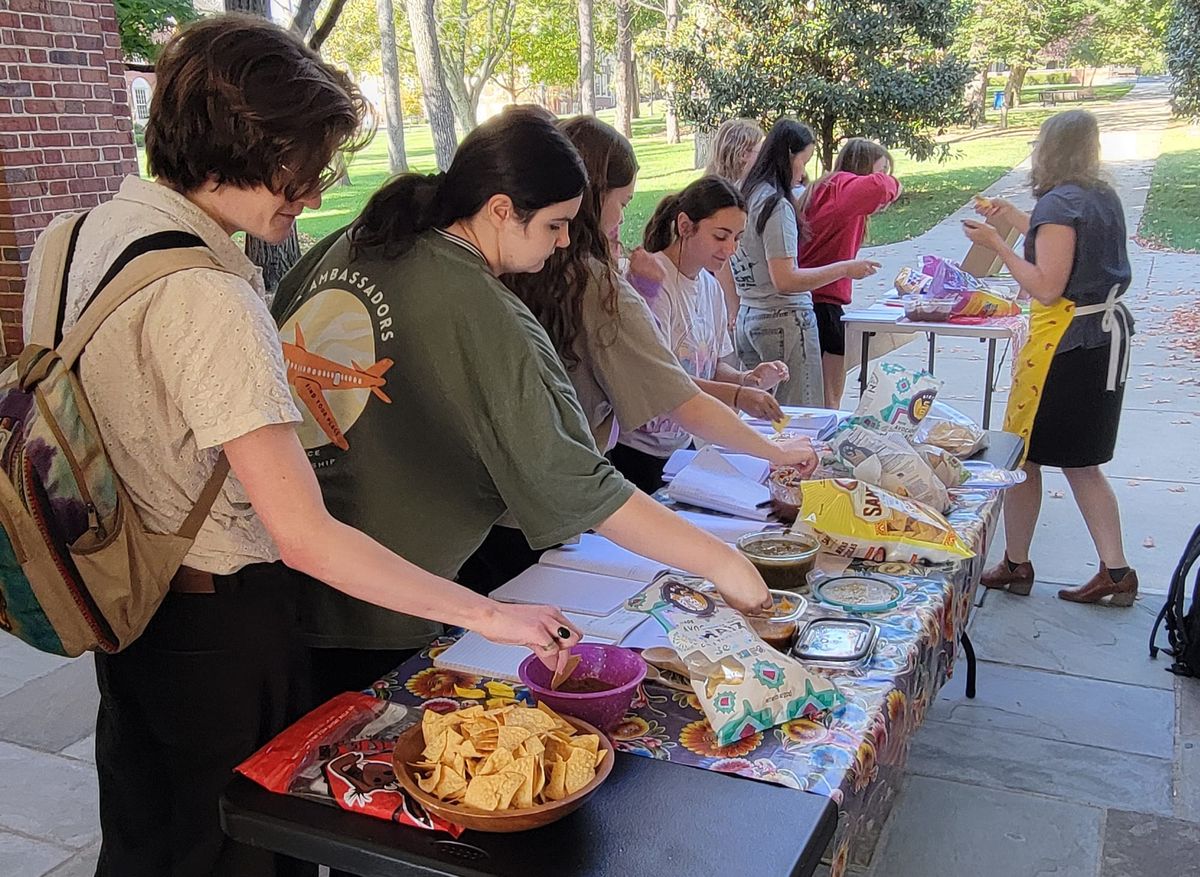
Making salsa doesn’t sound like a topic that would earn academic credit in the Miami University Department of History, but students in Elena Jackson Albarrán’s History of Food course recently did exactly that.
The official description of the course may not have suggested to students that making salsa would be a required assignment:
“History of Food explores the way that food and culinary traditions have shaped human interactions, economic systems, and environments over time. Topics may include commodity chains, trade networks, cultural practices, identity formation, labor history, and popular culture.”
Salsa, which means “sauce” in Spanish, refers to both Mexican food (more precisely, Mexican-American food) and a style of dance. A core ingredient of most salsas is chili peppers, which are grown locally at Craig and Sharon Harkrider’s Stoney Hedgerow Farm. The Harkriders bring a wide variety of chili peppers to the Oxford Farmers Market on Saturday mornings, as well as to MOON Co-op.
In addition to the typical core ingredients of chili peppers, tomatoes and onions, students added a variety of other ingredients, such as avocado, strawberry, and mango. One student, who has a nightshade allergy, made cowboy caviar salsa, with beans instead of tomatoes and peppers.
The History of Food students handled the preparation of the salsa ingredients in a variety of ways. Some roasted them, others boiled them and others left them raw. Veronica used a family recipe she has made her “entire life,” whereas Patrick found a recipe online. Others confessed that they simply winged it.
The salsas prepared by the History of Food students were remarkably varied in appearance. Some used a blender to create a smooth product, whereas others chopped the ingredients into a chunky finish. To get a chunky product, Penelope and Leila smashed their raw ingredients with a spatula. The final products displayed varying shades of green and red.
This was not a contest, so no ranking was recorded by either the students or the profs who were there. Everyone agreed that every salsa was better than those served in Mexican restaurants.
The heat level of a hot pepper is measured according to the Scoville Heat Unit (SHU). The measuring system was invented in 1912 by pharmacist Wilbur Scoville. He prepared and repeatedly diluted a sample of chili with sugar water until five test subjects no longer felt any heat – not a job I would want.
The score on the scale represents the level of dilution required for the sensation of heat to disappear completely. Since the 1980s, high-tech machines have largely replaced human tasters, but the result is still converted to SHU.
Albarrán recommended using lemon drop peppers, which has a heat index of around 25,000 SHU and is labeled as hot in MOON Co-op’s Stoney Hedgerow display. Several of the students self-identified the heat level of their salsa to be five on a scale of one-to-ten. In reality, the heat levels were lower than promised (or feared). None were incendiary.
Scoville may have had an Oxford connection. He married Cora Upham, and Miami’s president between 1928 and 1945 was Alfred Upham. Cora and Alfred were born within a decade of each other, so perhaps they were distant cousins, but I can’t find genealogical records to confirm this.
Coincidentally, the History of Food salsa class session was held outside under the Upham Hall arch. Students not in the class looked stoic as they walked through the passageway past the tables of salsa, but you could tell they were jealous.
James Rubenstein is president of the Board of Directors for the Oxford Free Press and professor emeritus of geography at Miami University.