
On My Plate: Eggplant
Eggplant was first domesticated in Asia around 4,000 years ago in either South Asia or East Asia (sources disagree). Eggplant cultivation moved westward from India to Persia, Mediterranean lands, across Europe and to the Americas (possibly brought by Thomas Jefferson).
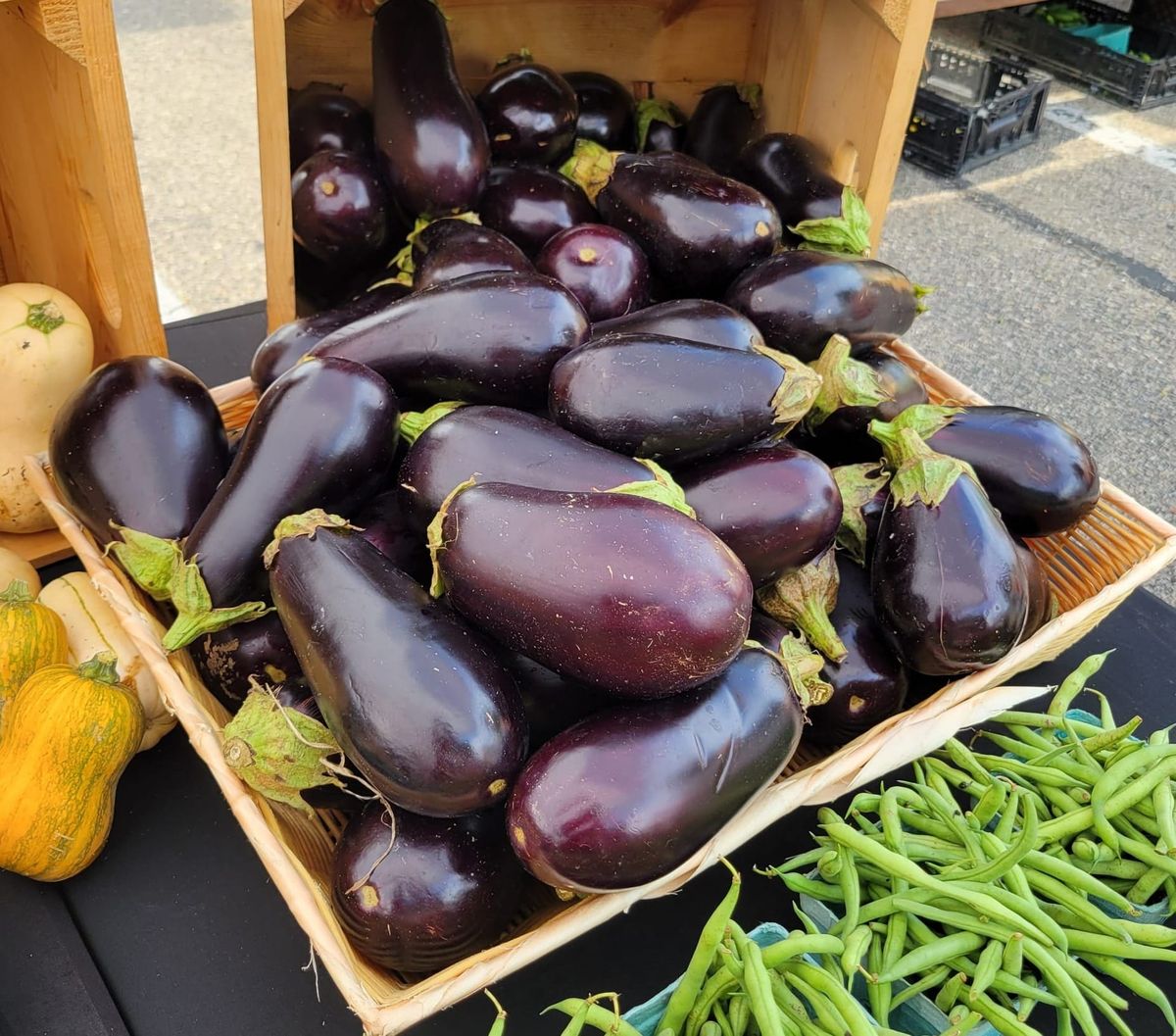
Local eggplant has been a topic for this column nearly every August since it started in 2014 in the old Oxford Press. The theme has been consistent over the years: I love crispy fried eggplant pieces, but I don’t want to deep fry them in a lot of oil.
Marie-Christine Daunay, in charge of eggplant research at the French National Institute for Agricultural Research (yes, France has an official eggplant researcher), has written that eggplant absorbs liquids through air pockets in a spongy flesh. As a result, eggplant absorbs a lot of oil when pan-fried, resulting in soggy rather than crisp pieces.
According to Daunay, two basic strategies exist to minimize absorption of oil. One option is to collapse the air pockets and the other is to coat the eggplant pieces. Performing both strategies increases the probability of getting crispy pieces.
To collapse air pockets, recipes typically recommend salting eggplant pieces. If you choose this option, place the salted slices in a colander for at least one-half hour to permit moisture to drain and remove any remaining moisture with a towel.
To coat eggplant pieces, fill three bowls with flour, a beaten egg and breadcrumbs. First, dip the slice in the flour and coat well. Second, dip the slice in the egg and moisten thoroughly. Third, dredge in the breadcrumb mixture, making sure that the crumbs adhere to both sides of the slice. Place the prepared pieces on a wire rack.
The coating option requires turning your countertop into an assembly line. The three bowls need to be positioned next to each other, as well as next to both the stovetop and the sink.
Proximity to the stovetop is logical for passing the eggplant slices quickly from the three bowls and the wire rack to the frying pan. However, quick access to the sink is even more important, so if you must choose between proximity to the sink or proximity to the stove for your workspace, select the sink.
The wire rack holding the prepared eggplant pieces can be carried to the stovetop, but as the pieces are moved from one bowl to the next, your fingers are caked with flour, egg and breadcrumbs. To avoid making a big mess, you need to wash your fingers very frequently. Keep a towel nearby as well.
To cook the eggplant, preheat the oven to 425 degrees and place a baking sheet in the oven while doing the coating. Heat a small amount of oil in a frying pan, preferably a skillet designed for very high temperatures, rather than a nonstick pan. Place the eggplant slices in the pan for one minute on very high heat, turn the pieces and cook for one more minute. Return the slices to the wire rack and place the rack on the heated baking sheet. Bake for 10 minutes at 425 degrees, turn over the slices and bake for another 10 minutes.
Eggplant was first domesticated in Asia around 4,000 years ago in either South Asia or East Asia (sources disagree). Eggplant cultivation moved westward from India to Persia, Mediterranean lands, across Europe and to the Americas (possibly brought by Thomas Jefferson).
As evidence of its westward migration, the Hindi, Sanskrit, Arabic, French and Spanish words are nearly identical, and the French aubergine is used in British English. Our odd American term eggplant derives from the light color and egg shape of some varieties. Unclear is why Americans started using the peculiar name eggplant instead of a variation of Hindi.
James Rubenstein is president of the Board of Directors for the Oxford Free Press and professor emeritus of geography at Miami University.